East Indian vs West Indian Nutmeg Oil: Label Guide
Most people meet "East Indian" and "West Indian" on a nutmeg oil label and assume one must be the premium grade. Neither is. They are two types of oil with different chemistry, and the difference is mostly about how far you can dilute them. Once you know that, the rest of the label starts to make sense field by field.
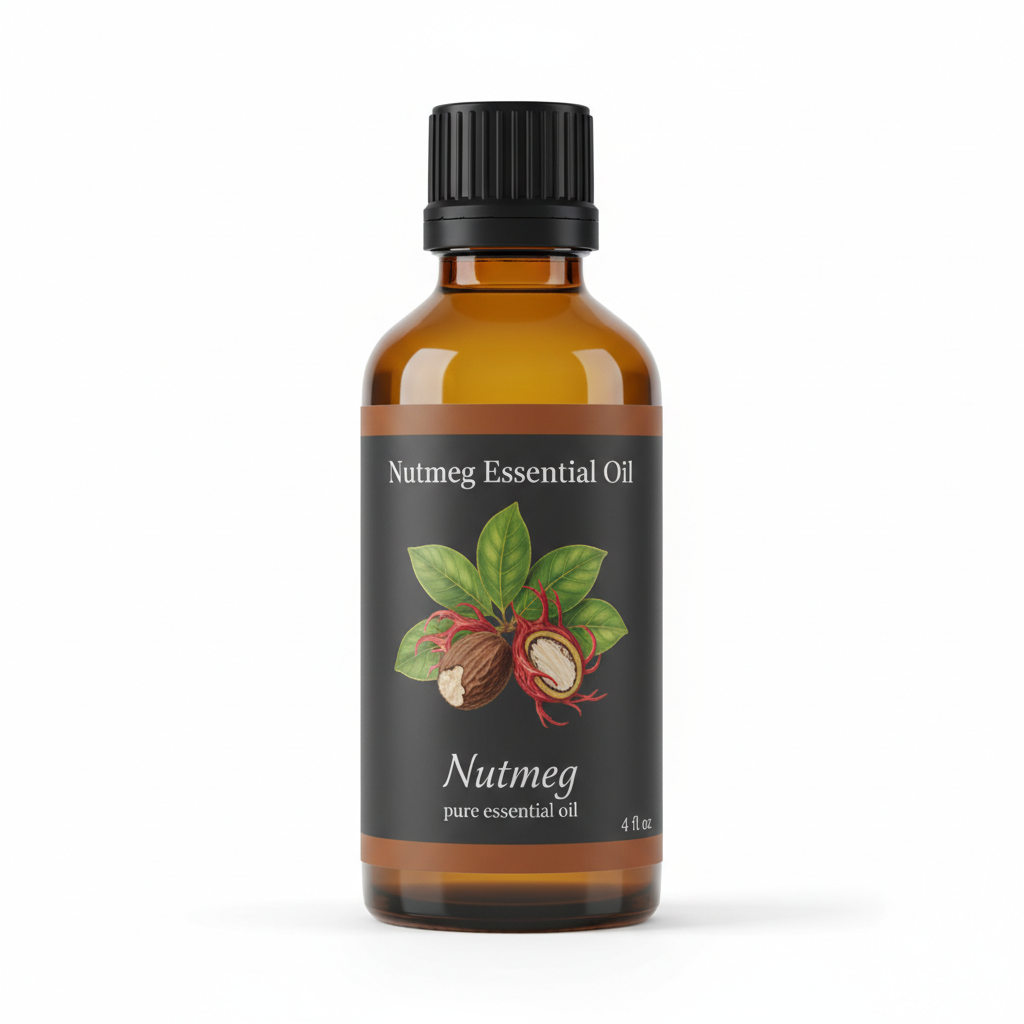
Nutmeg Essential Oil
Our own Nutmeg Essential Oil, in sizes from 0.5 oz to bulk.
From $10.99
Shop Now →Why labels are worth the trouble
A label is the first conversation a seller has with you, and it is worth reading slowly. We would rather you ask a question before you order than guess afterwards, and a seller who is happy to explain the label is usually a seller who has thought about it. Think of the label as a short checklist: each field is either filled in, or it is a question to ask.
What the two names actually mean
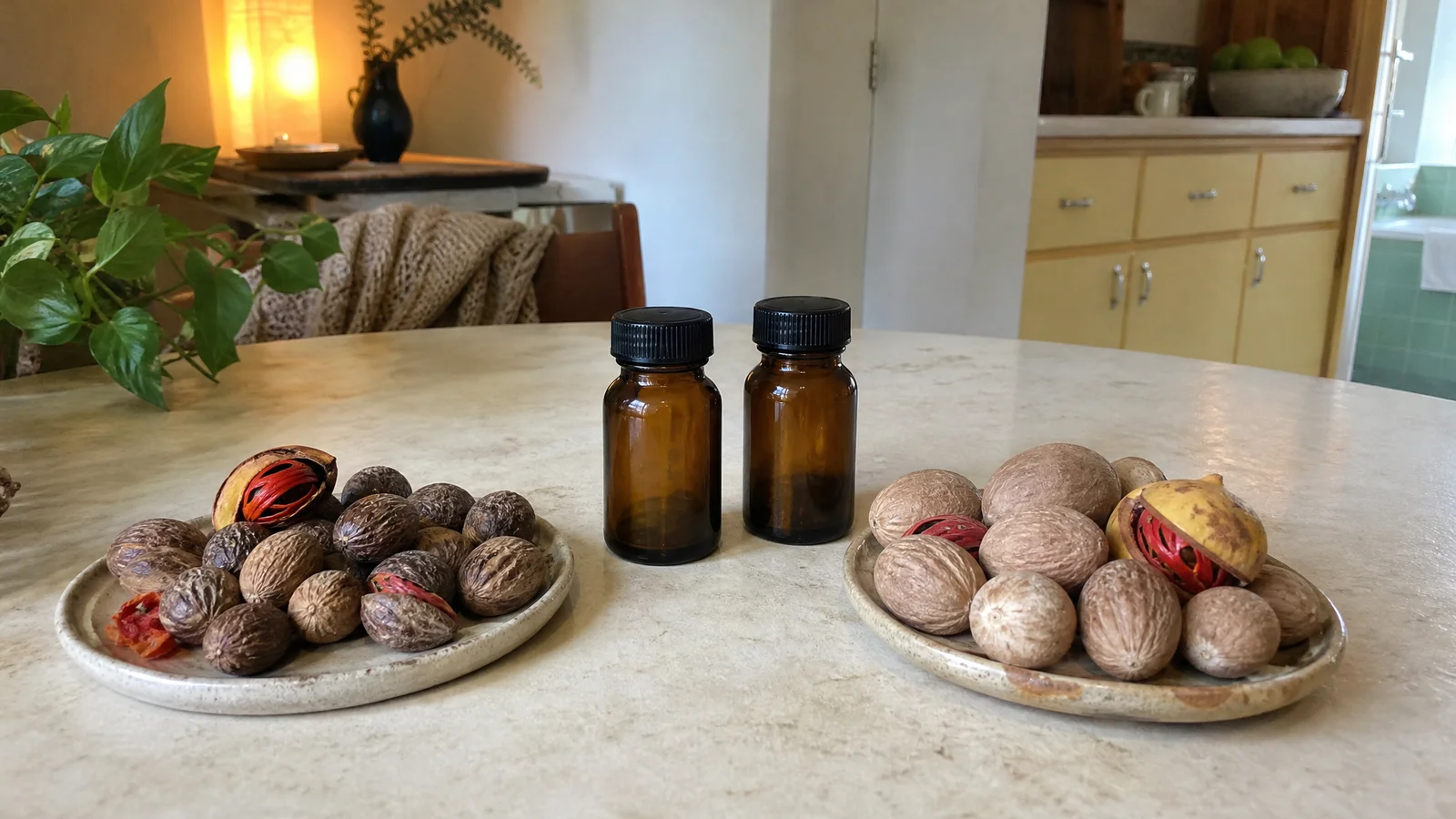
The names point to where the trees grow, the East and West Indies. The Tisserand Institute treats them as two oil types that contain quite different amounts of safrole and methyleugenol, the two constituents its safety guidelines are built around. Its nutmeg chart gives adults a maximum dilution of 0.8% for East Indian oil and 5% for West Indian oil. So the type on a label tells you which safety line applies, not which oil is better.
That is also why we start low. We suggest 0.5% to 2% in a carrier oil with a patch test first, and when a label does not tell us the type we start at the bottom of that range, at or under 0.5%.
Botanical name and plant part
The first field to look for is Myristica fragrans, the nutmeg tree. A label that says only "nutmeg" has left out the detail that separates it from lookalike names. Both nutmeg oils in our shop carry that botanical name, and so does the Certificate of Analysis we have for one batch.
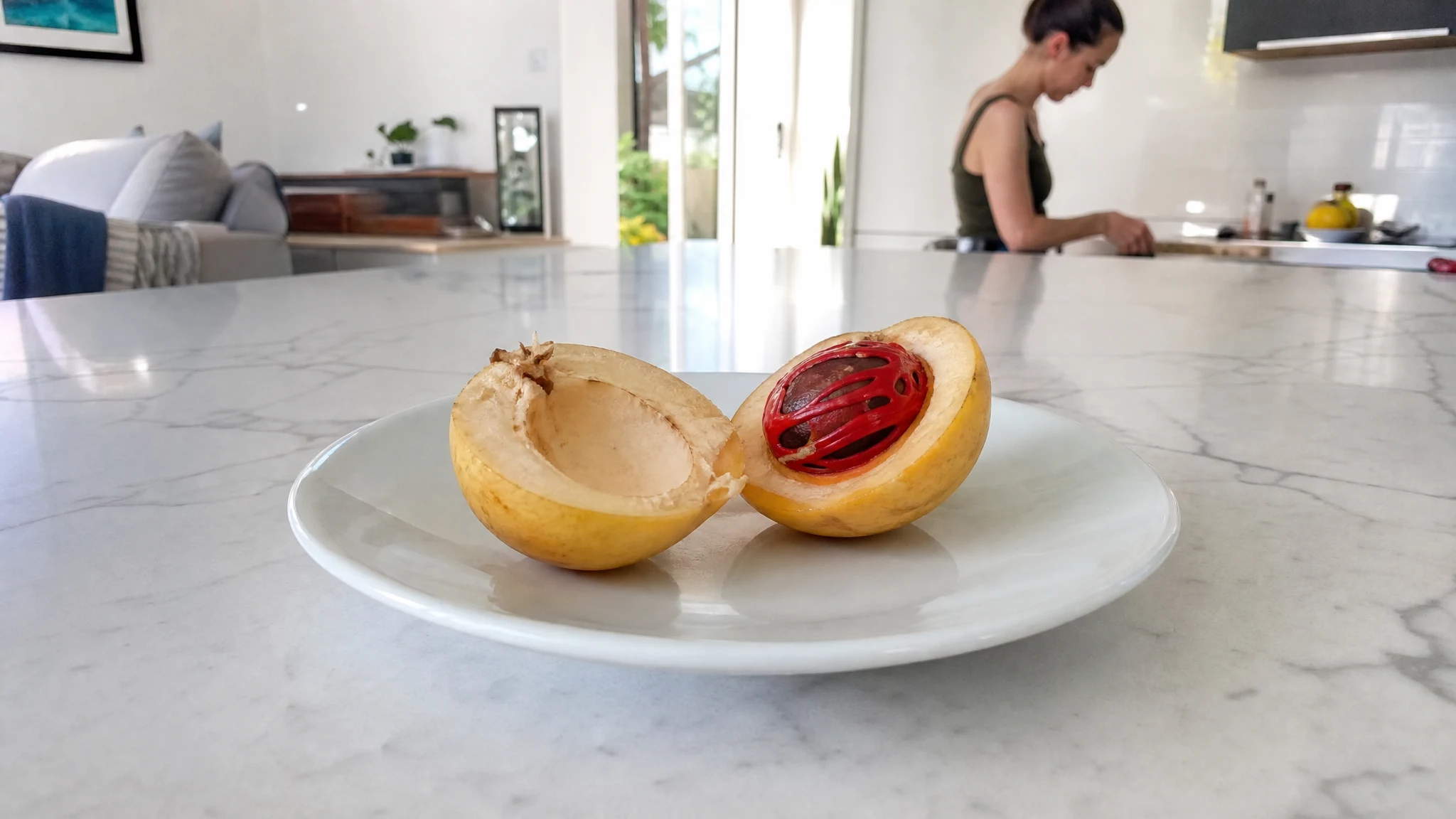
Next comes the part of the tree. Kernel, mace (the red covering of the seed) and leaf all give an oil, and a 2022 review of nutmeg oil found their yields and chemistry differ. Mace and leaf oils in that review carry different main constituents from kernel and seed oils. Our nutmeg and mace comparison covers the differences. We do not sell mace oil.
Origin: useful, but easy to over-read
Origin is a fair thing to ask about, and the same review shows why it should not be read as a recipe. Its table lists one study per place: a West Java seed oil with about 21% sabinene, a Grenada seed oil with about 53%, and a Sri Lankan kernel oil with about 43% sabinene but only 3% myristicin. Each row is a single sample set, and the authors attribute differences to soil, location and season. An origin tells you which region the chemistry probably resembles, not what is in your bottle.
For a sense of what a documented batch looks like, a 2023 European Food Safety Authority opinion measured seven Indonesian batches and reported safrole between 1.69% and 2.30%. Those are seven batches from one origin, so we would not read them as a rule for every Indonesian oil.
Extraction method
Nutmeg essential oil is a distillate. The EFSA opinion describes the oil it assessed as steam distilled from dried, crushed seeds, with the oil separated from the water afterwards. Our product pages describe our nutmeg oil as distilled. A CO2 extract is a different material altogether, which we cover in our CO2 extract comparison.
Batch number and GC-MS
A batch number connects a bottle to a report. The Certificate of Analysis we have lists one batch, with density, refractive index and optical rotation against stated ranges. For the type, you need a GC-MS report that gives safrole and methyleugenol percentages, since those are what separate East from West Indian oil. "GC-MS tested" on a label is a claim; the report is the evidence. If you need one from us, ask in writing through the contact page before ordering. Our GC-MS guide shows how to read it, and our quality checks guide puts all the checks in order.
Keep a bottle file
Once a bottle arrives, start a small file for it. A page or a note on your phone is plenty. Write down the name, the plant part, the batch number, the date you opened it and where you keep it, and save any written replies from the seller. Six months later, when you wonder which bottle is which or how old it is, that page answers the question in seconds, and it makes the next order easier to compare.
A label read field by field
Imagine a bottle that reads: "Nutmeg essential oil, 10 ml, 100% natural, GC-MS tested." The botanical name is missing, so you cannot tell it from lookalikes. The plant part, origin, type and method are missing, so you cannot choose a dilution. With no batch number, "GC-MS tested" cannot be matched to anything. Now picture a label with the botanical name, the part, the type or origin, the method and a batch number, with a report on request. It may still be an ordinary oil, but you can check it, and that is the point of a label.
Read the fields in that order, ask the seller for whatever is missing, and start with a small bottle. Whichever type you end up with, a gentle dilution and a patch test make a good first routine.
Nutmeg Essential Oil
Nutmeg Essential Oil from our own shop, in sizes from 0.5 oz to bulk.
From $10.99
Shop Now →Sources & Further Reading
- Tisserand Institute: Assessing the Safety of Essential Oils - the Nutmeg Case
- Ashokkumar et al.: Nutmeg (Myristica fragrans Houtt.) essential oil: A review on its composition, biological, and pharmacological activities
- EFSA Panel: Safety and efficacy of a feed additive consisting of an essential oil from the seeds of Myristica fragrans Houtt. (nutmeg oil) for all animal species (FEFANA asbl)