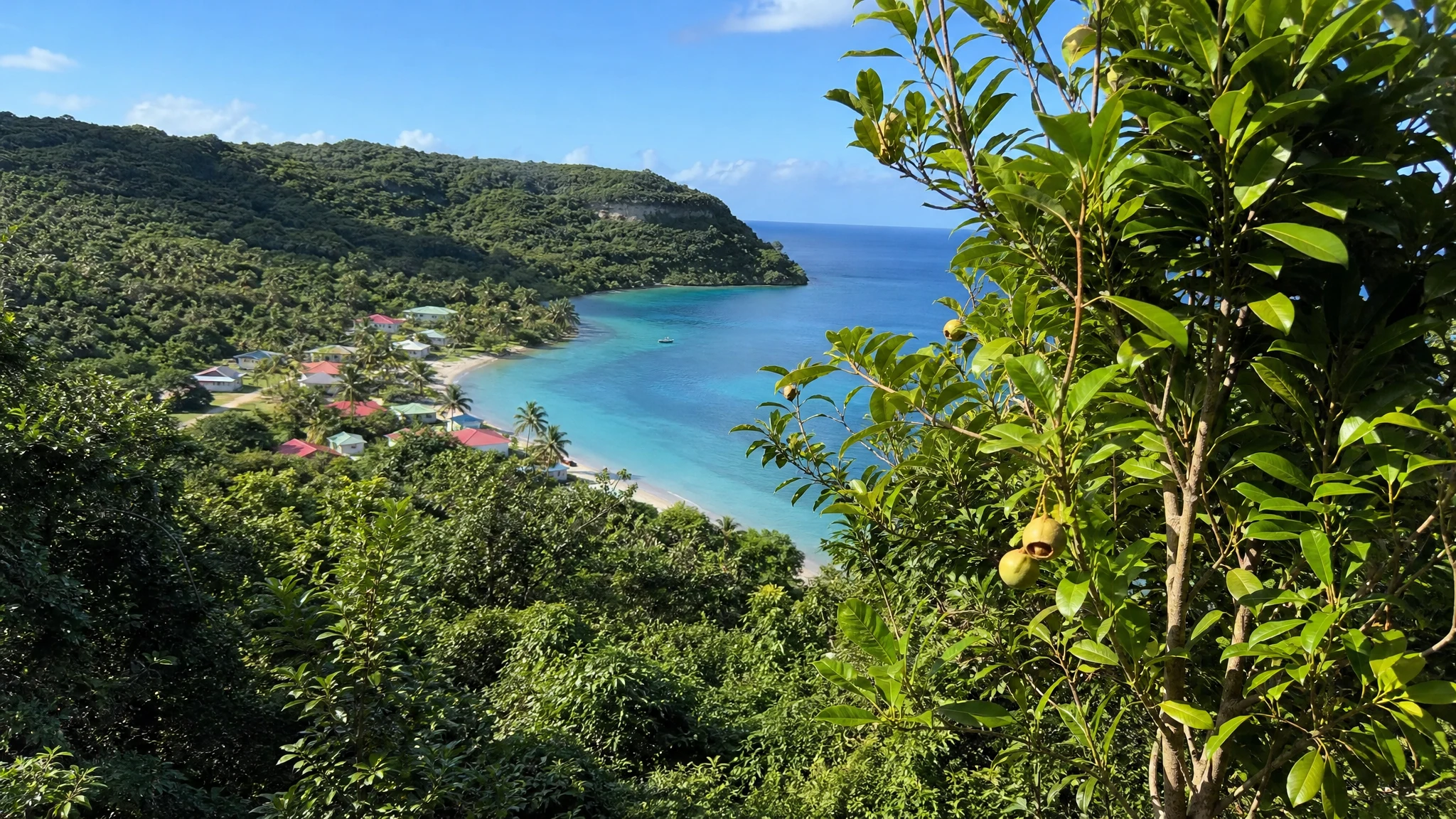
Grenada Nutmeg: Hurricane Ivan, Farmers and the GCNA
Grenada's nutmeg story is usually told as a flag and a nickname. The sources tell a harder one: a tree that needs years to bear, a storm in September 2004 that took most of the crop, and a recovery measured in farmers who did not come back. This post is about the island and its trees. It says nothing about where our own nutmeg oils come from, because no page we publish documents that.
Nutmeg Essential Oil
Our own Nutmeg Essential Oil, in sizes from 0.5 oz to bulk.
From $10.99
Shop Now →What is actually growing there
Nutmeg (Myristica fragrans, family Myristicaceae) is native to the Maluku Islands of Indonesia and was later spread to Grenada, India, Sri Lanka, Mauritius and South Africa, according to a 2022 review in Phytotherapy Research. The same review describes the fruit's seed as having a red outer aril, mace, around a brown inner kernel, nutmeg. So one tree yields two spices, and the essential oil literature is split the same way: oil from the kernel and oil from the mace are different materials with different tables. For the island's history before Grenada, see our Banda Islands history.
The tree is the constraint. A Government of Grenada, GIZ and UNDP climate brief (ICCAS programme, undated, written after 2009) says the tree takes 4 to 6 years to produce fruit and has shallow roots that strong wind can uproot. Those two facts explain most of what follows.
One storm, two sets of numbers
Hurricane Ivan struck Grenada on 7 September 2004 as a Category 3 storm. Two sources give different headline losses, and they are not measuring the same thing.
| Source | What it reports | Unit counted |
|---|---|---|
| OECS and UN ECLAC joint damage assessment, as quoted by the University of the West Indies and a 2019 national disaster agency presentation | Nearly 85 percent of the nutmeg crop affected, 60 percent completely destroyed | The crop |
| Government of Grenada, GIZ and UNDP brief | Ivan destroyed 70% of 555,000 trees; production fell to one tenth of the 2002 to 2004 average | Trees |
The arithmetic shows why the gap matters. Seventy percent of 555,000 is 388,500 trees lost and 166,500 left standing. A 60 percent loss of the same base would be 333,000 lost and 222,000 standing. A gap of 55,500 trees is that many more to replant, at 4 to 6 years each before fruit. The fetched pages do not reconcile the two, and the brief groups Hurricanes Ivan and Emily in its description of the damage while attributing the 70% figure to Ivan. The honest reading is that most of the island's productive trees were lost or damaged and that the exact share depends on whether you count crop, trees or damage, and on the base year. Treat any single clean percentage you meet in a travel article as one of these two, rounded.
Why the recovery took years, not seasons
Replanting does not restore supply on the farmer's timetable. Using the brief's 4 to 6 years to first fruit, a tree planted in late 2004 would not bear before about 2008 to 2010. The brief puts numbers on the human side: of three nutmeg processing plants, only one remained in operation, and in 2009 only 2,500 of 6,843 active farmers remained, which is about 37 percent. It also reports that production from July to December 2009 was 40.6 per cent higher than in the same months of 2008. That is growth, but from a base that the same brief describes as one tenth of the earlier average, so it should not be read as a return to pre-2004 volume.
The brief also lists what its authors recommend against the next storm: windbreaks and shelter belts, boundary planting, and intercropping nutmeg with cocoa, banana, cloves, coconuts, fruits and vegetables. It names nutmeg as the spice tree most at risk from climate change. That is the programme's own statement, not an independent ranking.
The cooperative
The Grenada Co-operative Nutmeg Association (GCNA) describes itself on its Pure Grenada tourism listing as the main stakeholder promoting the interest of the Grenada nutmeg industry and as having invested in the industry since 1947, with the aim of helping farmers develop and market their nutmeg locally and internationally. The page gives no membership figure or export tonnage. Other figures in circulation (member counts, share of world supply) came from news items and decades-old summaries that this search could not tie to a primary document, so they are left out here.
One University of the West Indies thesis, held in the UWI repository, is relevant to oil specifically. Its abstract says the cooperative's marketing strategy at the time of writing was to sell nutmegs raw, and it evaluated selling sound nutmegs raw while distilling defective ones into oil and nutmeg butter. The fetched text does not show the thesis year or author, and the abstract proposes the distillery; it does not say one was built.
What West Indian nutmeg oil looks like in print
This is where the island's name gets attached to chemistry, and where it is easiest to over-claim. Two papers give Grenada-linked tables, and neither is a range for "Grenadian oil."
- The Phytotherapy Research review reproduces a Grenada seed-oil entry from Mickus et al. (2021): sabinene 52.8%, alpha-pinene 13.5%, limonene 7.0%, alpha-terpinyl acetate 6.0%, gamma-terpinene 4.1% and beta-pinene 3.6%. The review lists no myristicin, safrole or methyleugenol value for that entry. For comparison its table gives sabinene of 21.4% for a West Java sample (Muchtaridi et al., 2010) and 19.3% for the Andaman and Nicobar Islands (Waman, 2020).
- Matulyte et al., 2019 (Molecules) analysed dried seeds from Grenada by GC-MS after four hydrodistillation runs, one conventional and three with an added silicate excipient. Sabinene came out at 6.53%, 49.64%, 61.42% and 47.10% across the four, beta-pinene at 26.61%, 4.03%, 4.32% and 3.84%, and myristicin at 3.26%, 2.34%, 2.15% and 2.16%.
The second paper is a warning about reading origin off a table: identical seeds gave a ninefold spread in sabinene because the method changed. The review itself attributes differences in oil yield to soil type, location, origin, extraction methods and environmental conditions. Set against that, EFSA (2023) characterised seven batches of nutmeg oil, all from Indonesia, with myristicin up to 12% and safrole 1.69 to 2.30%. Different labs, methods and sample types mean you cannot subtract one study from another, but the direction (a lower myristicin figure in the Grenada seed paper than in the Indonesian batches) matches the East versus West Indian distinction that sellers like to cite. It is a pattern in a handful of papers, not a specification.
How to use this if you are buying oil
A country name on a label tells you less than a lot-specific document does. Our label-reading post covers what East and West Indian mean on a bottle, and our sourcing questions post lists what to ask any supplier in writing. For how to read the chemistry once you have a report, see how to read a GC-MS report for nutmeg oil. The COA we publish names the botanical species, kernel as the part used, and a measured density, refractive index and optical rotation. It names no origin and contains no GC-MS, so it cannot place any bottle on this island or off it.
Grenada's trees are a reminder that nutmeg supply is slow, local and storm-exposed. If a country of origin matters to your product, ask the seller in writing before ordering and get the answer in writing.
Nutmeg Essential Oil
Nutmeg Essential Oil from our own shop, in sizes from 0.5 oz to bulk.
From $10.99
Shop Now →Sources & Further Reading
- Government of Grenada, GIZ and UNDP (ICCAS Programme), undated. How to Protect Our Nutmeg from Climate Change. climateresilience.gov.gd
- University of the West Indies, undated. Hurricane Ivan and Grenada (quoting the OECS and ECLAC assessment). uwi.edu/ekacdm/node/123
- Bonaparte R., 2019. National experience in statistics on disasters (Grenada NADMA presentation, UN Statistics Division meeting). unstats.un.org
- Ashokkumar K. et al., 2022. Nutmeg essential oil: a review on its composition, biological, and pharmacological activities. Phytotherapy Research 36(7):2839-2851. PMC9541156
- Matulyte I. et al., 2019. GC-MS analysis of the composition of the extracts and essential oil from Myristica fragrans seeds using magnesium aluminometasilicate as excipient. Molecules 24(6):1062. PMC6471610
- EFSA FEEDAP Panel, 2023. Safety and efficacy of a feed additive consisting of an essential oil from the seeds of Myristica fragrans (nutmeg oil). EFSA Journal 21(6):e08066. PMC10273060
- Pure Grenada, undated. The Grenada Co-operative Nutmeg Association. puregrenada.com
- University of the West Indies thesis on GCNA marketing strategy (abstract only; year and author not shown). uwispace.sta.uwi.edu