Reading a Nutmeg Oil GC-MS Report, Line by Line
Open a GC-MS report for nutmeg oil and your eye goes straight to the big numbers at the top: sabinene, the pinenes, a handful of others. They make a lovely fingerprint, but they are not the lines that shape how you use the oil. The ones that matter sit near the bottom of the table, and there are only three of them: safrole, methyl eugenol and myristicin.
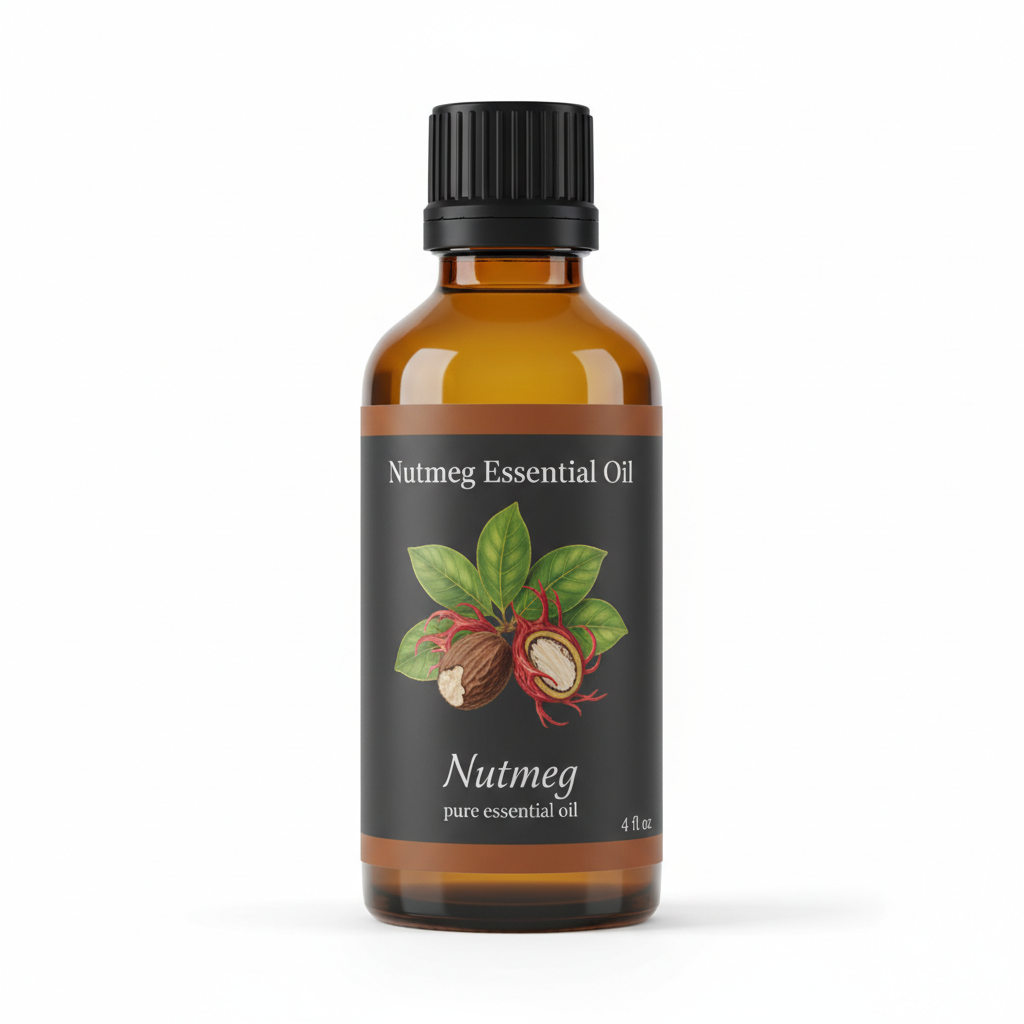
Nutmeg Essential Oil
Our own Nutmeg Essential Oil, in sizes from 0.5 oz to bulk.
From $10.99
Shop Now →What the report is, and what it is not
GC-MS vaporizes the oil, sends it down a long thin column where its components separate by how quickly they travel, and lets a mass spectrometer name each one as it emerges. The result is a list of compounds with a percentage beside each. A certificate of analysis is a different document: it records whichever tests a supplier chose to run. The Certificate of Analysis for one of our batches lists relative density 0.887, refractive index 1.478 and optical rotation +11.80 degrees at 20 C, each inside its stated range. Those are handy identity checks. If you need a constituent breakdown for a lot, ask us in writing through the contact page before you order.
The big peaks tell you what it is, not where it is from
Seven Indonesian batches assessed by the European Food Safety Authority averaged about 21% sabinene, 20% alpha-pinene and 13% beta-pinene, which is the bright, resinous, piney front half of nutmeg's scent. That picture shifts a lot with source. A review of nutmeg oil studies tabulates single samples with sabinene anywhere from 19% (Andaman and Nicobar seed) to nearly 53% (Grenada seed), though those rows come from different studies, methods and years, so they do not rank anything.
Method alone can move a table. One research team distilled the same Grenada seeds four ways, one conventional and three with a silicate additive in the flask. Sabinene came out at 6.5%, 49.6%, 61.4% and 47.1%. So when two reports disagree on sabinene, that does not mean one oil is better. It may only mean two labs did different things.
Percent area is not percent weight
Most reports give "%" as each peak's share of the total detected area, which is a good estimate and not a weighed amount. EFSA is a nice example. It received full GC-MS data, yet checked the oil's specification by a second method, GC-FID, and set the GC-MS myristicin figure aside because it considered GC-FID more reliable. Read "2.30% safrole" as "about 2.3% of what the detector saw".
The three small lines
Safrole. EFSA's batches ran from 1.69% to 2.30%, and the opinion notes that nutmeg oil is classed as a category 1B carcinogen in the EU on the strength of its safrole. IFRA, the fragrance industry's standard-setter, lets natural extracts carry safrole as long as the total in a finished consumer product stays at or below 0.01%.
Methyl eugenol. EFSA's batches ran 0.18% to 0.33%. IFRA's limits for it depend on product category; for body creams and oils (category 5A) the figure is 0.0015% of the finished product.
Myristicin and elemicin. These work as markers of identity, with EFSA's specification capping myristicin at 12%. They are worth seeing on a report, and a "not detected" beside a line is as informative as a number.
From a line on the report to a dilution
Here is the arithmetic we like best, because it turns a report into a decision. Divide the cap by the oil's share. This is our calculation from published figures, not an IFRA limit for nutmeg oil, and it treats area percent as weight percent.
| Line and cap | Share in oil | Highest oil share in product |
|---|---|---|
| Safrole, 0.01% total | 2.30% | 0.43% |
| Safrole, 0.01% total | 1.69% | 0.59% |
| Methyl eugenol, category 5A 0.0015% | 0.33% | 0.45% |
| Methyl eugenol, category 5A 0.0015% | 0.18% | 0.83% |
Our skin guidance runs from 0.5% to 2% in a carrier oil. Set against this arithmetic, we start at the low end and a little below it. With no lot-specific report in hand, we suggest about 0.4% for leave-on skin products, which is two to three drops in an ounce of carrier (around 20 drops to the milliliter; weighing is better than counting). At 0.4% the highest published safrole figure gives 0.0092% in the product, inside the line.
A report that names the origin helps in another way. The Tisserand Institute's nutmeg chart lists different maximum dilutions for East Indian oil (0.8% for adults) and West Indian oil (5% for adults), because the two types differ in safrole and methyl eugenol. Knowing which one is in your bottle tells you which row applies. See our label-reading guide and our post on nutmeg oil on skin for the household side.
A way to read it without getting lost
A report can look intimidating at first glance, a long page of unfamiliar names and decimals. A simple routine helps. First, find the batch number and check it against the one on your bottle. Second, find the three small lines we talked about and see whether they are there at all. Third, look at the date and the lab name. If all three are present, you already know more than most buyers ever ask. Everything else on the page can wait until you have a reason to read it.
What to ask for
When you request a report, ask for the batch number that matches your bottle, the laboratory, the date, the method, and explicit lines for safrole, methyl eugenol, myristicin and elemicin. Ask whether percentages are area percent. Get the answer in writing, from us or anyone else.
A chromatogram is a portrait of one sample, and the best habit is to match it to the lot in your hands before you rely on it.
Nutmeg Essential Oil
Nutmeg Essential Oil from our own shop, in sizes from 0.5 oz to bulk.
From $10.99
Shop Now →Sources & Further Reading
- Safety and efficacy of a feed additive consisting of an essential oil from the seeds of Myristica fragrans Houtt. (nutmeg oil) for all animal species (FEFANA asbl), EFSA Journal, 2023
- Nutmeg (Myristica fragrans Houtt.) essential oil: A review on its composition, biological, and pharmacological activities, Phytotherapy Research, 2022
- GC-MS Analysis of the Composition of the Extracts and Essential Oil from Myristica fragrans Seeds Using Magnesium Aluminometasilicate as Excipient, Molecules, 2019
- IFRA Standards, 51st Amendment (safrole note box; methyl eugenol)
- Assessing the Safety of Essential Oils - the Nutmeg Case, Tisserand Institute