How Nutmeg Oil Is Made: From Kernel to Bottle
It is easy to picture how nutmeg oil is made: spice goes in, steam goes through, oil comes out. That picture is right in outline, but the bottle you end up with depends on three decisions made along the way, and understanding them makes you a much better buyer. Here is the route from nutmeg tree to dropper bottle.
Nutmeg Essential Oil
Our own Nutmeg Essential Oil, in sizes from 0.5 oz to bulk.
From $10.99
Shop Now →First, which part of the tree?
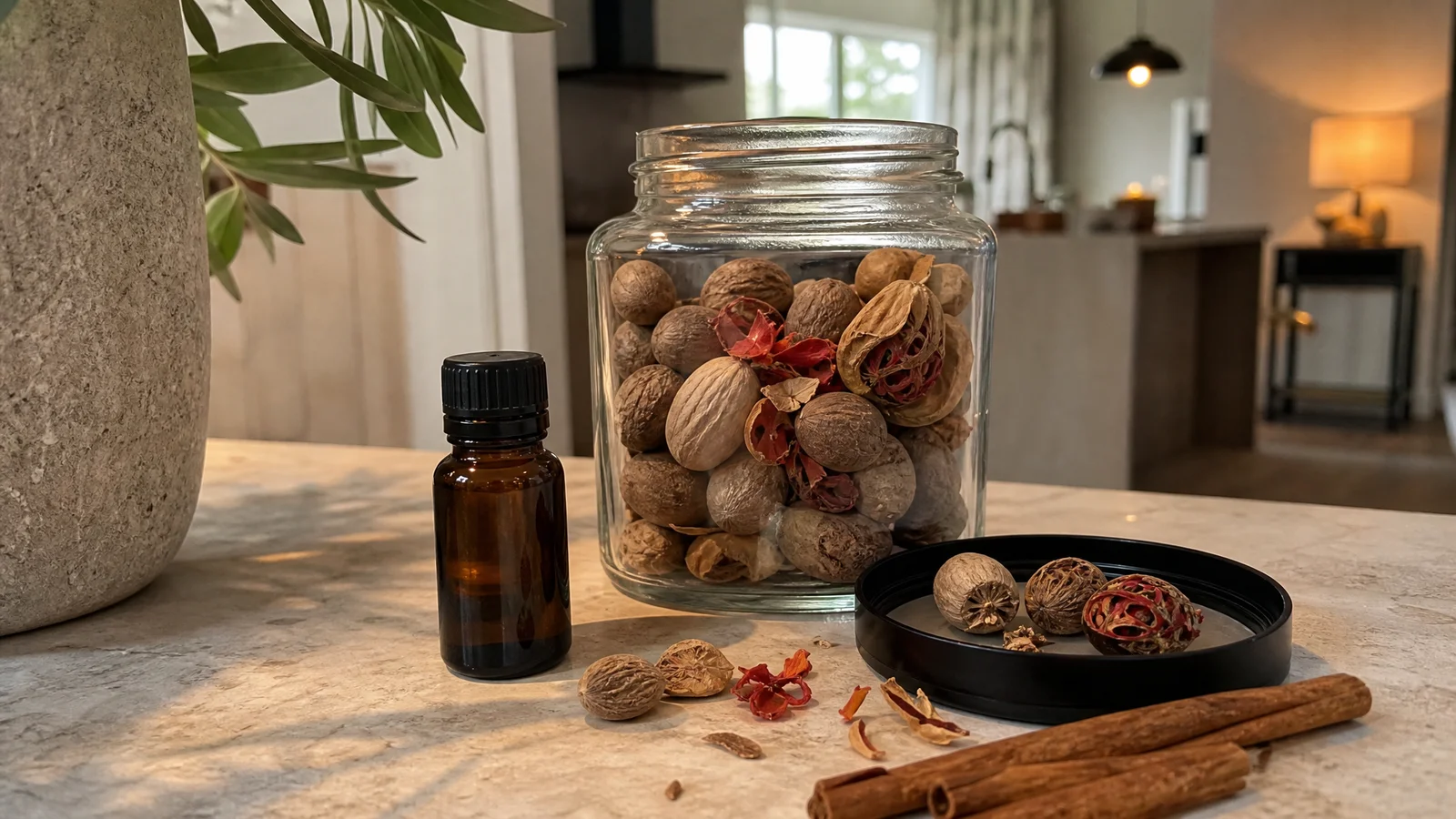
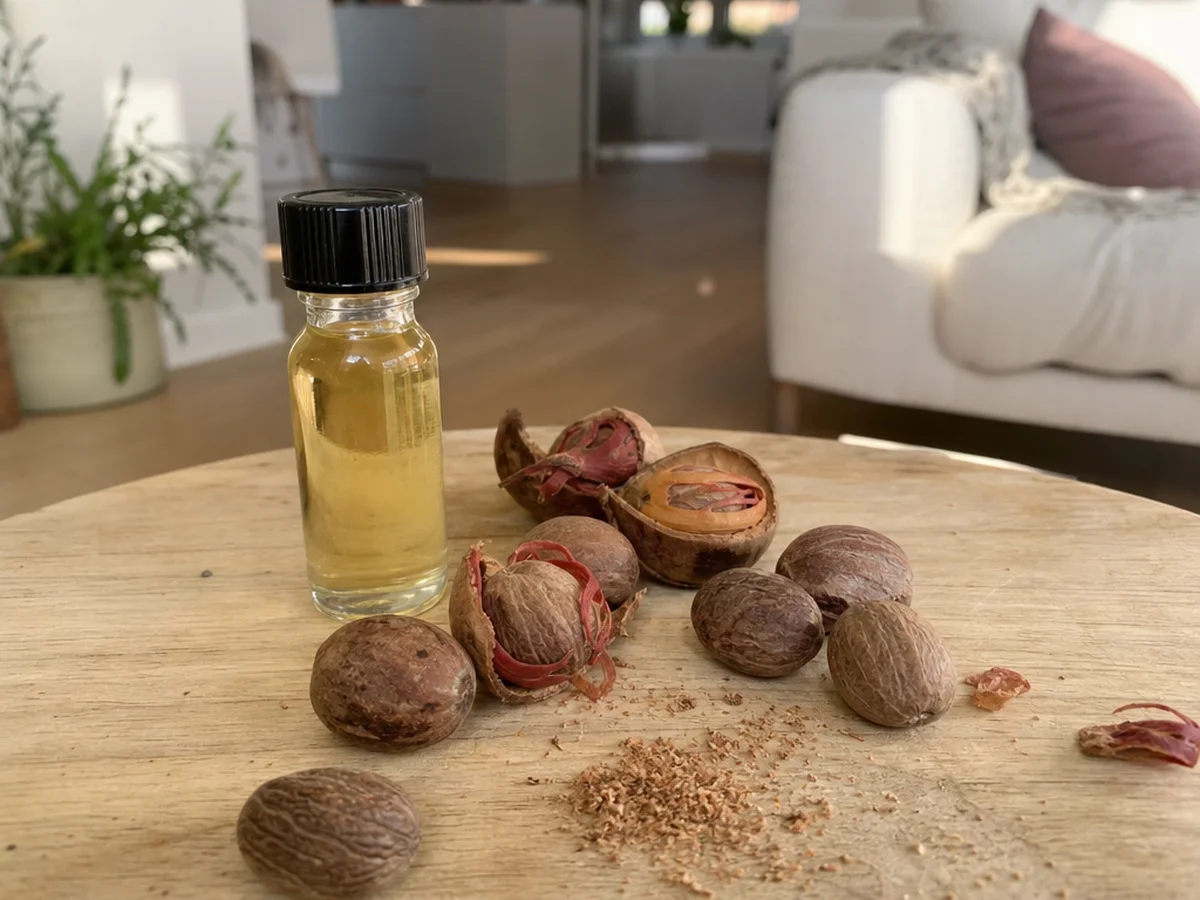
Myristica fragrans gives two spices. The seed is what we call nutmeg, and the red, lacy covering around it is mace. Both can be distilled, and so can the leaf, but they give different oils. A 2022 review of the oil's chemistry tabulates yields of about 6 to 8% for kernel and 8 to 10% for mace, while the leaf gives only a little. It also notes that safrole, one of the compounds regulators watch, turned up at 0.5% in a kernel oil and 3.9% in a mace oil in the examples it quotes (Ashokkumar and colleagues, 2022). So the plant part is not a detail. It changes the oil.
The regulatory language is relaxed about "seed" and "kernel", using them almost interchangeably. The EFSA opinion on nutmeg oil says the oil comes from the dried and crushed seeds, and quotes the European Pharmacopoeia as defining it as steam distillation of dried, crushed kernels. Our Purity listing uses much the same wording: steam-distilled from the dried, crushed kernels of Myristica fragrans. Our Botanical listing says distilled from the seed. If you want to see how mace oil differs, our nutmeg and mace post sets them side by side.
Second, which kind of distillation?
The same review lists four routes: hydrodistillation, steam distillation, microwave-assisted hydrodistillation and supercritical CO2 extraction. Classical hydrodistillation in a Clevenger apparatus is widely used in research. Commercial nutmeg oil is typically described more simply. The fragrance house Robertet lists its Indonesian nutmeg oil as made by steam distillation, and EFSA describes the sequence as dried and crushed seeds, steam, then separation of the oil from the water by decantation.
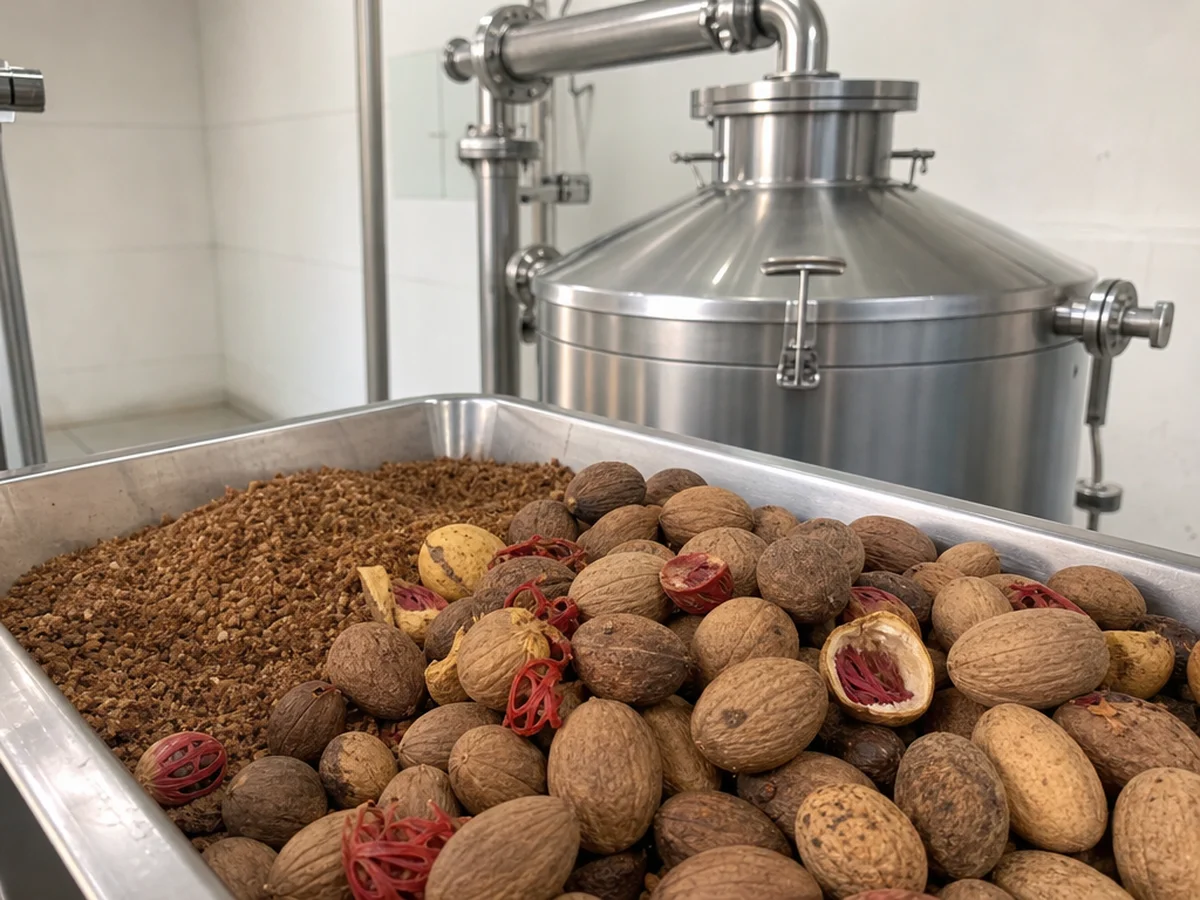
Think of it as a very gentle cooking process. Steam passes through the crushed seed and carries the aromatic molecules with it. When the steam cools, the oil and water separate. It sounds simple, but a 2024 laboratory study notes that the distillate is not always a tidy layer. Some of the oil stays dispersed or emulsified in the water, so recovering all of it is its own technical problem. The CO2 route yields something different again, which our CO2 extract comparison explains.
What you can picture when you open the bottle
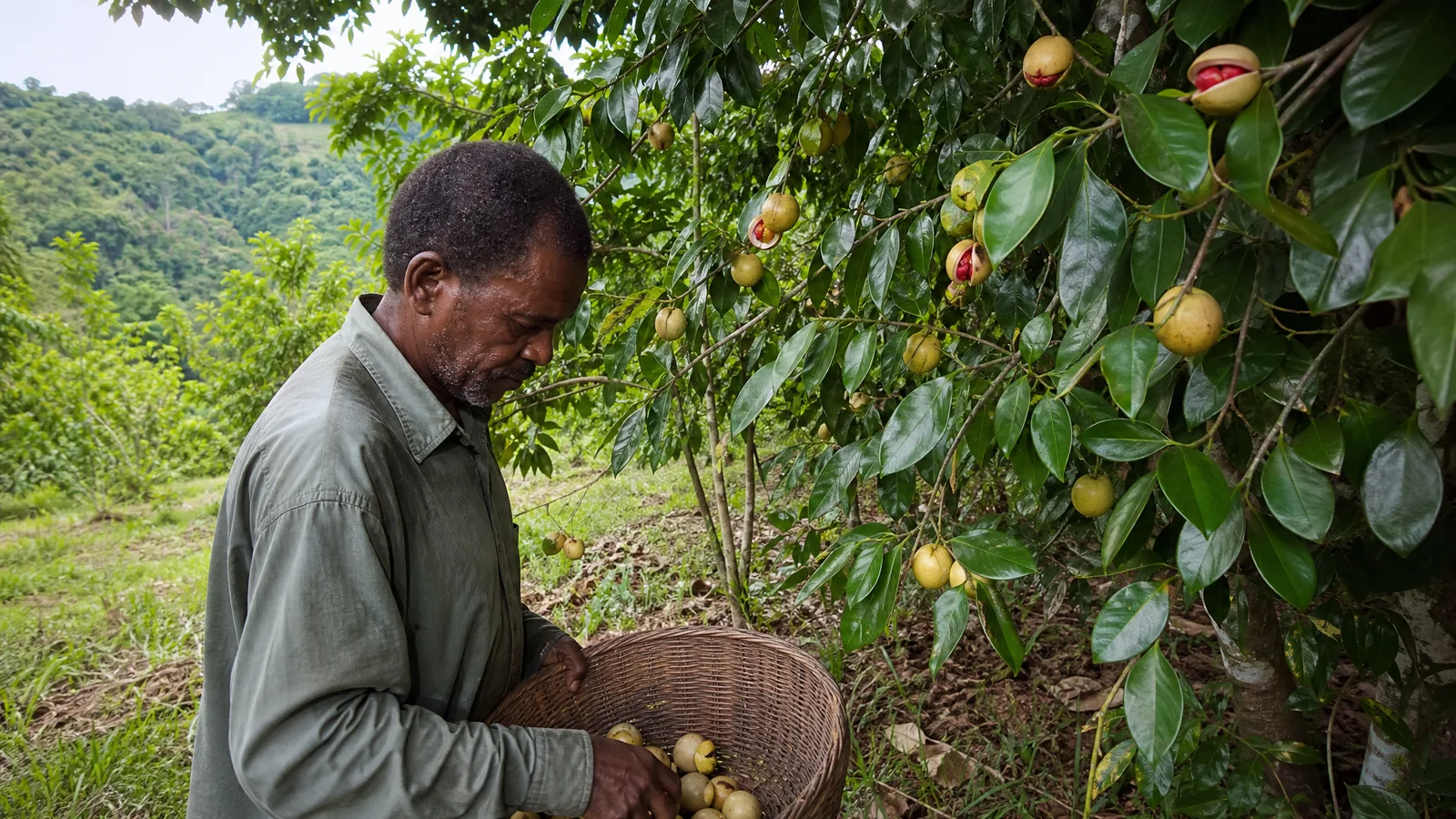
The next time you unscrew a cap, try this: smell the oil, then imagine the whole route behind it. A seed in a split fruit, a pile of dried kernels, a hot cloud of steam rising through crushed seed, and finally a few drops of pale liquid collecting on top of the water. It is a surprisingly physical, old-fashioned process, closer to cooking than to chemistry, and it helps explain why this oil smells so alive. The scent is the part of the seed that was light enough to travel on steam.
Third, where the tree grew
Place matters because nutmeg oil is naturally variable. EFSA analysed seven Indonesian batches and found them quite consistent with one another: sabinene around 20%, alpha-pinene around 20% and beta-pinene around 13%. A separate 2026 study used one commercial batch of unstated origin and found sabinene at over 27% and alpha-pinene at about 14.5%. Different laboratories and methods are involved, so we would not over-read the gap, but it shows why two bottles labelled "nutmeg oil" need not smell identical. EFSA itself concludes that nutmeg oil may be produced from plants of different geographical origins and by various processes.
Why the oil smells different from the grater
If you have grated a whole nutmeg and then sniffed the oil, you may notice the oil is brighter and fresher, with less of the dusty, baked note. That is a natural result of what the steam carries and what it leaves behind. Ground nutmeg also loses its top notes the longer it sits in a jar, which is why a freshly grated pinch always smells livelier than the same spice from the back of the cupboard.
Why we do not give a home still recipe
You will find do-it-yourself distilling advice online. We leave it out because EFSA classifies the finished oil as a category 1B carcinogen on its safrole content and says it should be handled accordingly, and heating and condensing a material like that is work for trained people with proper equipment. Buying a well-documented oil is a far better use of a weekend.
What to ask before you buy
Ask the seller four things: which part of the plant, which method by name, which origin, and what the batch report says. The Certificate of Analysis we publish is for one batch and lists density, refractive index and optical rotation. If you need constituent data such as myristicin and safrole, ask us in writing through the contact page before ordering and keep the reply. Our GC-MS guide explains how to read a report when you have one, and the quality checks post covers what else a label can tell you.
Knowing how nutmeg oil is made will not change how it smells, but it will change how confidently you can choose it.
Nutmeg Essential Oil
Nutmeg Essential Oil from our own shop, in sizes from 0.5 oz to bulk.
From $10.99
Shop Now →Sources & Further Reading
- Ashokkumar K, et al. Nutmeg (Myristica fragrans Houtt.) essential oil: A review on its composition, biological, and pharmacological activities. Phytotherapy Research, 2022
- EFSA Panel on Additives and Products or Substances used in Animal Feed. Safety and efficacy of a feed additive consisting of an essential oil from the seeds of Myristica fragrans Houtt. (nutmeg oil) for all animal species (FEFANA asbl). EFSA Journal, 2023
- Yin H, et al. Enrichment of Nutmeg Essential Oil from Oil-in-Water Emulsions with PAN-Based Membranes. Membranes, 2024
- Gaurav A, et al. Unmasking the fungicidal potency and multifaceted mechanisms of nutmeg essential oil against Candida auris. Pharmaceuticals, 2026
- Robertet. Nutmeg oil (product page)