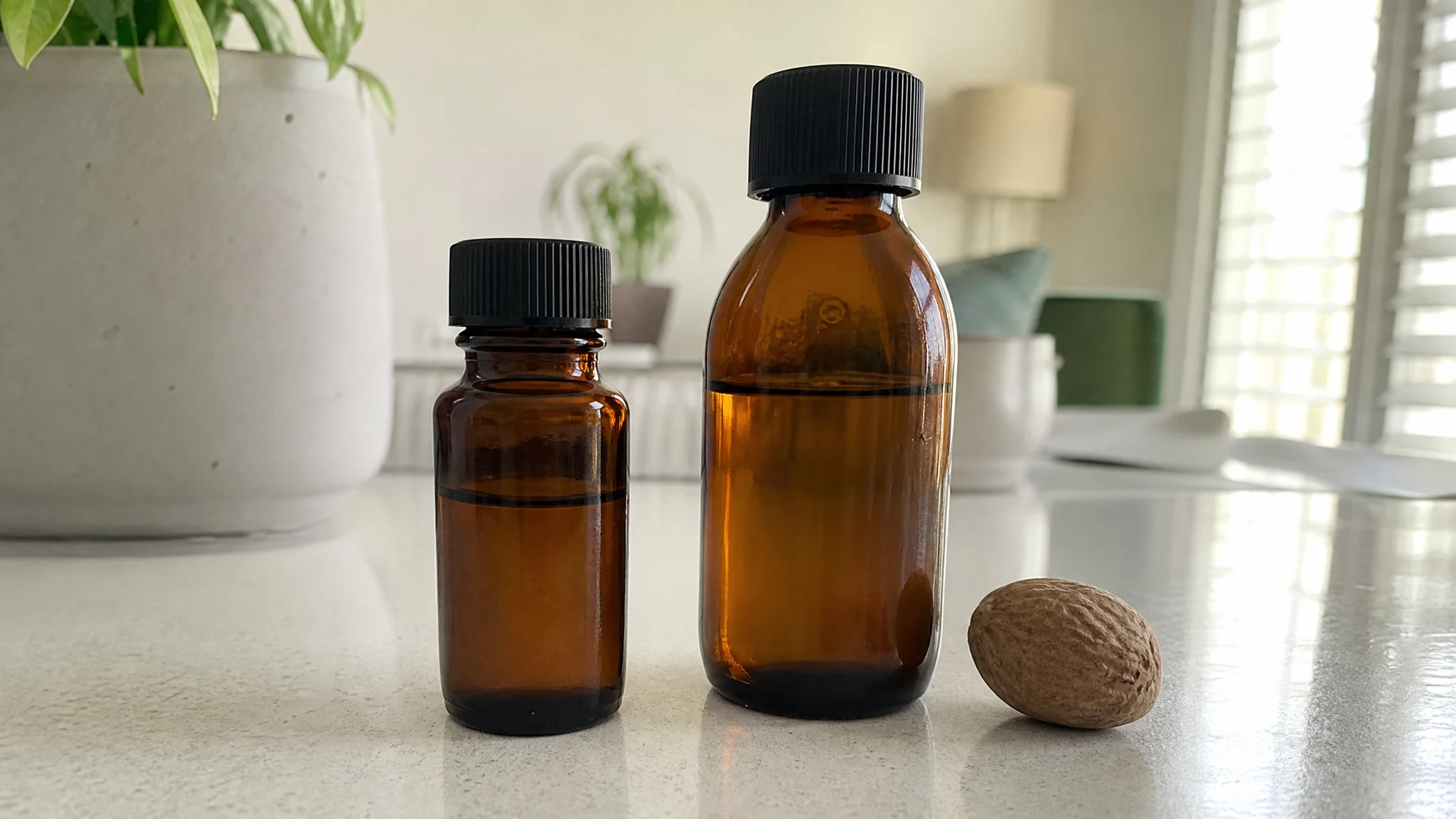
How to Compare Nutmeg Oil Prices Per Gram
Put two nutmeg oil quotes side by side and they almost never match. One is in milliliters, another in fluid ounces, a third by the pound, and each carries different paperwork. Before you decide which is cheaper, it helps to line them up properly. Here is the method we would use, followed by the reasons the numbers differ in the first place.
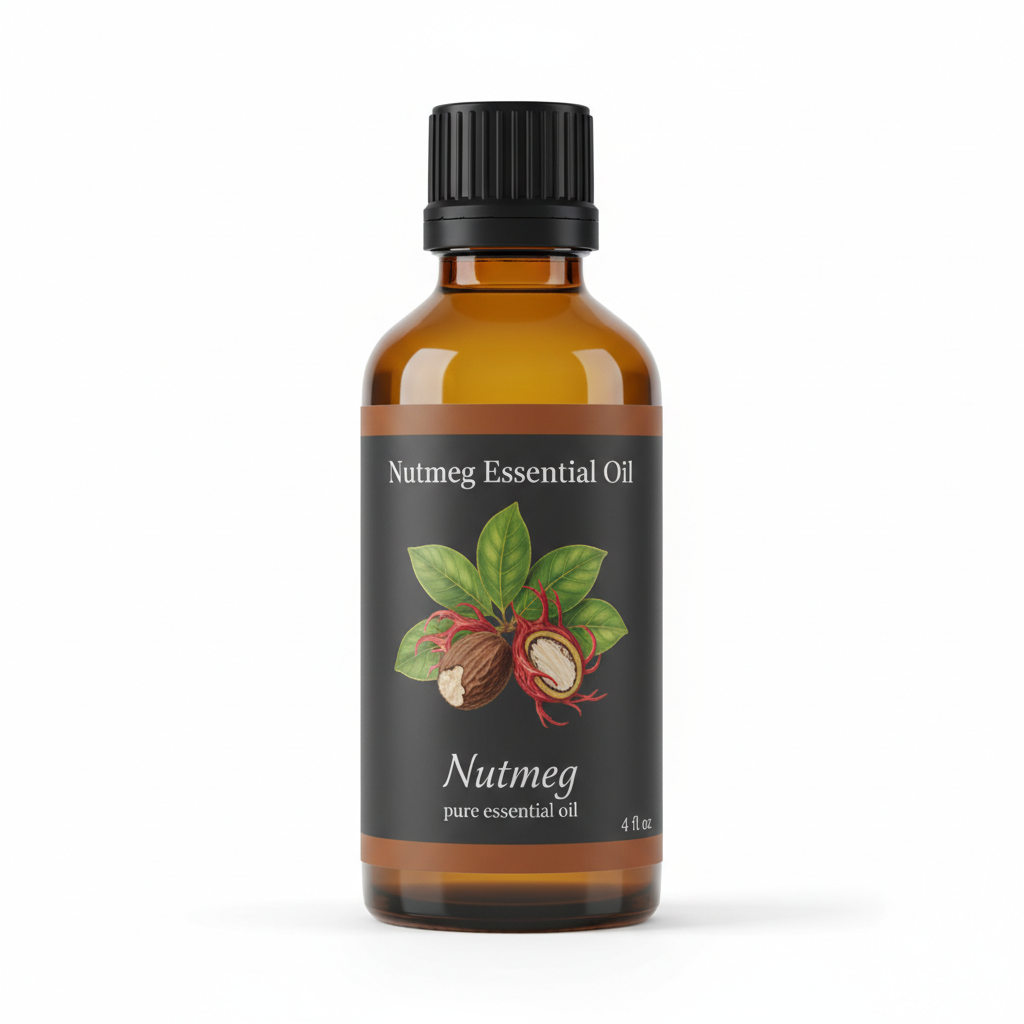
Nutmeg Essential Oil
Our own Nutmeg Essential Oil, in sizes from 0.5 oz to bulk.
From $10.99
Shop Now →Step one: one unit for everything
Oil is not water, so volume and weight do not convert one for one. The Certificate of Analysis we have for one batch gives a relative density of 0.887, so a milliliter weighs about 0.887 g and a fluid ounce (29.57 ml) about 26.2 g. Another batch will differ a little. To compare a bottle with a pound quote, work in grams:
- Convert the bottle: milliliters times 0.887. A 15 ml bottle is about 13.3 g.
- Divide the price by those grams to get price per gram.
- For a pound, divide the price by 453.6 g.
A classic trap is comparing "per ounce" on one page, which is fluid, with "per ounce" on another, which is weight. A weight ounce is 28.35 g and a fluid ounce of this oil is about 26.2 g, a gap of roughly 8%, enough to reverse two close quotes.
Step two: think in cost per use
Nutmeg oil is used at low strengths, so the oil is rarely the main cost of a finished product. Say an oil costs 1.00 per ml. In a skin blend at 0.5% to 2%, that oil adds 0.005 to 0.02 per ml of finished blend. The carrier oil, bottle and label usually cost more. So for most home makers, a slightly pricier bottle with better documentation is a small difference in the end. Scale changes that: for someone producing large volumes, a few percent on the oil price matters. Our bottle size guide shows how far each size goes.
Why two nutmeg oils are priced differently
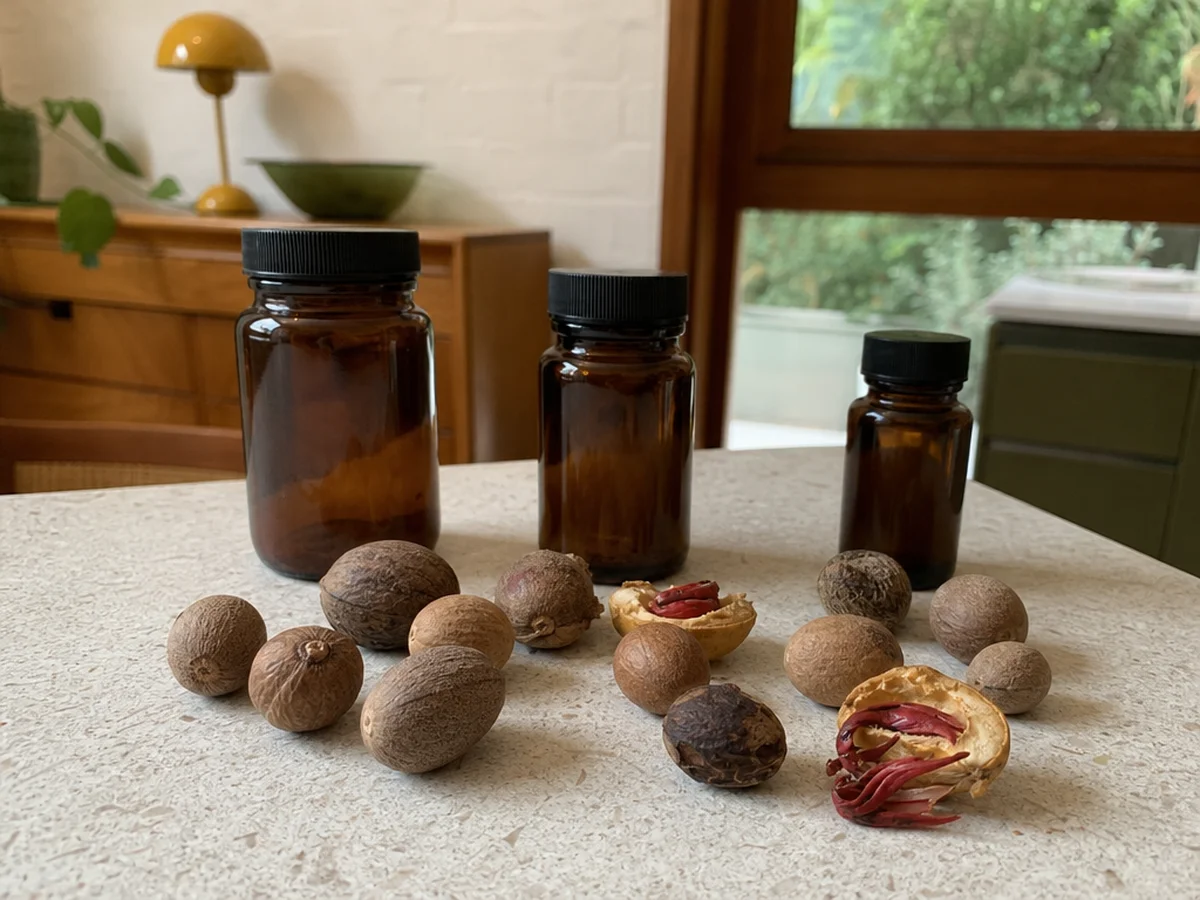
The plant part. Kernel, mace and leaf all give an oil, and yields differ widely. A 2022 review reported 6.2% to 7.6% oil from kernel, 8.1% to 10.3% from mace and 0.7% to 3.2% from leaf. Those figures come from many studies using different methods, so they do not predict any one supplier's cost, but they show that a different raw material can explain a different price. Check that the label names the part. Our nutmeg and mace comparison shows how the oils differ.
The type and origin. The Tisserand Institute explains that East Indian and West Indian nutmeg oils contain quite different amounts of safrole and methyleugenol. Their dilution limits differ as a result, so comparing across types compares two different working materials.
The paperwork. A batch-specific GC-MS report costs a supplier money to commission. Reasoning from that, an oil sold with one carries the cost, and an oil sold without one can be cheaper for that reason. The Certificate of Analysis we have lists density, refractive index and optical rotation for one batch. If you want constituent data, ask us in writing through our contact page before ordering. Our quality checks guide explains what to look for.
Size and handling. Larger sizes spread filling, labelling and shipping over more oil, which is the usual reason a bulk unit price comes in lower. We list six retail sizes and four bulk sizes (5, 25, 100 and 400 lb). Current prices are on each shop page, so convert them to price per gram before comparing with anything else, including an offer from us.
Dilution. A price well below its neighbours has to come from somewhere. A 2026 study that tested 20 commercial essential oils (not nutmeg specifically) found vegetable oil and other added material in some of them, at levels up to 52%. That does not mean any given nutmeg oil is stretched. It means the cheapest quote in a group earns a polite request for documents.
What does "fair value" look like?
We have not found a published benchmark price for nutmeg oil, so we will not invent one. What you can do is compare like with like: same plant part, same type, a batch number with a document behind it, and a stated density so you can convert. A bottle that sits half-used for years is also not a bargain at any price per gram. Our product pages give a typical shelf life of 2 to 3 years when the bottle is kept tightly capped in a cool, dark place, so size your purchase to what you will use.
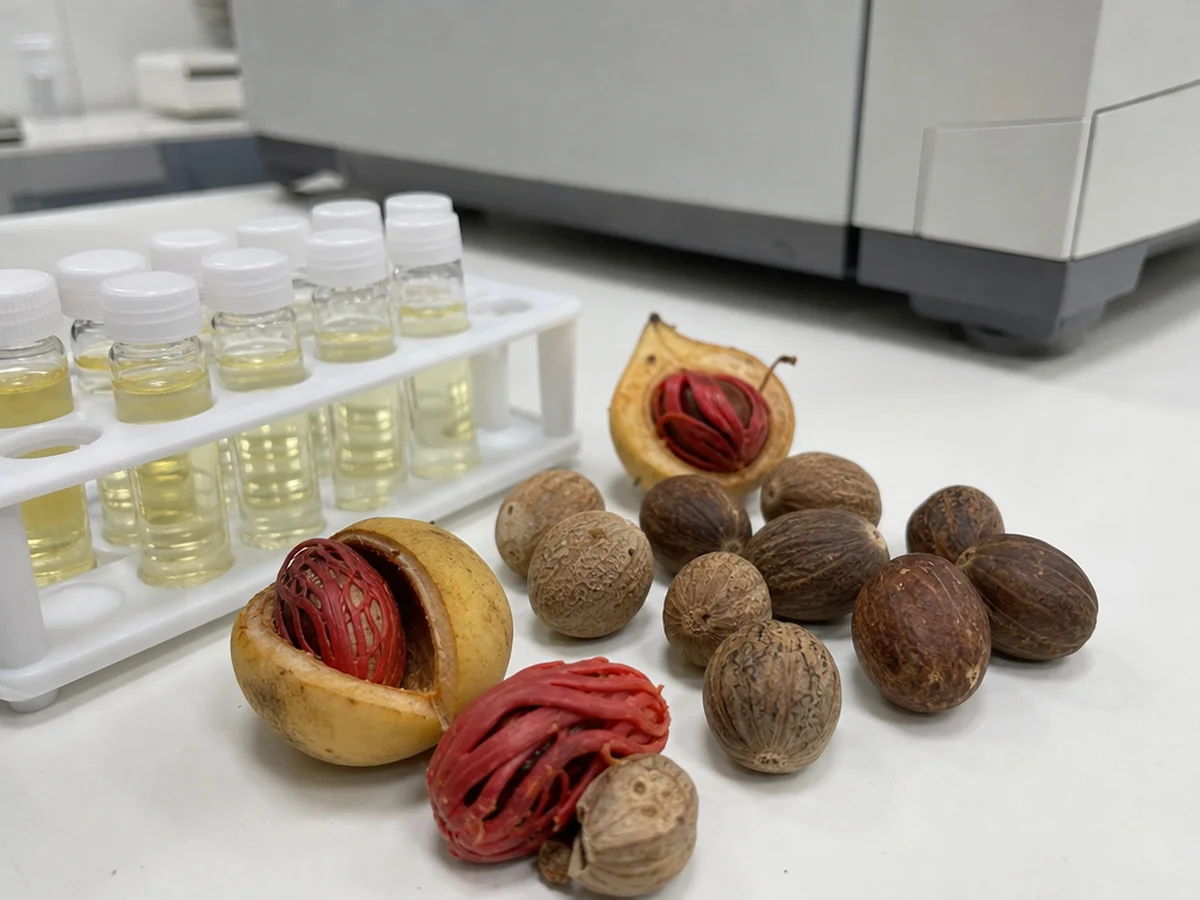
Keep a quote sheet
When you are comparing three or four sellers, a simple sheet saves a lot of frustration. Give each seller a row and add columns for:
- the size and unit they quote in,
- the weight in grams,
- the price per gram,
- shipping and any minimum order,
- what paperwork comes with the bottle.
Shipping changes the real cost per gram more than people expect, particularly on small bottles, so include it before you decide. After one or two rounds the sheet takes a few minutes, and you will be comparing like with like.
A worked example
Seller A quotes 10 ml for 10 units. Seller B quotes 1 fluid ounce for 30 units. Seller A: 10 ml is 8.87 g, so 1.13 units per gram. Seller B: 29.57 ml is 26.2 g, so 1.15 units per gram. The ounce bottle looks three times as expensive and is nearly identical per gram. If seller B also supplies a batch GC-MS report, B is the better value for anyone who needs the constituent data. If you do not need it, A is perfectly sensible. The arithmetic settles the unit, and the paperwork settles the rest.
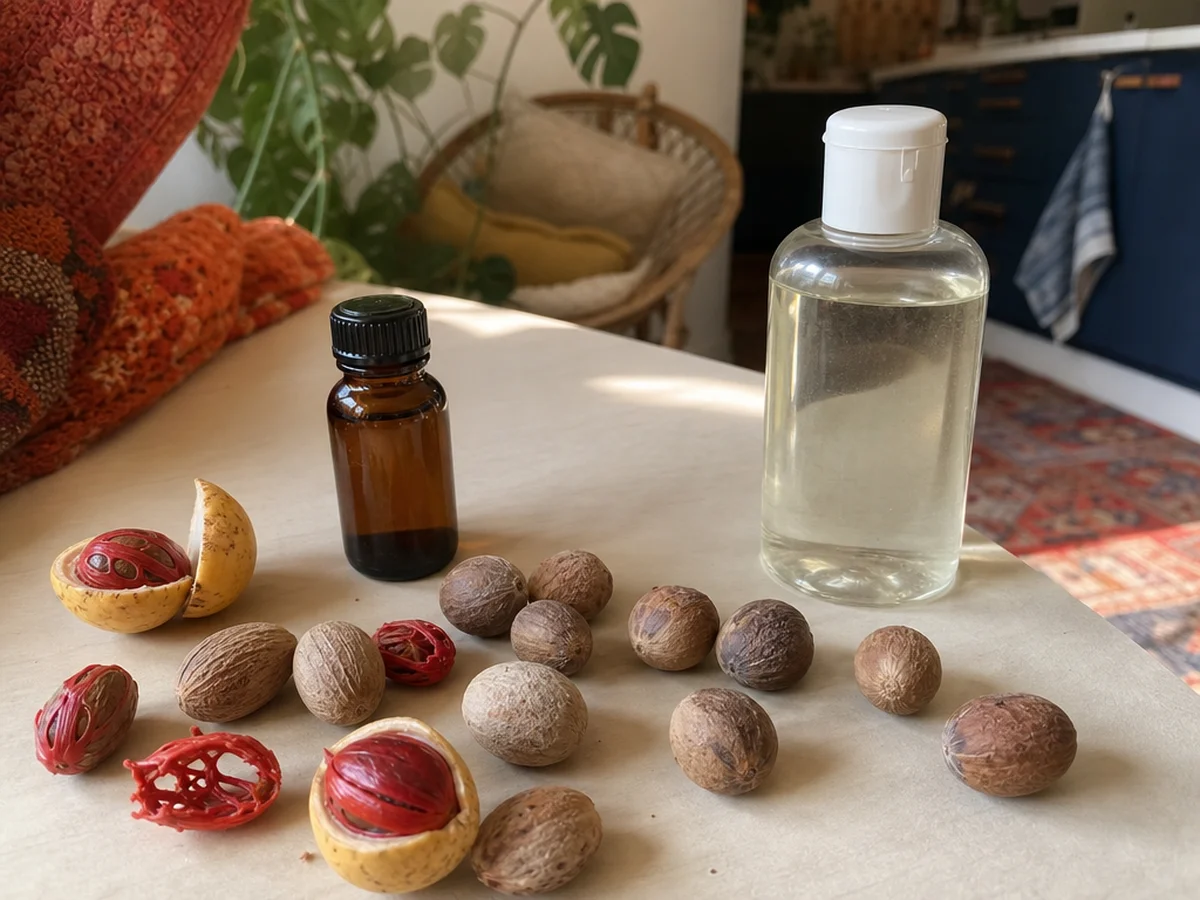
Line up your quotes this way and the decision usually becomes easy. Our soap and perfume posts show how little oil many projects actually call for.
Nutmeg Essential Oil
Nutmeg Essential Oil from our own shop, in sizes from 0.5 oz to bulk.
From $10.99
Shop Now →Sources & Further Reading
- Ashokkumar et al.: Nutmeg (Myristica fragrans Houtt.) essential oil: A review on its composition, biological, and pharmacological activities
- Tisserand Institute: Assessing the Safety of Essential Oils - the Nutmeg Case
- Fulin et al.: Detection of Essential Oil Adulteration Using High-Temperature Gas Chromatography with a Flame Ionization Detector