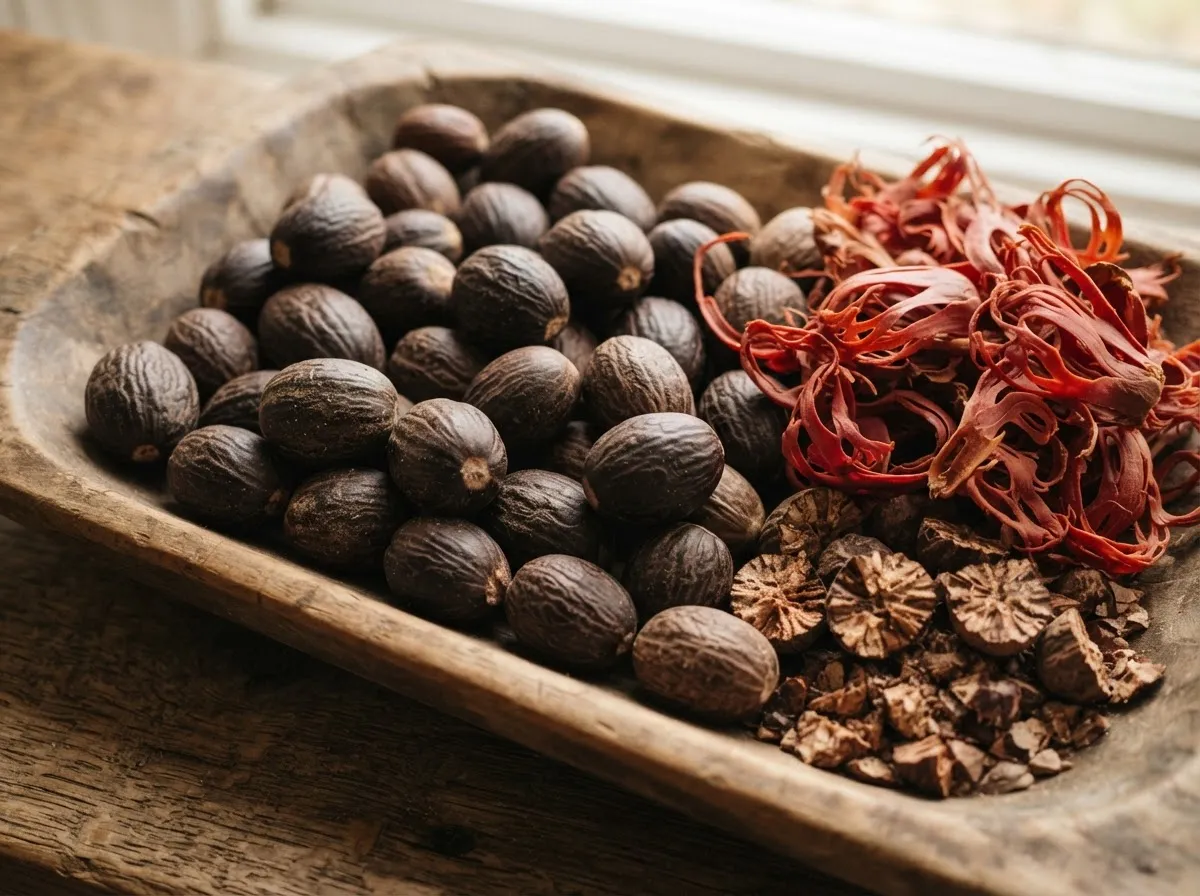
One fruit gives one nutmeg. We buy those kernels whole, crack them in the hour before the still is charged, and tell you plainly what the oil contains.
Each nutmeg fruit yields exactly one kernel, wrapped in the scarlet lace that becomes mace.
That arithmetic is the whole history of the spice: one seed per fruit, from trees that took years to bear, on a handful of islands. It is why the Banda Islands were fought over, and it is why nutmeg has never been a cheap material to distil honestly.
It also explains what commodity nutmeg oil is usually made from: broken kernels, undersized ones, and the residue left after the good nutmegs were sold whole to the spice trade. We buy sound whole kernels to a screen size, keep them whole, and crack them here.
We make no medical claims, and this caution is not a formality. Myristicin toxicity from nutmeg is well documented rather than theoretical, and the amounts involved are smaller than people assume.
It must never be swallowed. Hold the dilution very low indeed; it is unsuitable for anyone pregnant or nursing and unsuitable for children; and if you take medication acting on the central nervous system, do not use it at all.
Dilute well before skin contact and trial a small area. Diffuse sparingly. That it smells like a baking cupboard is no guide whatever to how safely it can be handled.
A lot that fails to read as sound kernel-distilled nutmeg never reaches a bottle, and we simply have none for sale until the following one arrives.
Myristica fragrans is an evergreen of the Indonesian islands, and the part we distil is the dried kernel rather than the mace around it.
Each material carries its own size specification and an upper limit on moisture. Damage, splits, poor colour and small size all get a lot turned away, since a small kernel is usually an unripe one, and unripe kernels give up less oil of a flatter character.
Left intact and dry, a kernel guards its oil for a remarkably long time, which is what lets us hold stock through a season and still fill a basket with material worth the steam.
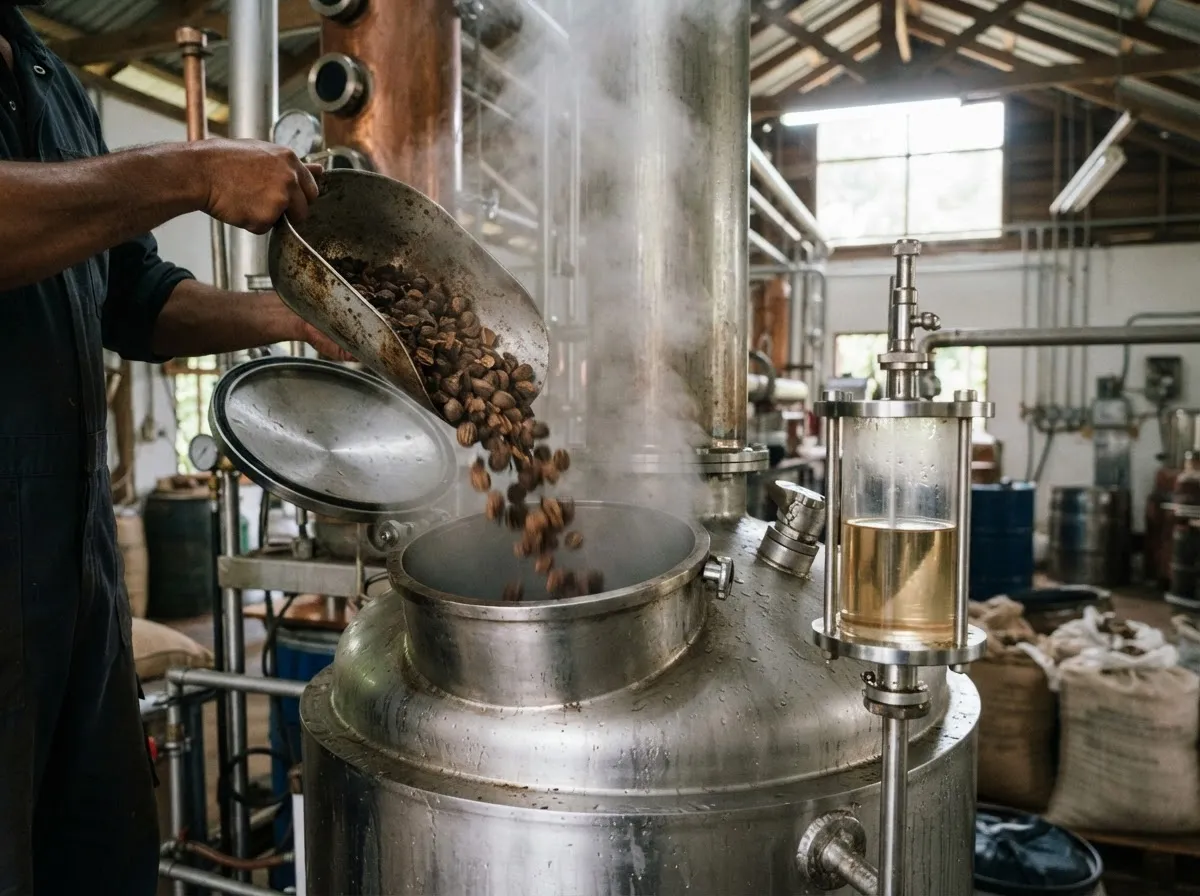
A nutmeg is a sealed package until you break it. Once cracked, the volatile top notes start leaving and the oil meets both oxygen and the kernel's own enzymes, so the interval between mill and still is something we keep to about an hour.
The setting is deliberately coarse. Milled fine, kernel behaves like wet sand in the basket: the bed compacts, the steam takes the easiest route around the outside, and you finish with an unevenly worked charge and burnt material at the bottom.
Steam then works through the bed until nothing more comes across, and the resulting lot is measured before any of it reaches a bottle.
True of every nutmeg lot we distil.
Not the broken residue left after the whole-spice trade has taken its pick.
Bought to a screen size and moisture ceiling, with immature kernels rejected.
Cracked coarse here, roughly an hour before the charge goes in.
Independently measured and provided on request rather than left unmentioned.
Mace is a different oil. It does not go in this bottle.
Bulk is available, though very few uses call for nutmeg in quantity.
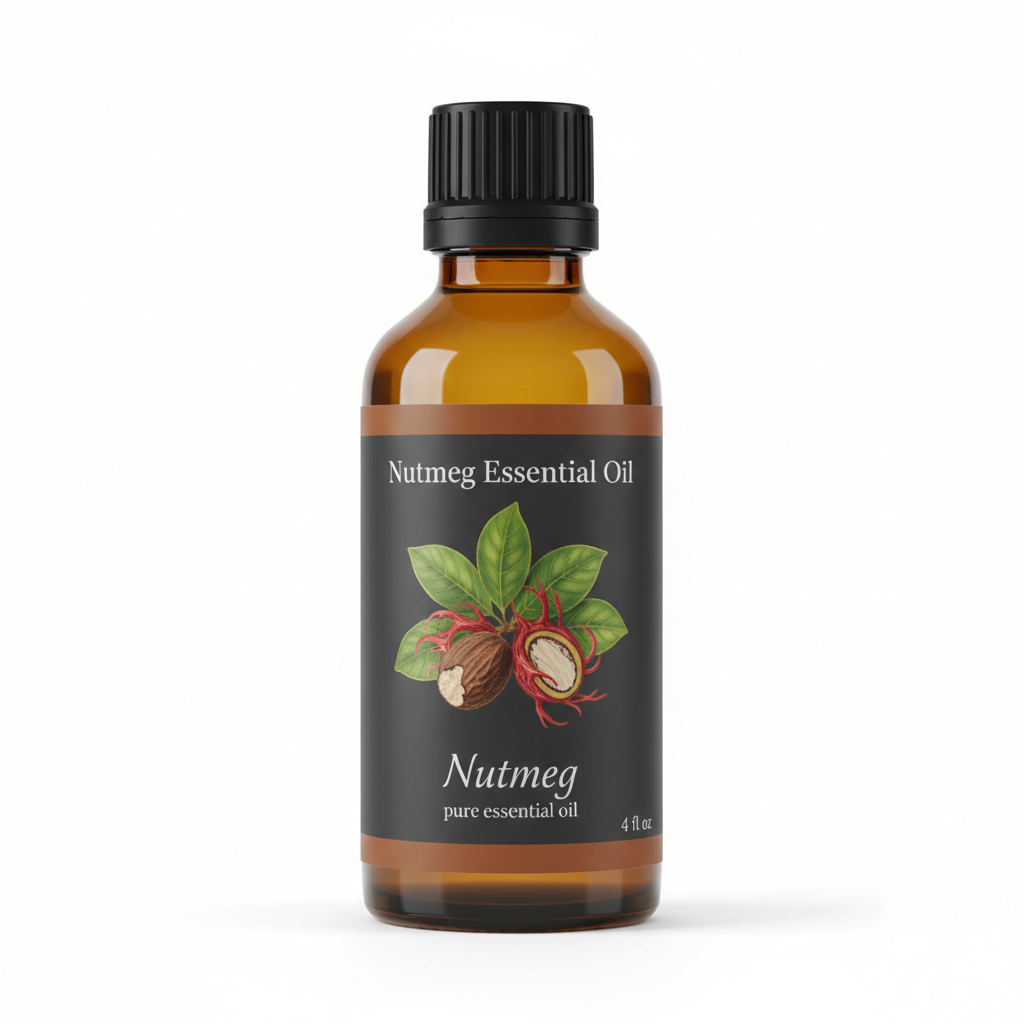
Every size ships in amber glass, from the smallest retail bottle to bulk.
Full-strength Myristica fragrans from kernel alone, with no mace oil and no carrier.
An independent laboratory examines every lot, and for nutmeg one of the numbers is squarely a safety matter.
Measured for every lot. It is the constituent behind nutmeg's toxicity at quantity, and the cautions below rest on knowing it.
The terpenes behind the fresher lift that separates the oil from ground kitchen spice.
Confirms kernel-distilled Myristica fragrans at full strength, with no mace oil blended in to extend it.
Ask us for the myristicin figure by lot and it will come back to you. The contact page reaches us as well.
Sound whole Indonesian kernels held to a size specification, broken coarsely on the premises, stilled here, and with myristicin quantified by an outside laboratory.
Buy the small bottle.
Shop Nutmeg Oil