Nutmeg Oil Substitutes: Matching the Job It Did
You reach for the nutmeg oil and the bottle is empty, or maybe you are looking for something similar for a formula that cannot use it. The honest answer is that no other oil is a true twin. Nutmeg oil does two jobs at once, and the best substitute depends on which one you need.
Nutmeg Essential Oil
Our own Nutmeg Essential Oil, in sizes from 0.5 oz to bulk.
From $10.99
Shop Now →The two jobs inside nutmeg oil
In the seven Indonesian batches analysed for the European Food Safety Authority, three terpenes made up over half the oil: sabinene (about 21%), alpha-pinene (about 20%) and beta-pinene (about 13%). They give the fresh, slightly piney lift. The rest includes myristicin (about 13%) and a little safrole (about 2%), the compounds that add depth and also the ones regulators watch. A swap that covers the lift usually leaves out the depth, and a swap that copies the depth tends to bring restricted compounds of its own.
If you need the fresh, peppery lift
Black pepper oil is the closest match on the terpene side. EFSA's analysis of five Sri Lankan batches found sabinene, alpha-pinene and beta-pinene all present, at lower levels than in nutmeg, with a warm, peppery beta-caryophyllene body at its heart (about 26%). No safrole was detected. Expect a drier, spicier and less sweet scent. We have no ratio to give you, so smell the two side by side on a strip of paper before you commit a batch.
If you need sweet warmth for a diffuser blend
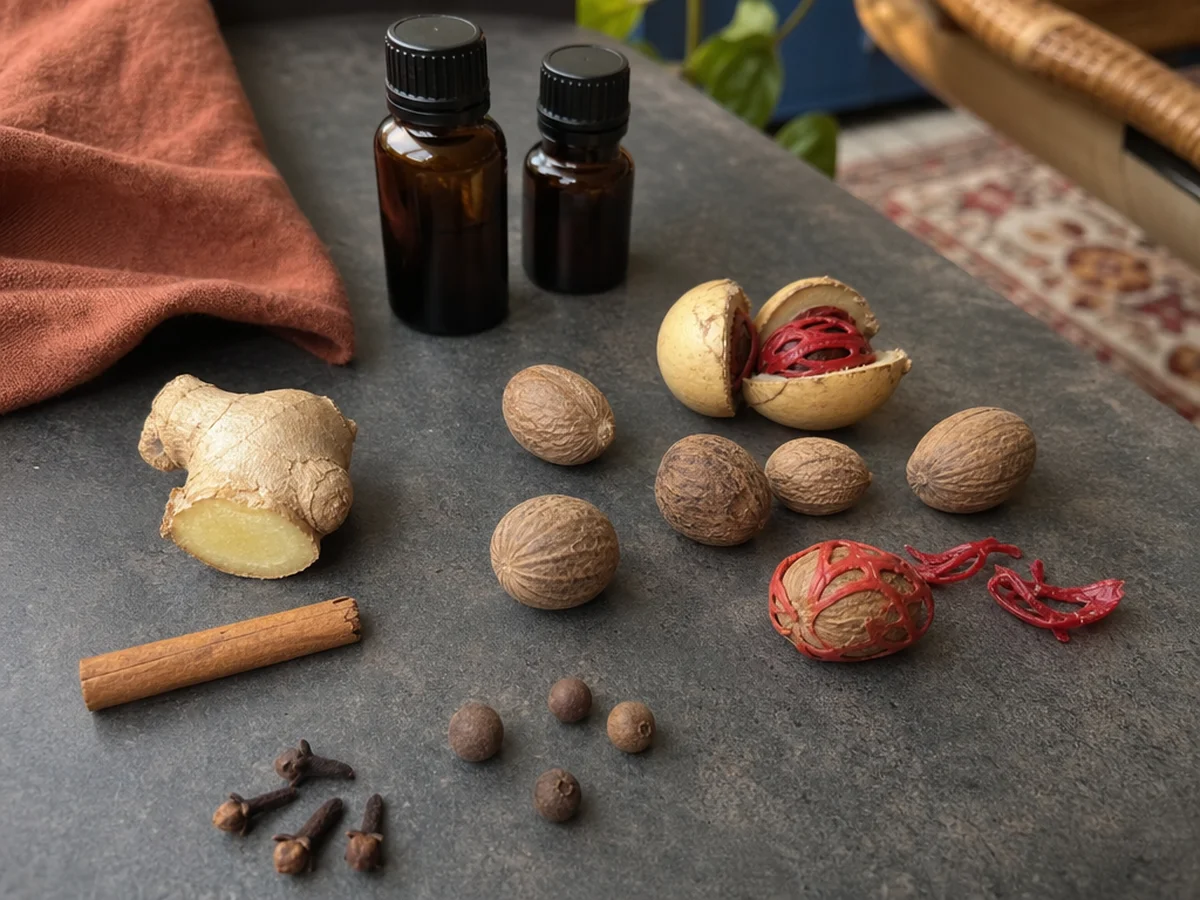
Cardamom is the better fit here. Its main compounds are terpinyl acetate (about 35%) and 1,8-cineole (about 23%), so it is brighter and more camphor-like than nutmeg, and it overlaps only through a little sabinene. Ginger is different again, led by zingiberene, and shares very little chemistry with nutmeg. Our nutmeg and ginger comparison covers what that means in practice. For ready-made ideas using these oils, the chai blend and pumpkin spice blend already give ratios by weight.
A myth worth clearing up: spice oils are not automatically safer
Cinnamon leaf and clove bud are tempting swaps because they smell so clearly of spice. Both are eugenol-rich oils, and cinnamon leaf also carries safrole, at about 0.9% in EFSA's five batches. EFSA classes it in the same category 1B hazard group on that basis and as a skin sensitiser. So swapping nutmeg for cinnamon leaf lowers the safrole but does not remove the need for care. Mace oil, from the same tree, can contain more safrole than the seed oil, so it is not a gentler option either (Ashokkumar and colleagues, 2022). Fewer restricted compounds is not the same as harmless, and EFSA describes black pepper oil as an irritant and sensitiser, while its cardamom panel could not conclude on safety for users.
Start with your nose, not the chart
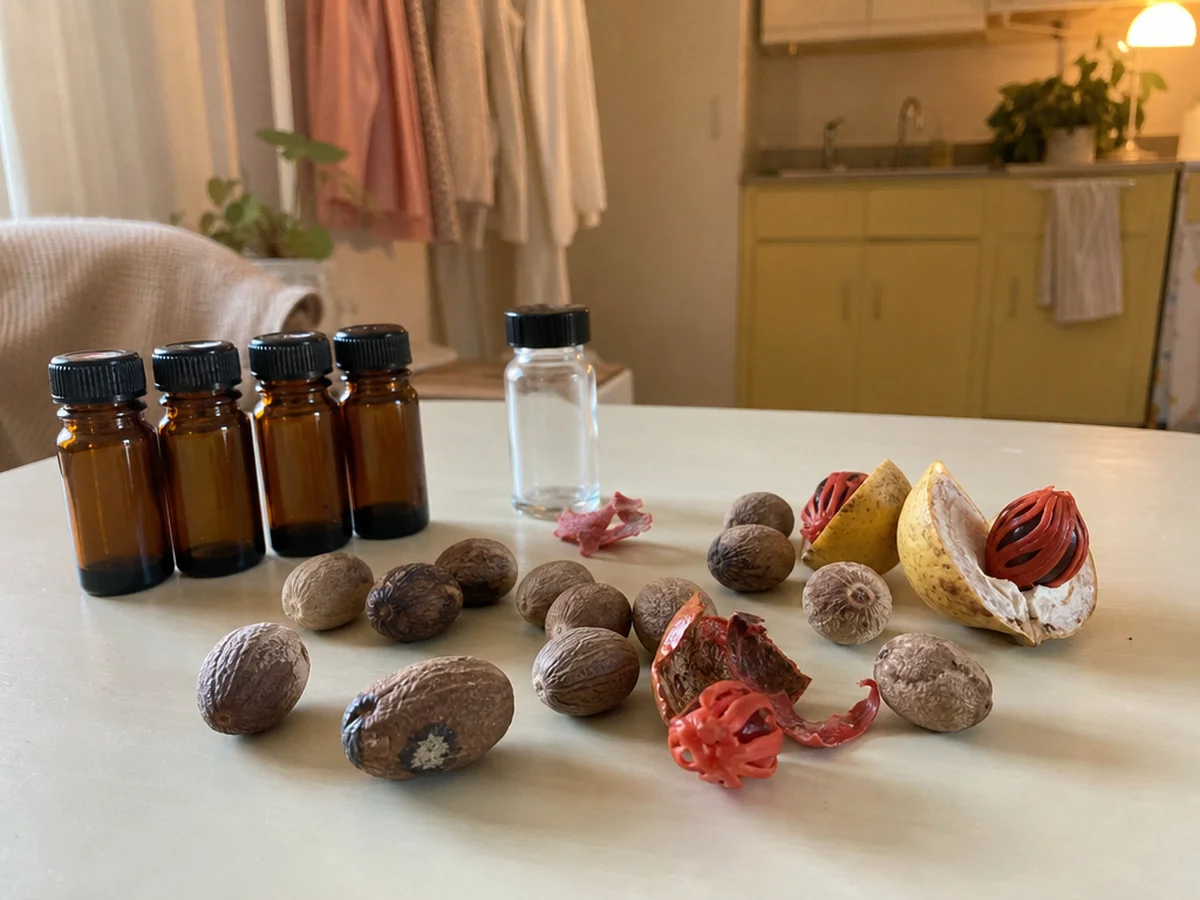
Before you read another word about chemistry, do something simple. Open a few small bottles, or a few paper strips, and sniff each one slowly, then come back to them after a minute. Nutmeg has a way of announcing itself in the first breath and then settling into something rounder, and that second stage is the part a swap most often misses.
Ask yourself what you are really missing. Is it the sweet, baking-spice comfort? The bright, slightly resinous opening? Or just the sense that a blend feels finished? Naming it in one plain sentence makes the choice of substitute much easier, because you stop shopping for "something like nutmeg" and start shopping for "something that adds a peppery lift" or "something that adds sweet warmth."
A swap resets the usage limits
For nutmeg in a finished product, IFRA has no nutmeg-named standard. The governing rule is the safrole note, which allows natural extracts as long as the total safrole in the finished product stays at or below 0.01%. At 2% safrole in the oil, that works out to about 0.5% nutmeg oil. A different oil has different limiting compounds, so a usage rate worked out for nutmeg does not carry across. Start again from the new oil's own safety data sheet and IFRA certificate.
Small changes, easy to correct
If you do swap, change one thing at a time. Replace the nutmeg with a single new oil, mix a tiny amount and wait a day, because a blend that smells exciting in the first minute can feel quite different the next morning. Write down what you used on a label so you can repeat the good ones and quietly forget the others.
It also helps to remember that sometimes the best substitute is a smaller blend. A recipe that leans on nutmeg for its backbone may do better with one fewer ingredient than with a stand-in that fights the others. Leaving a gap can be more elegant than filling it.
Where to find them
We focus on nutmeg oil, so we do not stock substitutes. Black pepper, cardamom, ginger, clove and cinnamon leaf oils are available from aromatherapy and soap-supply shops, and it is worth asking for the safety data sheet. If your recipe wanted ground nutmeg as a food, none of these oils is a kitchen swap, and our ingestion post explains why. If it is nutmeg oil itself you ran out of, larger sizes are listed on our bulk page.
Keep a swap log
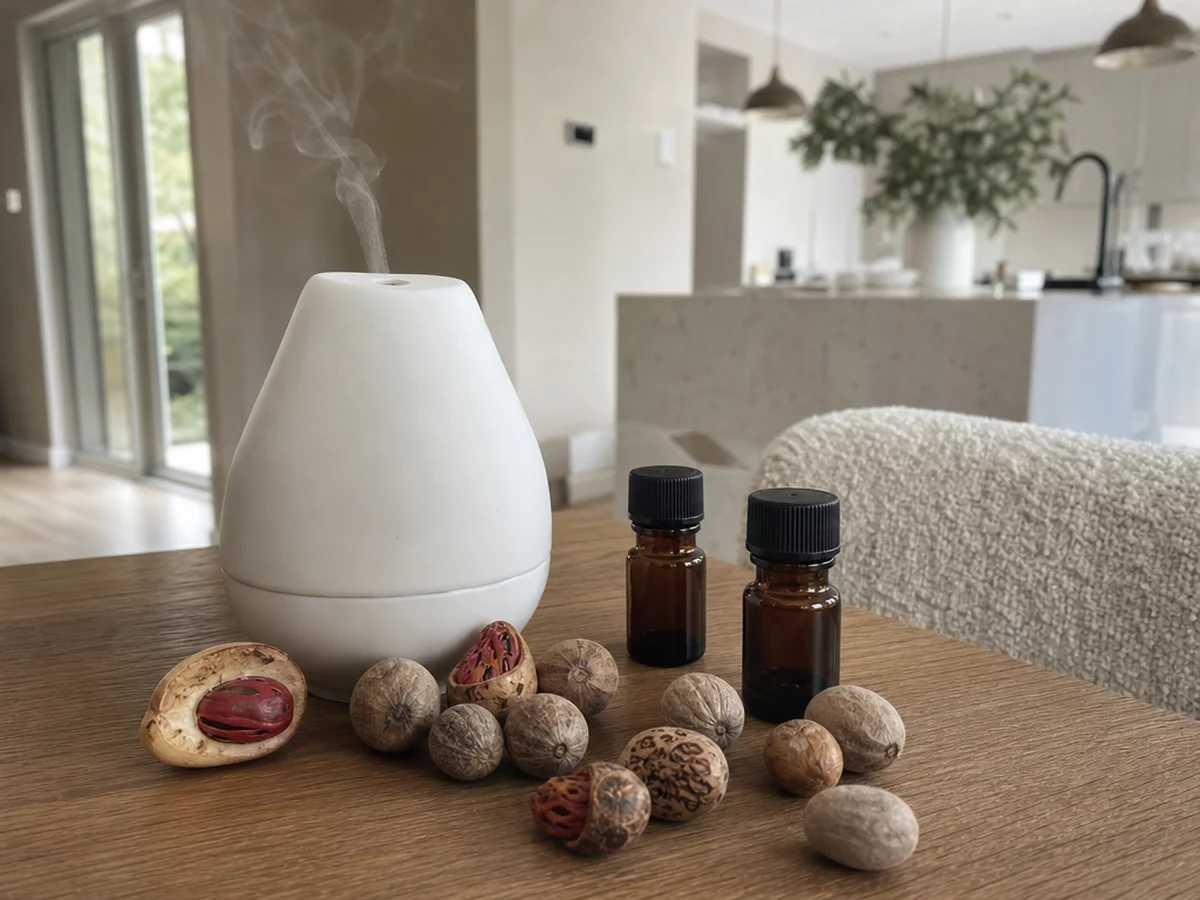
A tiny notebook pays for itself here. Jot down the date, the oil you swapped in, the amount and one honest line about how the blend smelled the next day. After two or three swaps you will have your own reference, which is worth more than any rule of thumb we could give you.
The practical order is simple: name the job nutmeg was doing, choose the oil whose composition covers it, check its own limits, and smell before you scale.
Nutmeg Essential Oil
Nutmeg Essential Oil from our own shop, in sizes from 0.5 oz to bulk.
From $10.99
Shop Now →Sources & Further Reading
- EFSA Panel on Additives and Products or Substances used in Animal Feed. Safety and efficacy of a feed additive consisting of an essential oil from the seeds of Myristica fragrans Houtt. (nutmeg oil) for all animal species (FEFANA asbl). EFSA Journal, 2023
- EFSA Panel on Additives and Products or Substances used in Animal Feed. Safety and efficacy of feed additives prepared from Piper nigrum L.: black pepper oil and black pepper oleoresin for use in all animal species and a supercritical extract for use in dogs and cats (FEFANA asbl). EFSA Journal, 2022
- EFSA Panel on Additives and Products or Substances used in Animal Feed. Safety and efficacy of an essential oil from Elettaria cardamomum (L.) Maton when used as a sensory additive in feed for all animal species. EFSA Journal, 2019
- EFSA Panel on Additives and Products or Substances used in Animal Feed. Safety and efficacy of essential oil, oleoresin and tincture from Zingiber officinale Roscoe when used as sensory additives in feed for all animal species. EFSA Journal, 2020
- EFSA Panel on Additives and Products or Substances used in Animal Feed. Safety and efficacy of feed additives consisting of essential oils from the bark and the leaves of Cinnamomum verum J. Presl (cinnamon bark oil and cinnamon leaf oil) for use in all animal species (FEFANA asbl). EFSA Journal, 2022
- Ashokkumar K, et al. Nutmeg (Myristica fragrans Houtt.) essential oil: A review on its composition, biological, and pharmacological activities. Phytotherapy Research, 2022
- IFRA. The complete IFRA Standards, up to and including the 51th Amendment, January 2024