
Nutmeg Oil in a Personal Inhaler: Cautions and Arithmetic
No source read for this article gives a drop count for a nutmeg oil inhaler, and the documented hazards of the oil point toward restraint, not a recipe. An inhaler is a small vial holding a cotton wick soaked in neat oil, held near the nose, which is the opposite geometry from a diffuser. This post sets out what the authorities say, what a wick holds in grams, and where our own position lands. We have not made or tested an inhaler, and nothing here is advice from a clinician.
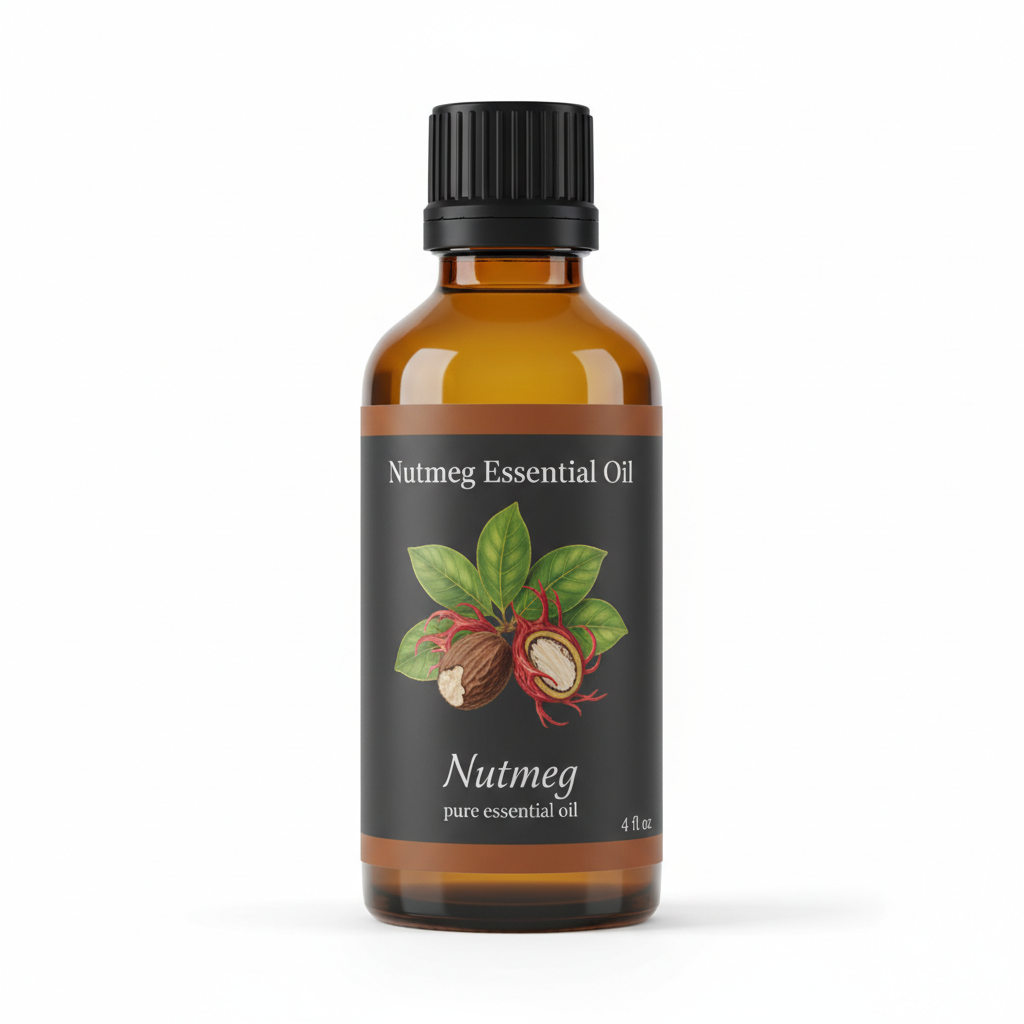
Nutmeg Essential Oil
Our own Nutmeg Essential Oil, in sizes from 0.5 oz to bulk.
From $10.99
Shop Now →What is documented, and what it does not show
| Source | What it covered | What it does not show |
|---|---|---|
| EFSA FEEDAP Panel, 2023 | Nutmeg oil as a feed additive: classified as an irritant to skin and eyes and as a skin and respiratory sensitiser; carcinogen category 1B on its safrole content (at 0.1% or more) | Hazard labels for the oil as supplied, not an exposure from an inhaler; no inhaled dose |
| Tisserand Institute, nutmeg article (Robert Tisserand, posted 2019) | Says nutmeg oil "is safe to diffuse in moderation" and that diluted skin use follows its chart | Does not define moderation; says nothing about inhalers |
| IFRA guidance, June 2023 | Lists aromatherapy applications among products outside the scope of the IFRA Standards | So there is no IFRA inhalation figure for nutmeg to quote |
| Steinemann, 2018 | Online survey of 1,137 US adults, 26.8% reporting a diagnosis of asthma or an asthma-like condition; of those, 64.3% reported at least one adverse effect from fragranced products, 43.3% respiratory problems and 27.9% asthma attacks | Self-reported, about fragranced products in general; not nutmeg, not inhalers, not a measured exposure |
The words "safe to diffuse in moderation" cut one way and the EFSA hazard classification the other, and neither says what a close-range wick does. The National Capital Poison Center's essential oils page says vaporizer products are usually fine when used as directed because only small amounts of oil go into a large volume of water. An inhaler reverses that: no water, no room, neat oil, a few centimetres from the nose. That contrast is our reasoning, not a study result. Our own process page says to diffuse sparingly, and that nutmeg must never be swallowed.
What a wick holds, in grams
The batch on our published COA has a relative density of 0.887, so 1 ml is about 0.887 g, and at about 20 drops per ml one drop is 0.05 ml, about 0.044 g. Droppers vary, so weigh if you can.
| Drops on the wick | Volume | Mass of oil |
|---|---|---|
| 1 | 0.05 ml | 0.044 g |
| 5 | 0.25 ml | 0.22 g |
| 10 | 0.50 ml | 0.44 g |
The plan for this post assumed a supplier-stated wick capacity. The inhaler page read for this article, Mountain Rose Herbs, says to add "a few drops" to the wick and gives only the case dimensions, 3.5 inches by 1 inch, so no capacity can be reported. Weigh the wick before and after on a 0.01 g scale instead of trusting a drop count.
Put those masses next to the skin arithmetic from our massage oil recipe. A whole ounce of body oil at the 0.4% working ceiling holds about 2 drops of nutmeg oil, so one drop on a wick is half the nutmeg in that bottle, applied as 100% oil in one small place. The routes differ and that is not an equivalence. It shows how concentrated a wick is.
Our position
Nutmeg is a poor first choice for an inhaler. The evidence for restraint is documented: a respiratory-sensitiser classification, a constituent profile, in the oil EFSA assessed, that includes safrole and methyl eugenol, no inhalation standard, and a close-range, repeated-use format that nobody has quantified. Our recommendation is not to make one for anyone in the groups below. If you are an adult outside them and go ahead anyway, the smallest step is one drop on a fresh wick, no top-ups, for your own use only, and stop at the first cough, wheeze, headache or irritation. That is our reasoning and not a published limit, and no source read here supports a larger load. How often you use it is something the sources do not define, and our own copy's word for diffusing is "sparingly".
Who should not use one:
- Children. Our copy says unsuitable. An Illinois Poison Center review of nutmeg exposures from 2001 to 2011 counted 32 cases; of 17 unintentional ones, 10 were in children under 13, and four of those children's exposures were ocular. That review concerns nutmeg spice, not oil in an inhaler, but a tube with an open wick is a child-access item. Ask a pediatrician; see the children post.
- Anyone pregnant or nursing. Our process page calls the oil unsuitable. Ask an obstetric clinician; see the pregnancy post.
- Anyone taking medication that acts on the central nervous system. Our process page says not to use it at all. Ask the prescriber or a pharmacist; see the medications post.
- Anyone with asthma or another airway condition. This is our reading of the sensitiser classification and the Steinemann survey, not a rule from either. A GP or asthma nurse is the person to ask before a close-range inhaler goes anywhere near the nose.
If breathing goes wrong
The NHS guidance on asthma attacks (reviewed April 2025) says to sit upright, use a reliever inhaler as prescribed, call 999 if you feel worse at any point, do not feel better after the maximum dose or have no inhaler, and not to drive yourself to hospital. That is UK guidance; elsewhere, call your local emergency number. The Poison Center page adds that an allergic reaction with difficulty breathing is a medical emergency, and that its help line, 1-800-222-1222, is free and open 24 hours a day for swallowed oil or a child's exposure.
Storage and claims
Keep the inhaler and the bottle where children and pets cannot reach them; our copy says to store the oil tightly capped, cool and dark, and the Poison Center page says to lock essential oils away from children and pets. Inhaler blanks, wicks and caps come from craft and aromatherapy supply shops; we do not sell them.
No claim is made here about stress, focus or any effect on the body. Under FDA's aromatherapy page (current as of September 2023), what a product is intended to do, as shown by its claims, decides whether it is a cosmetic or a drug. Our stress post reports the evidence and its limits. For scenting a room instead, see the diffuser and simmer pot post, the home-use guide and the safety basics.
Our nutmeg oils are sold neat, and for an inhaler that is the point to weigh: the wick takes the oil undiluted, so the choice not to load it is always open.
Nutmeg Essential Oil
Nutmeg Essential Oil from our own shop, in sizes from 0.5 oz to bulk.
From $10.99
Shop Now →Sources & Further Reading
- EFSA FEEDAP Panel, 2023. Safety and efficacy of nutmeg oil as a feed additive. EFSA Journal 21(6):e08066. PMC10273060
- Tisserand Institute. Assessing the Safety of Essential Oils: the Nutmeg Case. tisserandinstitute.org
- IFRA, 2023. Guidance for the use of IFRA Standards, 51st Amendment (scope). ifra-51st-amendment-guidance
- Steinemann A, 2018. Fragranced consumer products: effects on asthmatics. Air Quality, Atmosphere and Health 11(1):3-9. researchonline.jcu.edu.au/52402
- Ehrenpreis JE et al., 2014. Nutmeg poisonings: Illinois Poison Center, 2001 to 2011. J Med Toxicol 10(2):148-151. PMC4057546
- National Capital Poison Center. Essential oils. poison.org/articles/essential-oils
- NHS, 2025. Asthma attack. nhs.uk/conditions/asthma/asthma-attack
- FDA, 2023. Aromatherapy. fda.gov/cosmetics/aromatherapy
- Mountain Rose Herbs. Aroma inhalers (product page). mountainroseherbs.com