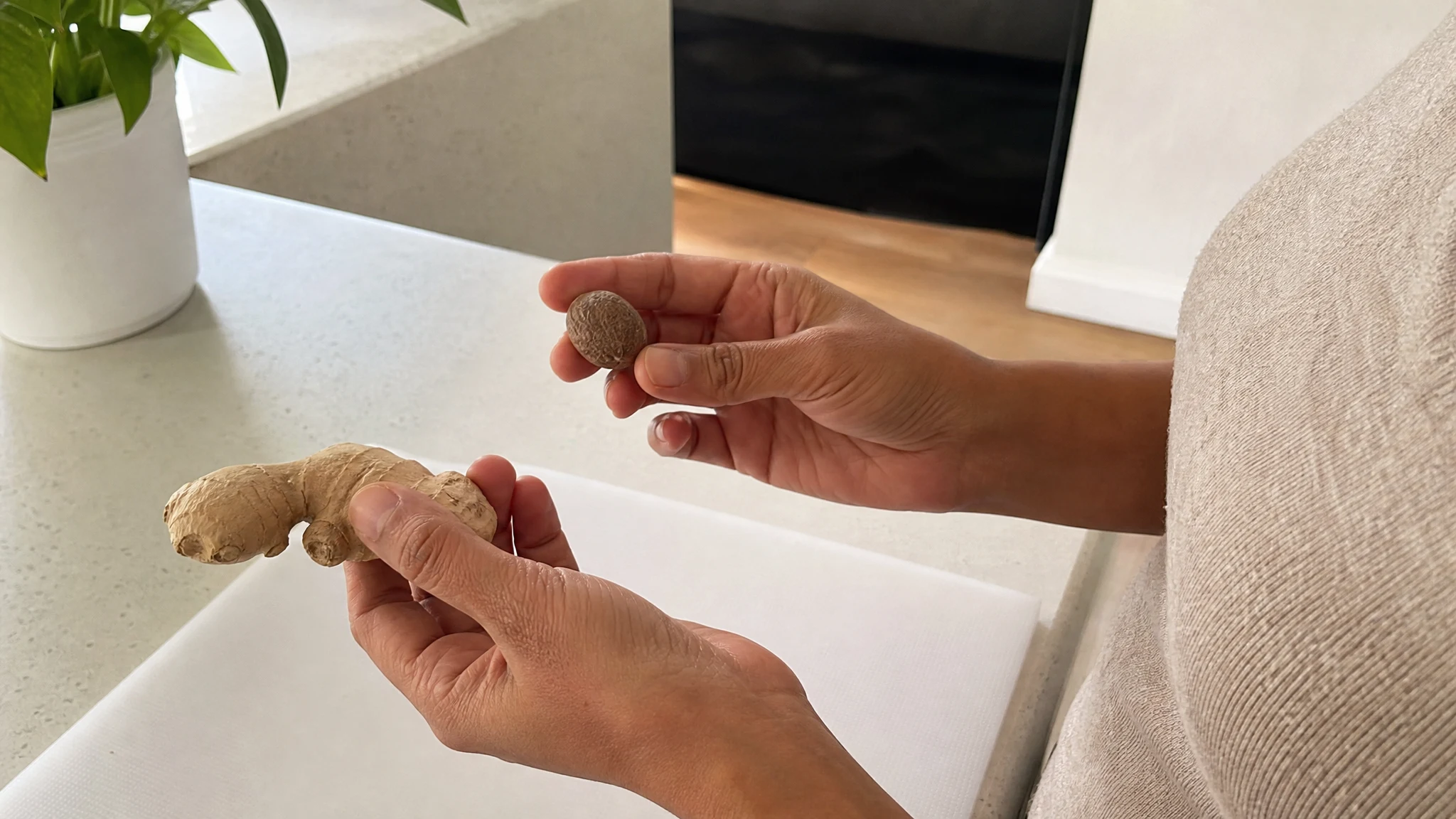
Nutmeg vs Ginger Oil: How Do They Differ?
Nutmeg and ginger turn up together in gingerbread, in chai and in autumn diffuser blends, so it is easy to treat their oils as cousins. They are better described as partners. One comes from the seed of a tree, the other from the underground stem of a herb, and the molecules that give each oil its character come from different families.
Nutmeg Essential Oil
Our own Nutmeg Essential Oil, in sizes from 0.5 oz to bulk.
From $10.99
Shop Now →A seed and a rhizome
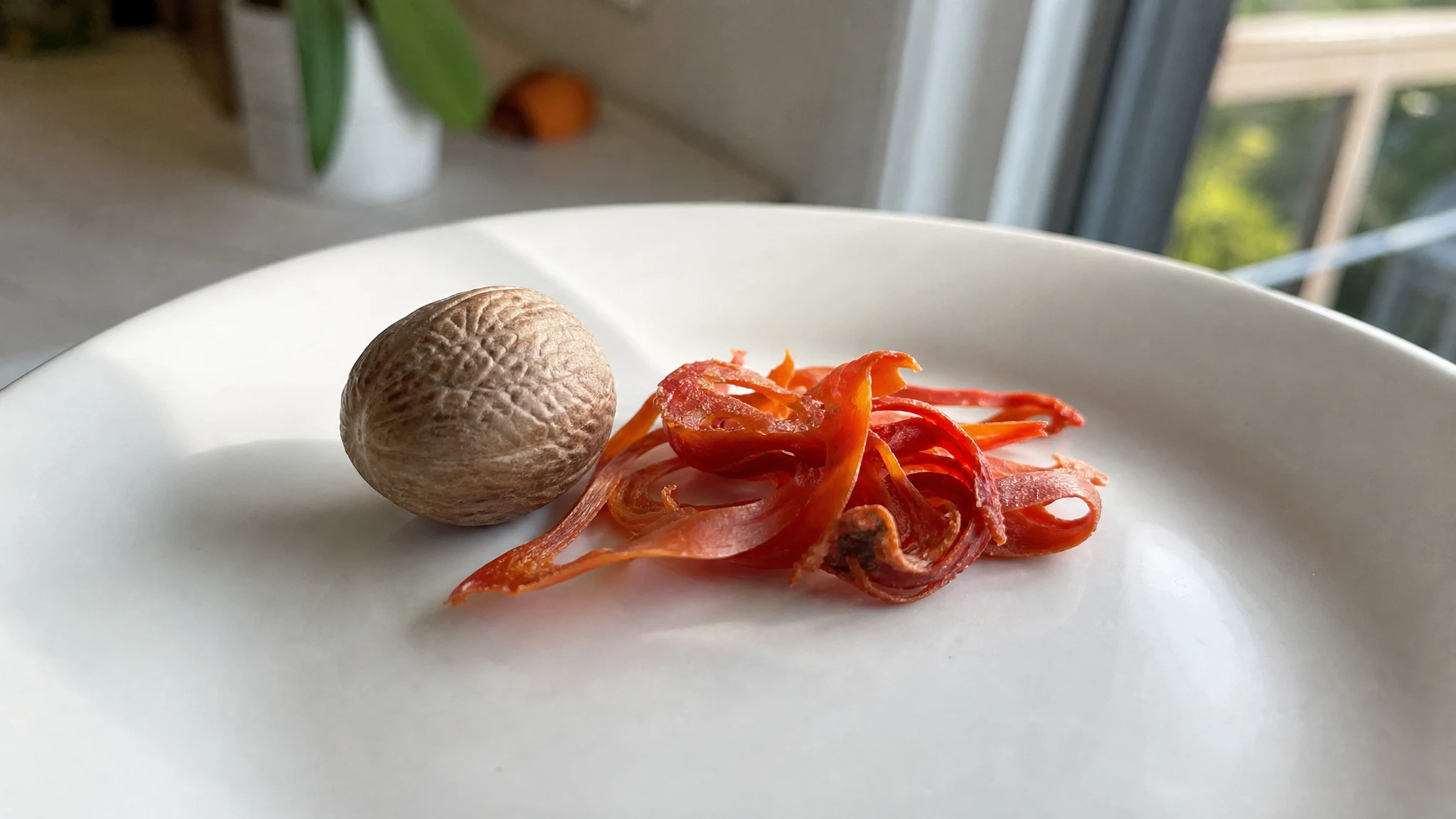
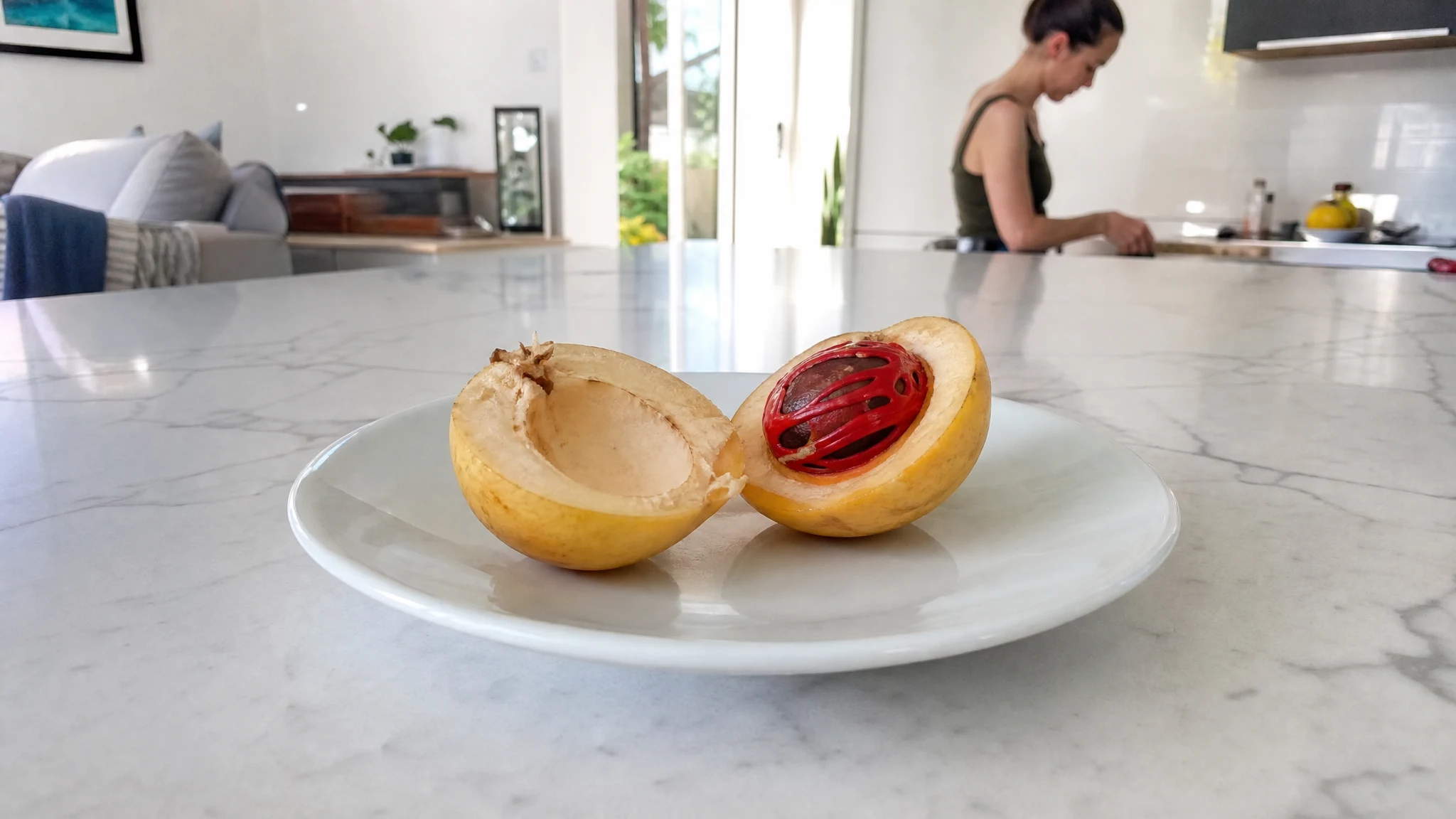
Nutmeg oil is made from the seed of Myristica fragrans. The European Food Safety Authority describes ginger oil as steam-distilled from the dried rhizome of Zingiber officinale, which is the thick underground stem you buy at the grocery. Different plant families, different plant parts, and as the numbers show, different chemistry.
Smelling them side by side
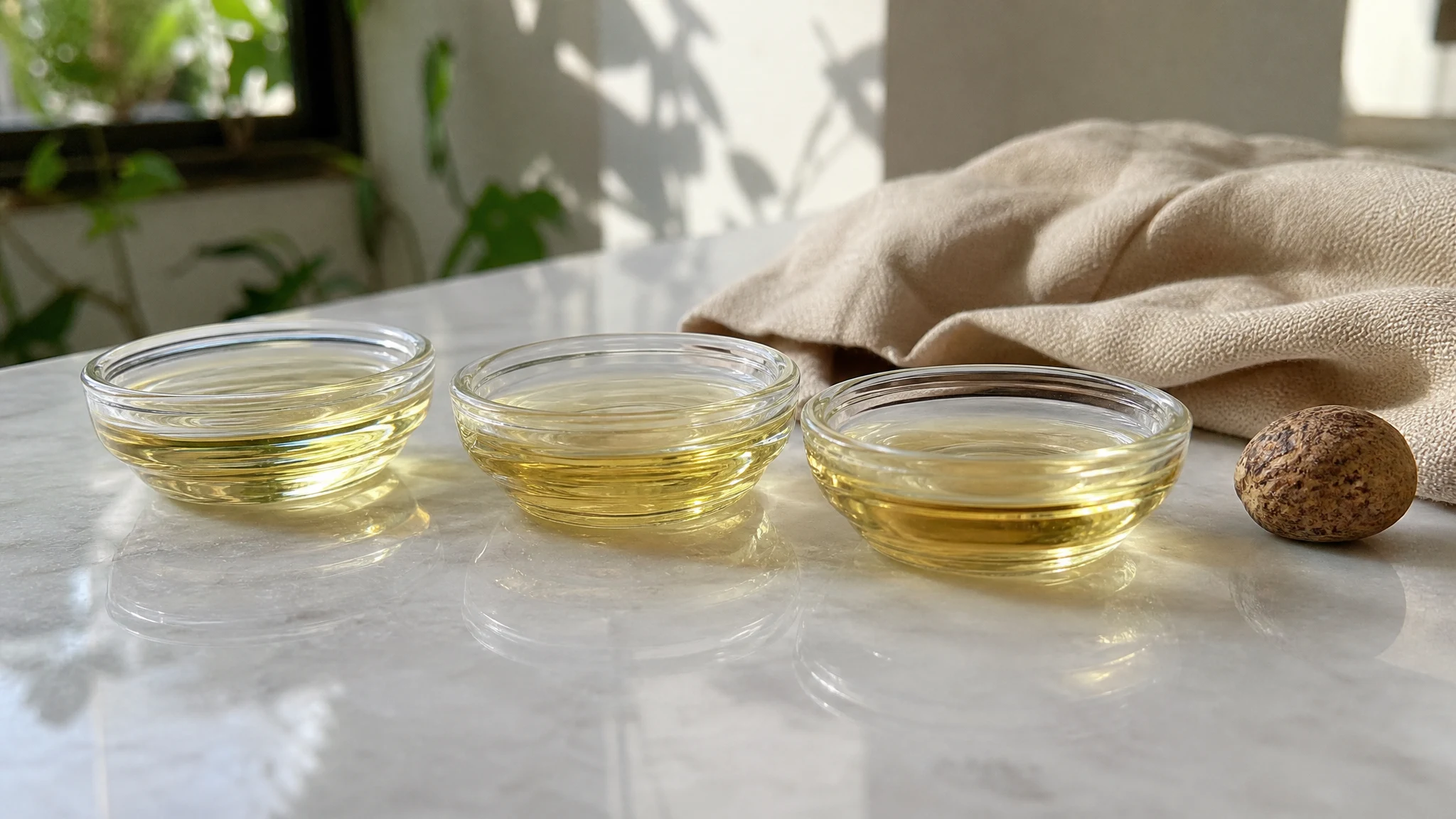
Numbers only go so far, so here is a better test. Put a drop of each on its own paper strip and compare them slowly. Nutmeg tends to read as sweet, rounded and spicy. Ginger tends to read as sharper, drier and more peppery, with a clean zing that wakes up a room. Neither is better; they behave like two different voices singing the same tune.
Wait a few minutes and sniff again. The openings fade and the deeper character shows, and that is when you will notice how well they complement each other.
Lighter molecules and heavier ones
EFSA assessed both oils as feed additives, which gives us a tidy side-by-side. In its seven Indonesian nutmeg batches, the leading compounds were sabinene (about 20%), alpha-pinene (about 22%) and beta-pinene (about 15%), all monoterpenes, plus myristicin. In eleven ginger batches from China and India, the leader was zingiberene at about 37% on average, followed by beta-sesquiphellandrene and ar-curcumene, which are sesquiterpenes. Chemists generally treat monoterpenes as the lighter, more volatile family and sesquiterpenes as the heavier one.
Reasoning from that, we would expect nutmeg to supply the brighter, lifted side of a warm spice blend and ginger to supply more body. That is an inference from molecular class, not a claim about any particular bottle, but it matches how the two are usually paired: both appear on our list of oils that suit nutmeg, and the combination is a natural fit in the diffuser blends we describe in our pairing guide.
Both figures are ranges across batches, and a lot-specific GC-MS report is the way to see where a particular bottle falls. We explain how to read one for nutmeg in our GC-MS guide.
What the safety wording says
EFSA's nutmeg opinion calls the oil an irritant to skin and eyes and a skin and respiratory sensitiser. For the ginger oils, the opinion notes the hazard notifications filed with the European chemicals agency (including skin irritation, skin sensitisation, eye irritation and respiratory irritation) and says the additives should be considered irritants to skin, eyes and respiratory tract and skin sensitisers. So the everyday handling advice is the same for both: dilute, patch test, keep away from eyes.
The difference is in nutmeg's safrole. EFSA classifies nutmeg oil as a category 1B carcinogen for labelling purposes because safrole is present at 0.1% or more, and the batches averaged about 2.0%. IFRA's standard allows natural extracts containing safrole only while the total in a finished product stays at or under 0.01%. Ginger oil does not bring that constraint with it, but it has its own data sheet, and we would ask a ginger supplier for it.
The blend arithmetic that matters
When both oils go on skin, nutmeg is the one that sets the ceiling. Tisserand's nutmeg chart gives adults 0.8% for East Indian nutmeg oil and 5% for West Indian. Our own guidance is 0.5% to 2% in a carrier, and we begin at 0.5%.
Here is a worked example. If you make a blend that is half nutmeg and half ginger and dilute it to 1% in carrier, the nutmeg is 0.5% of the final mixture. That sits within both Tisserand's East Indian figure and our starting point. At 2% total, the nutmeg would be 1%, above the East Indian figure. So decide on the nutmeg share first and work back to the total, not the other way round. This is simple arithmetic on documented limits rather than a tested recipe.
Picking a role for each oil
When we think about a warm-spice blend, we like to give each oil a job. One oil gets to be the star, another plays support, and a third adds a tiny accent. Nutmeg works well as the soft middle, with ginger as a bright accent that you add by the drop and adjust to taste. Reverse the roles and you get a livelier, spicier result. Try both on paper before you commit a whole bottle.
Choosing between them
If your aim is a spicy, sweet, woody warmth, nutmeg is the one we sell and the one to start with. Ginger enters as a second oil from your regular supplier when you want to add depth. Neither replaces the other, and together they cover more ground than either alone.
Writing it down
If you test the two together, note how many drops of each you used and which smelled better after a day. A short log makes your next blend easier and teaches you what you actually like, which may differ from any recommendation.
Whichever way you go, a small bottle of each and a patient hand will teach you more than any table.
Nutmeg Essential Oil
Nutmeg Essential Oil from our own shop, in sizes from 0.5 oz to bulk.
From $10.99
Shop Now →Sources & Further Reading
- Safety and efficacy of a feed additive consisting of an essential oil from the seeds of Myristica fragrans Houtt. (nutmeg oil) for all animal species (FEFANA asbl).
- Safety and efficacy of essential oil, oleoresin and tincture from Zingiber officinale Roscoe when used as sensory additives in feed for all animal species.
- Assessing the Safety of Essential Oils - the Nutmeg Case - Tisserand Institute
- The complete IFRA Standards: Up to and including the 51th Amendment, January 2024