Nutmeg Oil and Medications: What to Ask a Pharmacist
If you take a prescription, the nicest thing we can do for you is be straightforward: nobody has measured whether breathing or skin-applying nutmeg oil changes how a medicine behaves. That is not the same as knowing it is fine. Because of that, we keep our own advice simple, and we would rather you take the question to a pharmacist than rely on a blog post, including this one.
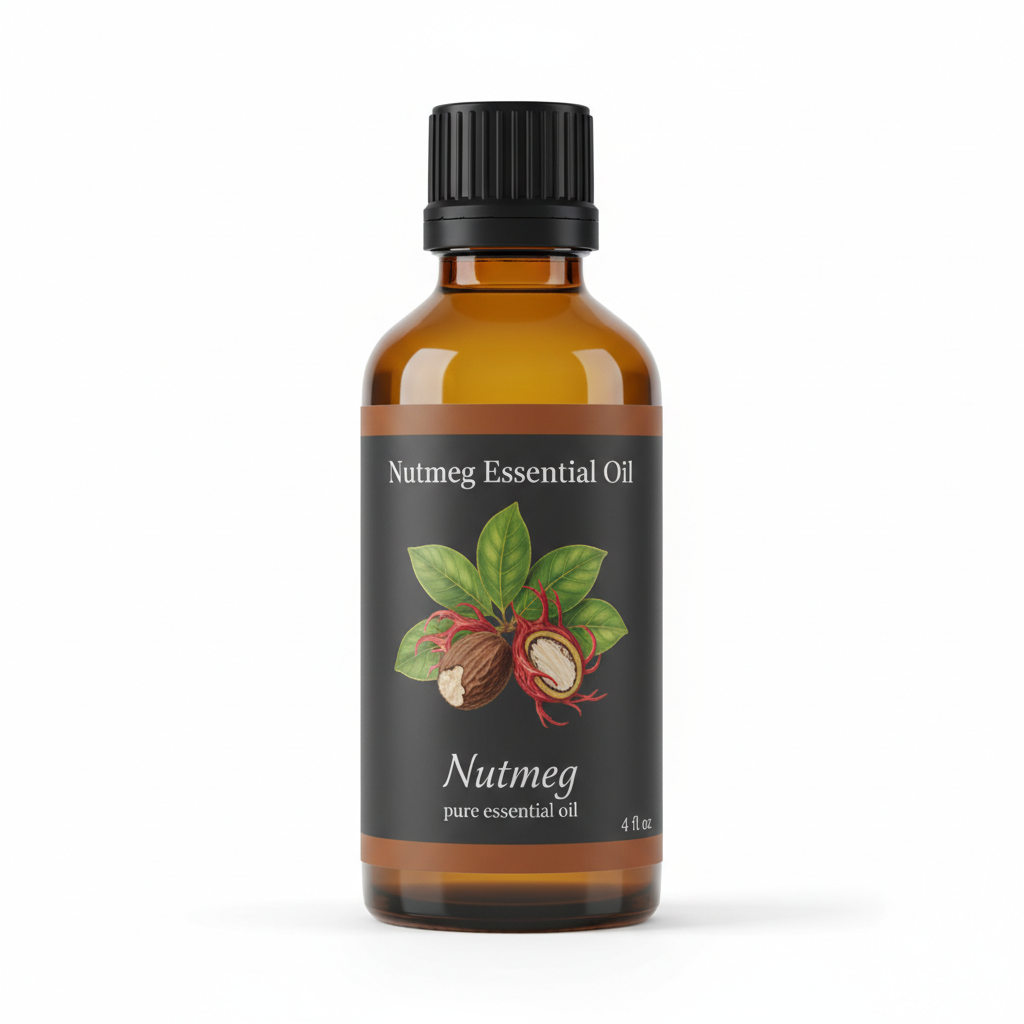
Nutmeg Essential Oil
Our own Nutmeg Essential Oil, in sizes from 0.5 oz to bulk.
From $10.99
Shop Now →Why we lead with the pharmacist
A pharmacist sees your whole medicine list, which a blog post never can. We sell a scented oil, and we would rather you spend five minutes at the counter than rely on anything we say here. It is the shortest route to an answer that fits your situation.
Why we say no with certain medicines
Our guidance is clear: if you take medication that acts on the central nervous system, do not use our nutmeg oil. That covers things prescribed for mood, sleep, seizures, attention or pain, and anything that is an MAO inhibitor. The reasoning is sound, even though the human data are thin. When a material shows activity on the enzymes that handle medicines, has a documented intoxication profile when swallowed and has no human studies on inhalation, the cautious step is to leave it out for the people who would be hurt most if we were wrong.
What the pharmacology literature does show
A 2021 literature review of myristicin, the best-known aromatic compound in nutmeg, reports two sets of findings. First, myristicin is "slightly capable of inhibiting" monoamine oxidase (MAO), an enzyme that breaks down serotonin and other neurotransmitters. Second, it shows some inhibitory effect on the human liver enzymes CYP2E1, CYP2C19 and CYP1A2, strongest on CYP1A2. Those enzymes clear many medicines from the body, so in principle blocking one can change how much of a drug stays around.
Three things keep this in proportion. The findings concern an isolated compound, not the oil or the spice. The review does not say which came from test tubes, animals or people. And nothing connects them to the small amount absorbed from a diffuser or a diluted skin product. The review names no specific drug interactions. It is a reason to ask, not a prediction.
Where swallowing comes in
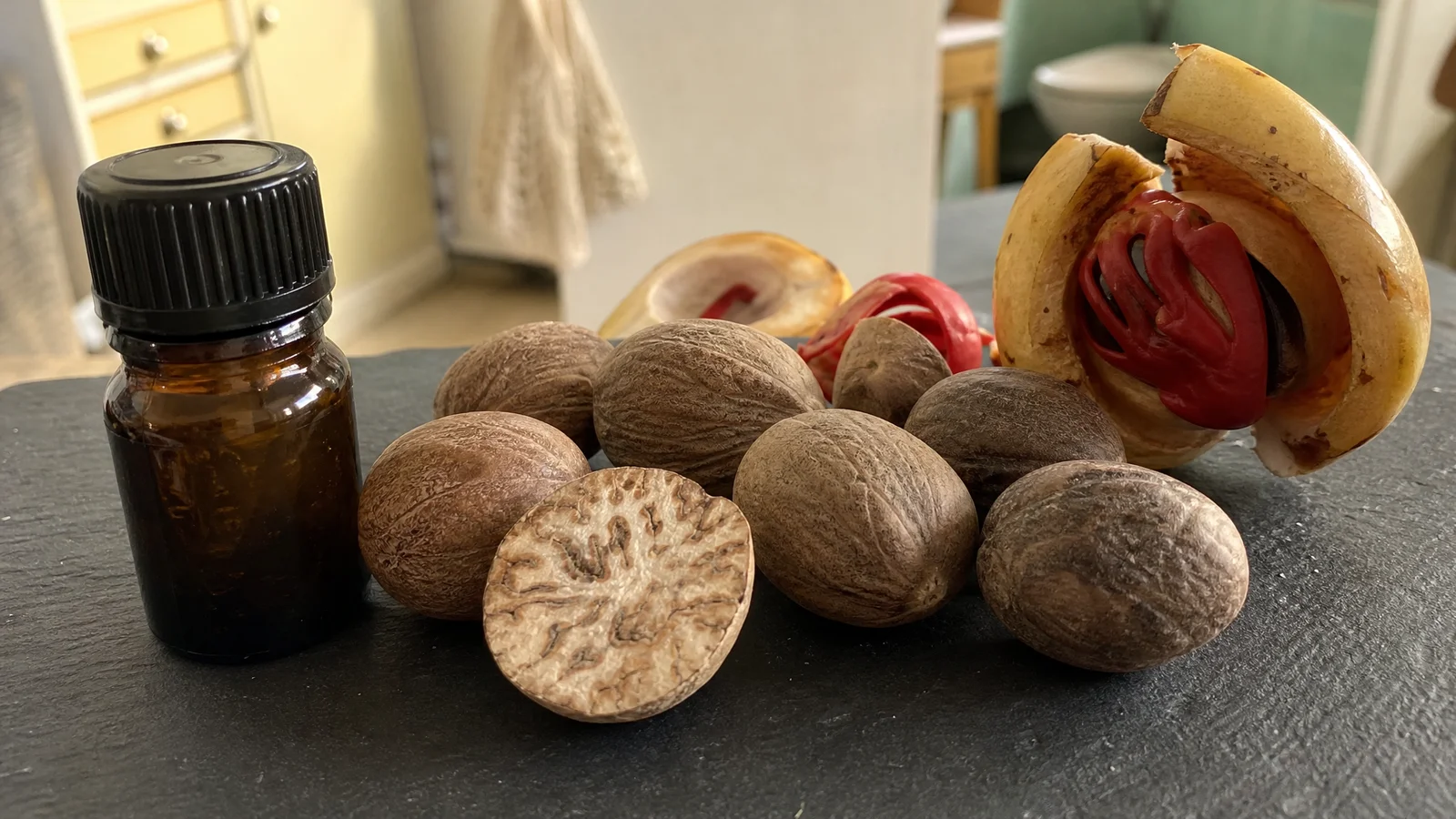
Most of what is known about nutmeg and the body comes from people swallowing the spice. The same review puts neuropsychological symptoms at around 10 to 15 g of nutmeg, or about 400 mg of myristicin. An Illinois Poison Center review of 32 nutmeg ingestion cases between 2001 and 2011 found that all four patients who were hospitalized had taken more than one substance, and that several intentional ingestions involved other drugs taken at the same time. The paper does not break cases down by spice or oil. We include it as a caution about mixing, not as a measure of what an oil does. Nutmeg oil is for scent only and should never be swallowed, which is why our post on ingestion exists.
The skin number
Our general skin guidance is to dilute to 0.5% to 2% in a carrier and to patch test first, and with nutmeg we stay at the 0.5% end. The reason is published limits. IFRA's standard lets natural extracts be used as long as total safrole in the finished product stays at or below 0.01%. EFSA reported safrole from 1.69% to 2.30% in seven nutmeg batches, so the safrole math gives an oil ceiling of roughly 0.43% to 0.59% in the finished product (our arithmetic). The Tisserand Institute's chart sets 0.8% for adults with East Indian oil. We do not call 2% safe. If you take a nervous-system medicine, are pregnant or nursing, or are choosing for a child, we would skip skin use entirely.
Making the conversation easy
A pharmacist conversation goes best when you arrive prepared. Take a photo of the bottle's label on your phone, and write your question in a single line before you go, something like: "I take these medicines and I would like to use a scented oil, diffused or diluted. Is there any reason not to?" Pharmacists answer short questions every day, and a clear one gets you a clear answer.
What to bring to a pharmacist
- The exact names and doses of your medicines, especially anything for mood, sleep, seizures, attention or pain.
- The product, nutmeg essential oil sold neat, and how you plan to use it (diffused, or diluted on skin).
- How often and how much. You can ask directly whether any of your medicines depends on CYP1A2, CYP2C19 or CYP2E1.
- Any other conditions, such as pregnancy, epilepsy or asthma, that a doctor should hear about first.
If anyone has swallowed the oil, call Poison Control at 1-800-222-1222 in the United States. We sell a scented oil, not a remedy, and we make no medical claims. For related reading, see our posts on pregnancy, children and reading a GC-MS report.
In the meantime
If you want a warm spice scent in the house while you wait for an answer, the kitchen is a good place to look. A pot of water with orange peel and a cinnamon stick, kept low and attended, gives you the feeling of autumn without opening a bottle of concentrated oil.
When a medicine is on your list, a short conversation with a pharmacist is worth more than any amount of reading, and leaving the bottle on the shelf costs you nothing.
Nutmeg Essential Oil
Nutmeg Essential Oil from our own shop, in sizes from 0.5 oz to bulk.
From $10.99
Shop Now →Sources & Further Reading
- Seneme EF et al., 2021. Pharmacological and Therapeutic Potential of Myristicin: A Literature Review. Molecules 26:5914
- Ehrenpreis JE et al., 2014. Nutmeg poisonings: a retrospective review of 10 years experience from the Illinois Poison Center, 2001-2011. Journal of Medical Toxicology 10:148-151
- EFSA FEEDAP Panel, 2023. Safety and efficacy of a feed additive consisting of an essential oil from the seeds of Myristica fragrans Houtt. (nutmeg oil) for all animal species (FEFANA asbl)
- IFRA, 2024. IFRA Standards - 51st Ammendment
- Tisserand Institute. Assessing the Safety of Essential Oils - the Nutmeg Case