Nutmeg Oil Lab Studies: What the MIC Numbers Mean
One drop of nutmeg oil weighs roughly 44 mg. That is simple arithmetic: the batch certificate of analysis we publish gives a relative density of 0.887, and a milliliter holds about 20 drops. It matters because every striking headline about nutmeg oil in a laboratory begins with a number like that, a tiny amount of oil stirred into a small volume of broth, and the number only makes sense once you can picture the dish it came from.
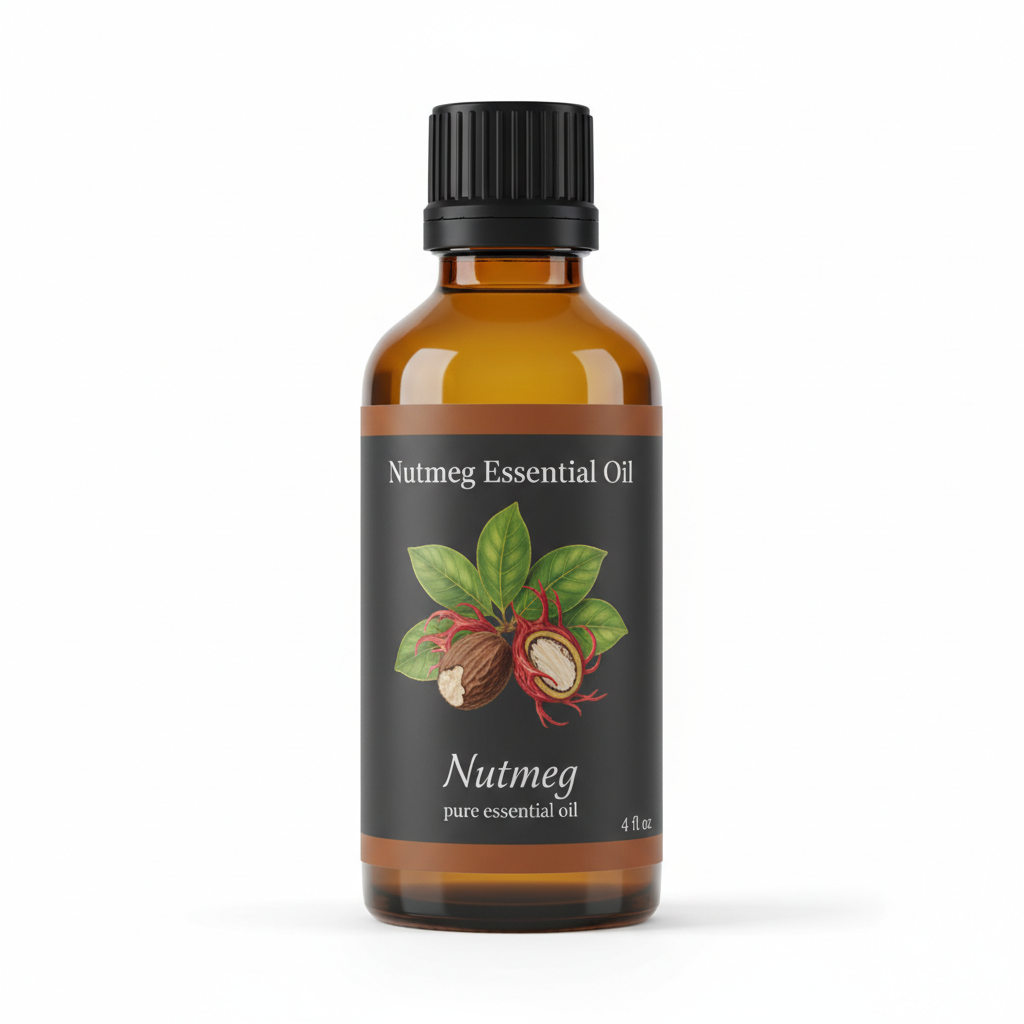
Nutmeg Essential Oil
Our own Nutmeg Essential Oil, in sizes from 0.5 oz to bulk.
From $10.99
Shop Now →What an MIC actually is
Most of these studies report a minimum inhibitory concentration, or MIC. It is the lowest concentration in a dilution series at which a particular lab organism fails to grow under that study's conditions. A related figure, the minimum bactericidal or fungicidal concentration, is the lowest one that kills the organisms when they are moved to fresh medium. Both belong to the strain, the medium and the way the oil was dispersed in water, because oil and water do not mix on their own.
The spread across plant oils is huge. In one well known survey of 52 plant oils and extracts, a few oils held back every test organism at 2% or less, while six did not hold back anything at that level, and in the finer broth tests the lowest MICs were 0.03% for thyme and 0.008% for vetiver, depending on the organism (Antimicrobial activity of essential oils and other plant extracts). Nutmeg was not among the headline results, which is a useful reminder that a lab number belongs to one oil, one organism and one set of conditions.
Two nutmeg papers, two very different pictures
A 2021 study put nutmeg oil against five clinical MRSA isolates and reported MICs of 0.098% by volume for four of them and 0.195% for the fifth (Inhibition of Bacterial Efflux Pumps by Crude Extracts and Essential Oil from Myristica fragrans Houtt. (Nutmeg) Seeds against Methicillin-Resistant Staphylococcus aureus). Taking our certificate's 0.887 as an illustration only, since that paper did not report its oil's density, 0.098% works out to roughly 870 micrograms per milliliter.
A 2023 paper tested nutmeg oil against seventeen reference strains by the broth microdilution method that EUCAST describes. Against several staphylococci, including an MRSA reference strain, the oil showed no MIC at the top of its 2000 mg/L series, and its lowest figure was 250 mg/L against one yeast, Candida parapsilosis (Essential Oils and Sustainability: In Vitro Bioactivity Screening of Myristica fragrans Houtt. Post-Distillation By-Products).
Both papers are about nutmeg oil and MRSA, yet they point in different directions. That is not a contradiction so much as a lesson in how much sits behind a number. The oils were different: the first had myristicin at about 2.5% of its profile, the second at about 13.4%. The strains, the inocula and the dispersal methods differed too. Neither figure transfers to the other, and neither transfers to your kitchen counter.
A dish is not a surface, a room or a person
A third example makes the same point. A 2026 study reported that one commercial nutmeg oil had an MIC of 500 micrograms per milliliter and a fungicidal concentration of 650 against a single type strain of Candida auris, using broth microdilution and no mammalian cells (Unmasking the Fungicidal Potency and Multifaceted Mechanisms of Nutmeg Essential Oil Against Candida auris). It is a careful piece of work, and it describes what happened in a plate, not what happens when oil is wiped on a countertop, diffused into a room or applied to skin. Reasoning from the arithmetic above, 500 micrograms per milliliter is about one drop in 90 ml of liquid, a concentration that simply does not occur when you scent a room or a soap.
So we treat these papers the way we would treat any interesting science about an ingredient we love: as a window into what the oil is made of, not as a promise. Nutmeg oil is rich in sabinene and the pinenes, with myristicin and a little safrole in the mix, and those constituents are why laboratories find it interesting. If that composition side appeals to you, our guide to reading a GC-MS report and our look at the aroma compounds behind the warm spice are the natural next stops.
Picturing the dish
When you meet a laboratory number, it helps to picture the setting. These experiments happen in small wells, with a tiny measured amount of oil and a carefully chosen organism. Then picture what you are actually doing with the bottle at home: a drop in a diffuser, a few drops in a carrier. They are different worlds, and a good habit is to ask whether the thing you are scenting looks anything like the dish.
How to read the next headline
When a page says nutmeg oil "kills" something, ask four questions. Which organism and strain? In what units, since percent by volume, mg/L and micrograms per milliliter are not interchangeable without a density? What was the oil's composition? And was it the oil, or an extract of the leftover material after distillation, as in several papers? Those four answers usually shrink a headline to its true size.
We sell nutmeg oil as an external aroma and craft ingredient, and we make no antimicrobial claim for it. If you need a disinfectant, look to a cleaning product labelled for that purpose, and for any infection, a pharmacist or doctor is the right call. If you want constituent data for the batch you are considering, ask us in writing through the contact page before you order.
Nutmeg Essential Oil
Nutmeg Essential Oil from our own shop, in sizes from 0.5 oz to bulk.
From $10.99
Shop Now →Sources & Further Reading
- Antimicrobial activity of essential oils and other plant extracts
- Inhibition of Bacterial Efflux Pumps by Crude Extracts and Essential Oil from Myristica fragrans Houtt. (Nutmeg) Seeds against Methicillin-Resistant Staphylococcus aureus
- Essential Oils and Sustainability: In Vitro Bioactivity Screening of Myristica fragrans Houtt. Post-Distillation By-Products
- Unmasking the Fungicidal Potency and Multifaceted Mechanisms of Nutmeg Essential Oil Against Candida auris