
What Is Nutmeg Oil? The Complete Guide to the Spice Rack's Distilled Core
Key Takeaways
- Nutmeg essential oil is steam-distilled from the dried kernel (or occasionally the outer mace layer) of Myristica fragrans, a tropical evergreen native to the Banda Islands of Indonesia.
- Its scent profile is warm, woody, and softly spiced, with a complexity that makes it prized in perfumery, cosmetic formulation, and home-scenting.
- The oil contains a compound called myristicin, which requires attention to dilution and usage guidelines. Always dilute properly before any skin contact.
- Nutmeg oil is distinct from nutmeg butter, nutmeg oleoresin, and the raw spice itself. Each has different chemistry and different applications.
- Quality varies significantly between suppliers. Knowing what to look for on a certificate of analysis can save you from an inferior product.
- This guide covers everything: botany, distillation, chemistry, scent, safe use, and sourcing. Use the table of contents to jump to what matters most to you right now.
What Nutmeg Oil Actually Is (And What It Isn't)
Nutmeg essential oil is a concentrated volatile aromatic liquid obtained by steam distilling the dried seed kernel of Myristica fragrans. It is not an infusion. It is not a carrier oil. It is not the spice ground up and dissolved in alcohol. The distillation process isolates only the volatile aromatic compounds from the kernel, leaving behind fats, starches, and non-volatile material. The result is a pale yellow to colorless liquid with a potency that bears almost no resemblance to the mild spice you might grate over a winter drink.
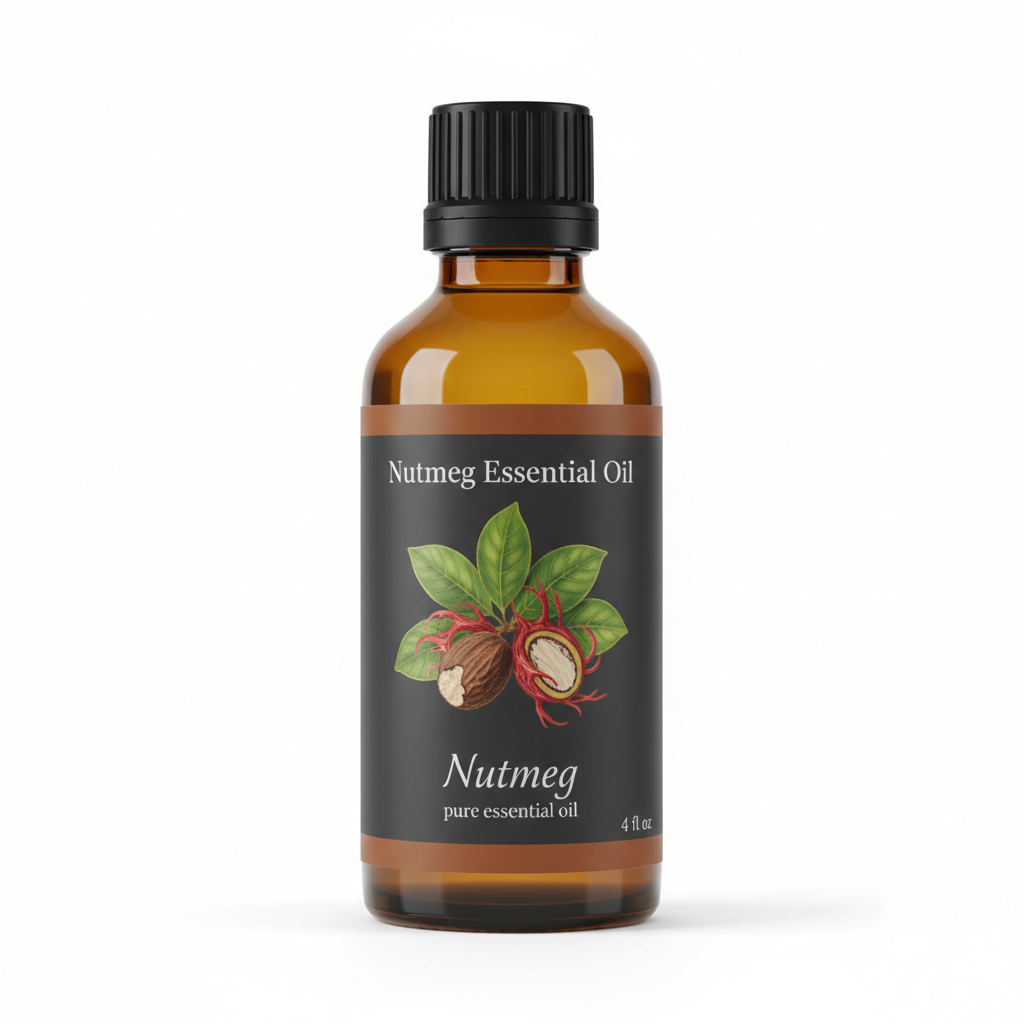
Nutmeg Essential Oil
Our own Nutmeg Essential Oil, in sizes from 0.5 oz to bulk.
From $10.99
Shop Now →This distinction matters more than many beginner guides acknowledge. When people search for "what is nutmeg oil," they sometimes find pages that conflate several entirely different products. Let's sort them out clearly.
Nutmeg Essential Oil vs. Nutmeg Butter
Nutmeg butter is a semi-solid fat extracted from the kernel through expression or solvent extraction. It is rich in myristic acid and behaves more like a cosmetic base than an aromatic ingredient. You use nutmeg butter in a body balm the way you would use shea butter. Nutmeg essential oil is the volatile aromatic fraction, used in drop-counts, not tablespoons.
Nutmeg Essential Oil vs. Nutmeg Oleoresin
An oleoresin is a combined extract that captures both volatile aromatic compounds and heavier resinous material. Oleoresins are common in the food industry because they deliver a fuller flavor profile. For aromatic and cosmetic use, the essential oil is the more refined and predictable material.
Nutmeg Essential Oil vs. Mace Essential Oil
Mace is the lacy red aril (the outer covering) of the nutmeg seed. It can be distilled separately to produce mace essential oil, which shares many aromatic compounds with nutmeg oil but has a somewhat brighter, more floral character. Both come from the same tree, Myristica fragrans. When a product is labeled "myristica fragrans oil" without further specification, check whether the source material was the kernel or the mace.
For the rest of this guide, "nutmeg oil" refers specifically to the steam-distilled essential oil from the dried kernel of Myristica fragrans. This is the version most widely available, most extensively studied in aromatic literature, and most commonly used in perfumery and cosmetic formulation. It is also the nutmeg essential oil we bottle and sell ourselves.
Botanical Origins: Myristica fragrans and the Banda Islands Legacy
Myristica fragrans is an evergreen tree in the family Myristicaceae. It grows to about 10 to 20 meters tall, produces glossy dark-green leaves, and bears small pale-yellow flowers. The fruit resembles a small apricot. When ripe, the outer flesh splits open to reveal the brilliant crimson mace wrapped around a hard brown shell. Inside that shell is the nutmeg kernel, which is what concerns us here.
The tree is dioecious, meaning individual trees are either male or female. Only female trees bear fruit, and growers have historically needed to maintain a proportion of males for pollination. Modern cultivation increasingly uses grafting techniques that allow some control over the sex ratio.
Where Nutmeg Grows Today
The Banda Islands of eastern Indonesia remain the historical heart of nutmeg cultivation. For centuries, this small archipelago in the Banda Sea was the only place on Earth where nutmeg grew, a geographic monopoly that made the spice extraordinarily valuable. The VOC (the Dutch East India Company) fought brutal campaigns to control these islands in the 17th century, and nutmeg's history is inseparable from the history of colonial violence and the spice trade.
Today, cultivation has spread far beyond its origin point. Grenada in the Caribbean is now one of the world's largest nutmeg producers and carries the nutmeg on its national flag. Sri Lanka, India (particularly Kerala and Tamil Nadu), Malaysia, and Papua New Guinea also produce significant quantities. The geographic origin of the nutmeg used for distillation can influence the essential oil's aromatic profile in subtle but measurable ways.
Cultivation and Harvest Basics
A nutmeg tree typically takes seven to nine years from planting to bear its first meaningful harvest. A healthy tree can remain productive for 60 years or more. The fruit is harvested by hand when the outer husk splits naturally. The mace is carefully removed, flattened, and dried separately. The kernel is dried over several weeks, either in the sun or over low heat, until the seed rattles inside its shell. At that point, the shells are cracked and the dried kernels are sorted for quality.
The drying process matters for essential oil quality. Kernels that are dried too quickly at high temperatures can lose volatile aromatic compounds before distillation even begins. Slow, careful drying preserves more of the complex aromatic profile that makes high-grade nutmeg oil worth the premium.
For a deeper look at the journey from kernel to bottle, see our guide on how nutmeg oil is made from the Myristica fragrans kernel.
How Nutmeg Essential Oil Is Made
The standard production method for nutmeg essential oil is steam distillation. The dried kernels are first ground or coarsely cracked to increase the surface area available to the steam. This is important: whole, intact kernels distill poorly because the steam cannot penetrate efficiently to reach the oil-bearing cells inside the tissue.
The Steam Distillation Process
In steam distillation, steam passes through the plant material. The heat and moisture cause the aromatic compounds to volatilize. These volatilized compounds travel with the steam into a condensation coil, where cooling converts everything back to liquid. The resulting liquid separates into two layers: the lighter essential oil and the heavier hydrosol (aromatic water). The essential oil is drawn off from the top.
For nutmeg, distillation times vary by producer but typically run between four and eight hours. Shorter distillations tend to yield a top-heavy aromatic profile rich in lighter monoterpene compounds. Longer distillations bring out heavier sesquiterpene constituents that contribute depth and warmth. Some producers fraction their distillation, collecting different portions separately and then blending to hit a target chemical profile.
East Indian vs. West Indian Nutmeg Oil
Two broad designations appear frequently in supplier catalogues: East Indian nutmeg oil and West Indian nutmeg oil. East Indian refers to material sourced from Indonesian or Sri Lankan production. West Indian refers primarily to Grenadan nutmeg. The two types share the same base chemistry but often differ in the relative proportions of key compounds.
West Indian (Grenadan) nutmeg oil is generally described by perfumers as slightly softer and more refined in its spice note. East Indian types tend to be more assertive and camphoraceous in the top notes. Neither is inherently superior; the preference depends on the application.
Yield and Economics
The essential oil yield from nutmeg kernels is roughly 5 to 15 percent by weight, which is relatively generous compared to many essential oils (rose, for example, yields a fraction of a percent). This relatively high yield is one reason nutmeg oil is not among the most expensive essential oils on the market. However, significant price variation still exists between producers, reflecting differences in kernel quality, distillation care, and the overall supply chain.
A very cheap nutmeg oil should prompt scrutiny. The economics of distillation set a floor on what a genuine, quality product should cost. Prices well below that floor often signal adulteration with cheaper materials, a topic we return to in the buying guide section.
Chemical Composition: What's Inside the Bottle
Essential oils are not single compounds. They are complex mixtures of dozens or even hundreds of individual molecules. Nutmeg essential oil is no exception. Understanding its main chemical classes helps explain both its aromatic character and the safety considerations that apply to it.
Major Chemical Families
| Chemical Class | Key Compounds | Typical Percentage Range | Aromatic Contribution |
|---|---|---|---|
| Monoterpene hydrocarbons | Sabinene, alpha-pinene, beta-pinene, camphene | 60–80% | Fresh, piney, bright top notes |
| Oxygenated monoterpenes | Linalool, terpinen-4-ol, alpha-terpineol | 5–15% | Floral, slightly woody mid-notes |
| Phenylpropanoids | Myristicin, elemicin, safrole | 5–20% | Warm, slightly earthy, characteristic "nutmeg" depth |
| Sesquiterpenes | Beta-caryophyllene, ar-curcumene | 2–8% | Woody, warm, grounding base notes |
Sabinene: The Dominant Monoterpene
Sabinene is often the single largest component in nutmeg oil, comprising anywhere from 20 to 50 percent of the total in many commercial samples. It contributes the fresh, slightly peppery-woody quality that appears in the top notes. Sabinene is also found in black pepper oil, carrot seed oil, and tea tree, which hints at the family of aromas that nutmeg shares with those materials.
Myristicin: Important but Misunderstood
Myristicin is the compound that gets the most attention in safety discussions about nutmeg oil, and understandably so. It is a phenylpropanoid, a chemical class that tends to be more biologically active than simple terpenes. Myristicin is present in varying amounts depending on origin and distillation method, typically between 5 and 15 percent in well-produced oils, though some samples test higher.
Concerns about myristicin are rooted in the documented effects of consuming very large quantities of raw nutmeg powder, which contains significantly more myristicin per gram than the essential oil (since distillation does not yield a 1:1 representation of all compounds). This is a context-dependent conversation. For external aromatic and cosmetic use at proper dilution levels, the relevant safety guidance is about dilution and application method, not about myristicin in isolation. We cover this in detail in the safety section below, and our dedicated piece on nutmeg oil safety basics, myristicin, dilution, and pets goes further still.
Elemicin and Safrole
Elemicin is another phenylpropanoid present in smaller quantities. It contributes a slightly warm, almost balsamic character to the oil's mid-profile. Safrole is present in trace amounts in many nutmeg oils. Its presence or absence, and at what level, can be a point of scrutiny on a certificate of analysis for certain commercial applications.
Why Chemical Composition Varies
The chemical composition of nutmeg oil is not fixed. It shifts based on the geographic origin of the kernels, the age and variety of the trees, the ripeness at harvest, the drying method, and the distillation parameters. This is why a certificate of analysis from a reputable supplier is not just a formality. It is the only objective evidence you have about what is actually in a specific batch of oil.
Two bottles labeled "nutmeg essential oil" from different suppliers could have meaningfully different aromatic profiles and myristicin percentages. For home aromatic use, the difference may be noticeable mostly in smell. For formulation work where you are targeting a specific scent profile or working within safety guidelines for a leave-on cosmetic, those differences matter considerably more.
Scent Profile and Aromatic Character
Nutmeg essential oil smells like the spice it comes from, but not in the way that statement might lead you to expect. The dried spice on your kitchen shelf has had its most volatile aromatic compounds muted by time, air exposure, and the masking effect of the non-aromatic solid matrix it's suspended in. The essential oil presents those same aromatic compounds in concentrated, undiluted form, without the woody powder backdrop.
The overall impression is warm and spiced, but it opens with a freshness that surprises many people on first encounter. There is a piney, almost green quality in the first moments of smelling it, contributed by sabinene and the alpha-pinene fraction. This gives way quickly to the rounder, more recognizable nutmeg warmth that most people associate with the spice.
Aromatic Notes Broken Down
- Top notes: Bright, slightly camphorous, fresh pine and green spice. These are the first impressions and they fade relatively quickly on a smell strip or in a diffuser.
- Heart notes: The characteristic warm spice body that reads unmistakably as nutmeg. There is sweetness here, but it is not sugary. A subtle earthy quality also emerges from the phenylpropanoid fraction.
- Base notes: Woody, softly balsamic depth contributed by sesquiterpenes. This lingers longest and is what gives nutmeg oil its staying power in a blend.
How Nutmeg Oil Behaves in Blends
Nutmeg oil is a natural team player. Its warm spice character supports and enhances other aromatic materials without overwhelming them, provided it is used judiciously. It is often classified as a middle-to-base note material in perfumery, though its bright top-note fraction means it also contributes some initial lift.
Nutmeg oil blends particularly well with:
- Other warm spices: clove bud, black pepper, cardamom, cinnamon (used carefully given cinnamon's own sensitization considerations)
- Woods: cedarwood, sandalwood, vetiver
- Citrus: sweet orange, mandarin, bergamot (the citrus brightness contrasts well with the warm spice body)
- Resins and balsams: frankincense, benzoin, labdanum
- Florals used sparingly: ylang ylang, geranium
In home-scenting applications, a small amount of nutmeg oil in an autumnal or winter diffuser blend can anchor the entire composition and give it a sense of depth that purely citrus-forward or floral blends lack. For a full exploration of how the scent evolves and how it performs in different formats, see our guide on what nutmeg oil smells like.
Comparing Nutmeg Oil to Related Spice Oils
| Oil | Dominant Character | Shared Notes with Nutmeg Oil | Key Difference |
|---|---|---|---|
| Black pepper | Sharp, dry, peppery | Piney freshness (sabinene) | Less warm, more assertively spicy-sharp |
| Cardamom | Green-spicy, slightly floral | Aromatic warmth, hint of camphor | Fresher, more eucalyptus-adjacent |
| Clove bud | Intensely eugenol-dominated, sweet-spicy | Warm spice body | Much heavier eugenol character, stronger sensitization risk |
| Mace (from the same fruit) | Warm spice with floral lift | Nearly identical compound family | Slightly brighter, less earthy than the kernel oil |
Uses and Applications: Cosmetic, Aromatic, and Craft
Nutmeg essential oil has a long history in perfumery and flavoring. In the context of this site, our focus is its cosmetic and aromatic applications, from diffuser blends and room sprays to massage oil formulations and personal care products.
Diffuser Blends and Home Scenting
This is probably the most accessible entry point for most people. A few drops of nutmeg oil in an ultrasonic diffuser can shift the aromatic atmosphere of a room toward something warmer and more grounded. It works particularly well in autumn and winter blends, and in spaces where you want to create a sense of comfort and quiet focus.
A starting point for a simple diffuser blend:
- 3 drops sweet orange
- 2 drops cedarwood
- 1 drop nutmeg oil
Nutmeg oil is potent aromatically, so err toward using less rather than more, especially when first experimenting. One drop more than the right amount is more disorienting than one drop less.
Perfumery and Fragrance Blending
In professional perfumery, nutmeg oil appears in oriental, spicy, and woody fragrance families. It is used as a modifier: a material that rounds out and enriches the character of a blend rather than necessarily defining it. Some well-known classic fragrances use nutmeg-family materials in their heart-to-base transition for precisely this reason.
For amateur blenders, nutmeg oil is worth keeping in the collection specifically because of this supporting role. It can rescue a blend that feels thin or disconnected by providing a warm, aromatic spine that ties components together.
Cosmetic Formulation
Nutmeg oil appears in various cosmetic formulations, particularly those positioned around warming or grounding skin-care rituals. It is found in some facial serums, body oils, and hair care products. In these applications, the key considerations are dilution (addressed in detail in the next section) and stability: as an oxidation-prone essential oil, nutmeg oil should be stored properly and used within its shelf life to avoid using degraded material on skin.
In massage oil blends, nutmeg oil's warm aromatic profile makes it a natural fit. A typical usage rate in a massage oil would be within established dilution guidelines for the intended application, which we cover in the safety section.
Candle and Craft Applications
Nutmeg oil can be incorporated into candle-making, soap, and other craft projects. Note that essential oils in candle wax behave differently from fragrance oils. The flash point of nutmeg oil is an important consideration for candle safety (typically around 45 to 50 degrees Celsius, though this varies by batch). For soap-making, nutmeg oil's aroma can fade during the saponification process, so blending with more stable aromatic materials is a common approach.
For a comprehensive list of creative applications, our guide covering 18 warm ideas for home scenting and craft with nutmeg oil goes into step-by-step detail.
Historically Documented Uses
Nutmeg and its derived materials have a long history in traditional aromatic and cosmetic practices across multiple cultures. Indonesian jamu traditions have incorporated nutmeg-derived preparations for centuries. Ayurvedic traditions reference nutmeg (called jaiphal in Sanskrit contexts) as an aromatic ingredient. European herbalists from the medieval period through the 19th century documented nutmeg extensively.
These historical references are worth knowing for context, but they describe practices with the whole spice or unrefined preparations, not the modern concentrated essential oil. The essential oil is a product of relatively modern distillation technology. Treating historical spice references as equivalent to guidance for using the concentrated oil would be a category error.
For more on what research and traditional knowledge together suggest about nutmeg oil's characteristics, see our piece on nutmeg oil benefits: an honest look at what the warm spice note offers.
Safety, Dilution, and Who Should Avoid It
Nutmeg essential oil is safe for its intended cosmetic and aromatic uses when used appropriately. The emphasis is on "appropriately." This section covers what that means in practical terms. For a more detailed exploration, see our full guide on nutmeg oil safety basics covering myristicin, dilution, and pets.
Important: The information in this section is educational and does not constitute professional advice. Consult a qualified healthcare provider before using any essential oil if you have existing health concerns, are pregnant or nursing, or are formulating products for clinical use.
Dilution: The Most Important Practice
Essential oils should never be applied undiluted (neat) to skin. This applies to virtually all essential oils, and nutmeg oil is no exception. The concentrated phenylpropanoid content (myristicin, elemicin) makes proper dilution particularly important for this oil.
Standard dilution guidelines for adults (using a carrier oil such as jojoba, sweet almond, or fractionated coconut oil):
- Body massage or body oil: 1 to 2% dilution. This means 1 to 2 drops of essential oil per teaspoon (5 ml) of carrier oil.
- Leave-on facial products: 0.5% or lower. Facial skin is more sensitive than body skin, and leave-on products have prolonged contact time.
- Rinse-off products (soap, shampoo): Up to 2 to 3%, but note that the aromatic benefit of essential oils in rinse-off formats is limited by the brief contact time.
- Diffuser use: Follow your diffuser manufacturer's guidance. For an average room, 3 to 6 total drops in a standard ultrasonic diffuser is a reasonable starting point. Ensure the space is ventilated and do not run a diffuser continuously for hours at a time.
Patch Testing
Before using any new essential oil in a leave-on cosmetic application, perform a patch test. Apply a small amount of your properly diluted preparation to the inner forearm or the inside of the elbow. Leave it in place for 24 hours without washing. If you notice any redness, itching, or irritation, discontinue use of that formulation.
Who Should Exercise Extra Caution
- Pregnant and nursing individuals: The safety of many essential oils, including nutmeg, has not been studied in pregnancy. The general guidance from aromatherapy professional bodies is to avoid or minimize essential oil use during the first trimester and to consult a healthcare provider before use throughout pregnancy. This is a precautionary position, not a statement of proven risk.
- Young children: Essential oils are generally not recommended for infants and toddlers without specific professional guidance. Many standard adult dilution rates are too strong for young children, and some essential oil components require additional care around children. Keep all essential oils stored securely away from children.
- Individuals with sensitive skin: If you have a history of skin sensitivities or reactions to fragrance materials, introduce nutmeg oil very cautiously and at lower dilution rates.
Pets
Essential oils can be harmful to companion animals, particularly cats and dogs. Cats are especially vulnerable because they metabolize certain aromatic compounds differently from humans. Diffusing nutmeg oil in a space shared with pets should be approached with care: always ensure the animal can leave the room freely, do not diffuse in small enclosed spaces with animals present, and discontinue use if you observe any signs of distress in your pet. Never apply essential oils to pets without explicit guidance from a veterinarian.
Shelf Life and Oxidation
The monoterpene-rich composition of nutmeg oil means it is susceptible to oxidation over time. Oxidized essential oils can be more likely to cause skin reactions than fresh oil from the same source. Store nutmeg oil in dark glass bottles in a cool location, away from light and heat. Keep the cap tightly closed when not in use. Most nutmeg oils have a useful shelf life of two to three years from the distillation date when stored correctly. If your oil has developed a noticeably different smell (sharper, more resinous, or "off" in some way) compared to when you first opened it, it may have begun to oxidize.
Inhalation and Ventilation
Prolonged, intensive inhalation of high concentrations of any essential oil is not recommended. When diffusing, run your diffuser in intervals (30 minutes on, 30 minutes off is a commonly suggested approach) rather than continuously. Keep rooms ventilated. If you experience headache, eye irritation, or any discomfort while diffusing, turn off the diffuser and ventilate the space.
How to Buy Nutmeg Essential Oil: Quality Markers and Red Flags
The essential oil market has a quality problem. Adulteration, mislabeling, and inconsistent sourcing are documented issues across the industry. Nutmeg oil is not the most commonly adulterated essential oil, but its relatively moderate price point means there is still an incentive to cut or substitute inferior materials. Knowing how to evaluate what you are buying is a practical skill.
What Good Labeling Looks Like
A quality nutmeg essential oil should be labeled with all of the following:
- Botanical name: Myristica fragrans. If the label says only "nutmeg oil" without the Latin name, that is a basic gap in transparency.
- Plant part: Should specify "seed" or "kernel." If the source was mace (the aril), it should say so, since mace oil has a distinct profile.
- Country of origin: Indonesia, Grenada, Sri Lanka, India, or another documented producing country.
- Extraction method: Steam distilled.
- Lot or batch number: This allows you to trace a specific batch if needed.
- Distillation or fill date: Helps you assess freshness.
The Certificate of Analysis
A certificate of analysis (COA) is a document from a third-party laboratory that reports the GC/MS (gas chromatography/mass spectrometry) profile of a specific batch of oil. It lists the major compounds and their percentages. Reputable suppliers make COAs available, either automatically with purchase or on request.
What to look for in a nutmeg oil COA:
- Sabinene should typically be among the dominant compounds (often 20 to 50%).
- Alpha-pinene and beta-pinene should be present.
- Myristicin should be listed. Its absence from a COA could indicate either a very low-myristicin variety (possible but worth querying) or an incomplete analysis.
- The total should add up to close to 100%. Large gaps in the accounting can indicate incomplete analysis or the presence of unidentified compounds.
Red Flags When Buying
- Price that seems too good: Genuine nutmeg oil distillation has real costs. Very cheap oils frequently reflect either adulteration (cutting with cheaper materials), the use of low-grade feedstock, or both.
- No botanical name on the label: A basic transparency failure.
- No COA available: Not disqualifying for every single small artisan producer, but for any volume purchase or formulation work, you should be able to get this data.
- Smell that is sharply camphoraceous and flat: A very camphorous, one-dimensional smell with little warmth can indicate either a poor-quality distillation or a material that has been partially reconstructed with synthetic components.
- "Fragrance oil" or "perfume oil" labeling: These are not essential oils. They may contain synthetic aromatic compounds. They are not the same product and should not be substituted for each other in skin applications.
Organic and Wildcrafted Considerations
Certified organic nutmeg oil is available and may be worth seeking out if minimizing pesticide residue is a priority for your formulation. The certification adds cost, and the certification bodies vary by country of origin. Check which certification standard the organic claim refers to.
"Wildcrafted" nutmeg oil is less common given that nutmeg is primarily a cultivated tree crop rather than a wild-harvested species. Use of this term should prompt a question about what it actually means in the supplier's context.
Building a Relationship with a Supplier
For serious aromatic work or formulation, the single best investment you can make is finding a supplier who communicates openly about their sourcing, provides batch-specific COAs, and is willing to answer questions about their supply chain. This is more valuable than any individual piece of quality assurance, because a supplier with that level of transparency is systematically less likely to ship you something problematic.
Small artisan distillers, direct-from-farm operations, and established specialist aromatics suppliers each have different strengths. Large marketplace platforms carry enormous variation in quality within the same search results. Applying the checklist above to any purchase, regardless of channel, is the most reliable approach.
How Much Do You Actually Need?
Nutmeg oil is potent and a small quantity goes a long way. For general home aromatic use and experimental blending, a 5 ml bottle will last most people a long time. For formulation work where you are making batches of products, calculate your expected usage based on your dilution rate and batch size before buying in larger volumes. Buying large quantities of an essential oil that subsequently oxidizes before use is a false economy.
For answers to common questions about sourcing, storage, and usage rates, our nutmeg essential oil FAQ covering 15 common questions addresses the most frequent points of confusion in one place.
Bringing It Together
Nutmeg essential oil is one of those materials that rewards attention. It has a history richer than almost any other aromatic ingredient. Its chemistry is genuinely complex. Its scent has layers that reveal themselves differently in different blending contexts. And its safety profile, while requiring some care and respect, is manageable with basic knowledge and consistent dilution practice.
The journey from a kernel grown on a small island in eastern Indonesia to the amber glass bottle on your shelf is longer and more layered than the price tag usually suggests. Understanding that journey, knowing the botany, the distillation, the chemistry, and the quality markers, puts you in a far stronger position to use the material well and to recognize when you have something worth using.
Explore the sections above in whatever order serves your current interest. If you are new to nutmeg oil, the scent and safety sections are the best starting points. If you are formulating or sourcing at volume, the chemistry and buying guide sections will be most useful. The internal links throughout this guide will take you deeper into each topic when you are ready.