
What Does Nutmeg Oil Smell Like? A Full Warm-Spice Scent Profile
Nutmeg essential oil occupies a peculiar and underappreciated corner of the aromatic world. It is spicy without being sharp, warm without being heavy, and woody enough to anchor a blend without dominating it. If you have ever opened a fresh jar of ground nutmeg and paused before adding it to a recipe, you already have a rough introduction to the nutmeg oil smell. The essential oil version, however, is considerably more concentrated, more nuanced, and worth understanding on its own terms before you reach for the dropper.
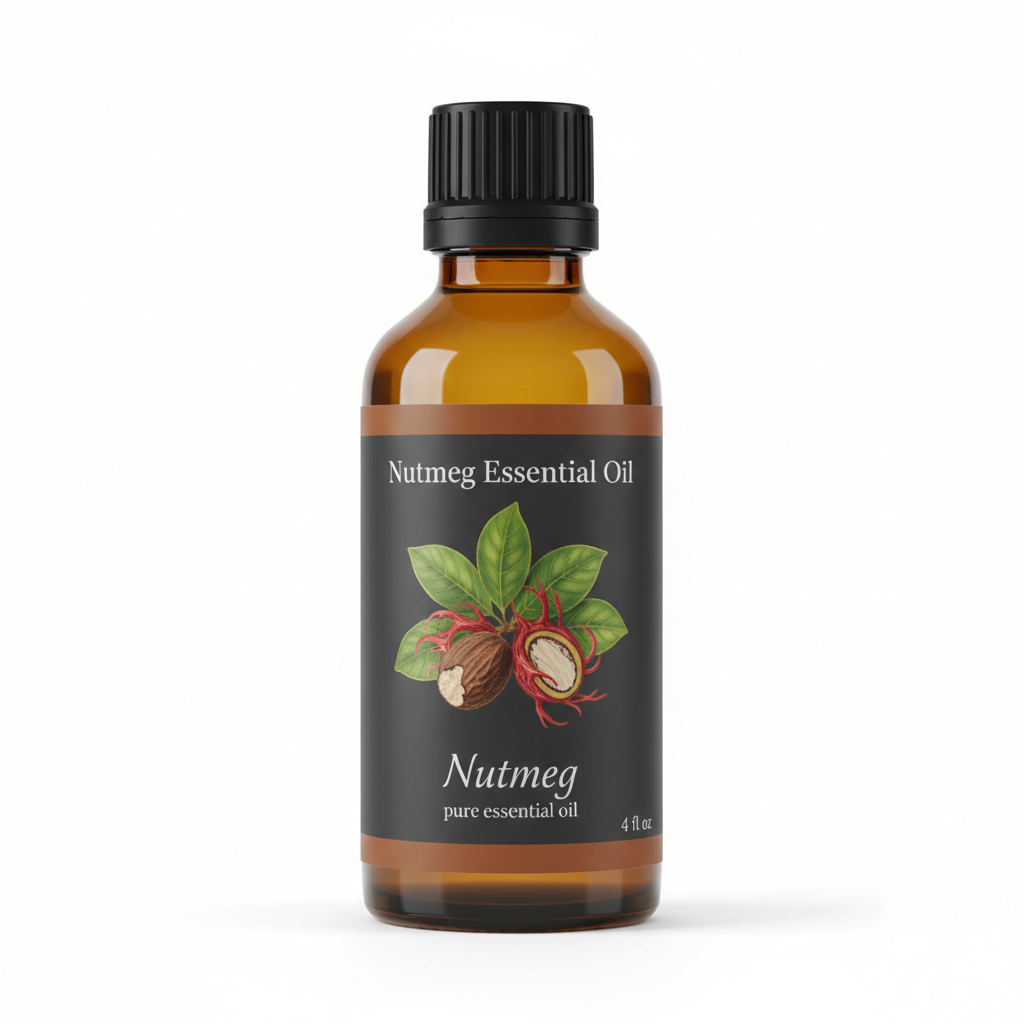
Nutmeg Essential Oil
Our own Nutmeg Essential Oil, in sizes from 0.5 oz to bulk.
From $10.99
Shop Now →This deep-dive covers what that scent is actually made of at a molecular level, what researchers have observed about its key compounds, how sourcing affects the aroma you ultimately experience, and what safety considerations belong in any honest conversation about this oil.
The First Impression: How Perfumers and Aromatherapists Describe the Nutmeg Scent
Describing what nutmeg oil smells like is a bit like describing a chord rather than a single note. The opening is bright and slightly sharp, with a green, almost camphorous edge that softens quickly. Within a minute or two on skin or a test strip, the heart of the oil emerges: a rich, dry-spice warmth that most people associate immediately with baked goods, mulled drinks, and winter kitchens.
Perfumers typically place nutmeg oil in the middle-note category, though it can behave as a top note in its opening moments. In fragrance families, it sits comfortably within the oriental and spicy categories, and it pairs with an impressive range of partners: citrus oils (bergamot, sweet orange), resins (frankincense, labdanum), woods (cedarwood, sandalwood), and other kitchen spices (clove bud, black pepper, cardamom).
The dry-down is where nutmeg becomes genuinely interesting. A faint, almost earthy woodiness lingers, which is quite different from the sweetness people sometimes expect after smelling ground nutmeg powder. The essential oil is drier and more complex than the spice on your shelf.
Chemical Composition: What Actually Creates That Smell
The nutmeg scent is not a single molecule. It is the combined result of dozens of volatile compounds that interact with each other and with the chemistry of your skin. Understanding the major players helps explain why different nutmeg oils can smell noticeably different from one another.
Monoterpene Hydrocarbons: The Bright, Fresh Foundation
The largest chemical fraction in most nutmeg essential oils is made up of monoterpene hydrocarbons. Alpha-pinene and beta-pinene together often account for 15 to 30 percent of the oil's composition, depending on origin and distillation method. These compounds are responsible for that brief, resinous, slightly piney freshness you notice in the first moments of smelling the oil. Sabinene is typically the dominant single compound, frequently comprising 20 to 50 percent of the total, and it contributes a soft, woody-spice quality that forms the backbone of the nutmeg oil smell.
Other monoterpenes present in meaningful quantities include limonene (which adds a faint citrus lift), gamma-terpinene, and terpinen-4-ol. The specific ratios of these compounds shift based on where the nutmeg was grown and how the oil was extracted. For a detailed look at the extraction process itself, see our guide on how nutmeg oil is made from the Myristica fragrans kernel.
Oxygenated Compounds: Depth and Warmth
The warming, slightly sweet quality of the nutmeg scent comes primarily from its oxygenated fraction. Safrole, eugenol, and isoeugenol are phenylpropanoids that appear in smaller but perceptually significant quantities. Eugenol, which many people associate with clove, adds a gentle spice warmth. These compounds are far less abundant in nutmeg oil than in clove bud oil, which is why nutmeg smells warmer than clove but considerably less intense.
Linalool and terpinen-4-ol contribute a soft, slightly floral and herbaceous character that prevents the oil from smelling purely culinary. This is part of why nutmeg oil works in fine fragrance contexts where ground nutmeg spice would simply smell like food.
Myristicin: The Compound That Demands Attention
No discussion of nutmeg oil's chemistry is complete without addressing myristicin. This phenylpropanoid ether typically makes up between 2 and 13 percent of the oil, varying considerably by origin. Indonesian nutmeg oils tend to run higher in myristicin; East Indian varieties, particularly from Kerala, often contain lower concentrations.
Myristicin contributes relatively little to the scent profile directly, but it is the compound responsible for the most significant safety considerations associated with this oil. Research suggests it is the primary bioactive compound of concern at elevated exposures, and it is why nutmeg oil requires careful handling and appropriate dilution. We address this in considerably more detail in our article on nutmeg oil safety basics, myristicin, dilution, and pets.
Two Species, Two Scent Profiles
Most commercial nutmeg oil comes from Myristica fragrans, the species native to the Banda Islands of Indonesia and long cultivated across tropical Asia and the Caribbean. A second species, Myristica malabarica (sometimes called Bombay nutmeg), also yields an essential oil, but it has a noticeably different composition and is generally considered inferior for aromatic use. The two smell quite different.
Myristica fragrans oil has the balanced warm-spice profile described throughout this article. Myristica malabarica oil tends to smell more camphorous and less rounded, with a higher proportion of compounds like camphene. Reputable suppliers will specify the species clearly. If a listing simply says "nutmeg oil" without species identification, that is a quality indicator worth paying attention to.
East Indian vs. West Indian Nutmeg Oil: Does Origin Change the Smell?
Yes, noticeably. Nutmeg oil is produced in two broad regional categories, and experienced users can often distinguish them by scent alone.
| Origin | Key Aroma Character | Typical Sabinene % | Typical Myristicin % |
|---|---|---|---|
| East Indian (Indonesia, Kerala) | Spicier, more resinous, slightly sharper opening | 30 to 50% | 5 to 13% |
| West Indian (Grenada) | Softer, slightly sweeter, more rounded dry-down | 20 to 35% | 2 to 6% |
West Indian nutmeg oil from Grenada is often preferred in fine fragrance work because its softer profile blends more easily. East Indian oils tend to project more boldly, which makes them popular in scented candles and diffuser blends where you need presence in a larger space.
What Research Suggests About the Key Compounds
The essential oil research literature on Myristica fragrans is reasonably substantial, though much of it was conducted in laboratory settings rather than in human trials. A few consistent observations emerge.
Research suggests that sabinene-dominant nutmeg oils have a characteristic woody-spice aroma profile that holds relatively stable across different distillation batches, making sabinene percentage a useful quality marker for buyers. Studies examining the volatile profile of the oil have consistently identified terpinen-4-ol as a significant contributor to the herbaceous mid-note quality, and some researchers have noted that oils with higher terpinen-4-ol concentrations tend to smell more complex and less one-dimensional.
Gas chromatography and mass spectrometry (GC-MS) analysis has been used in multiple published studies to map the composition of nutmeg oils from different geographic origins. These studies collectively suggest that geographic origin is a more reliable predictor of chemical profile than brand or price point, at least among unadulterated oils. A 2016 study published in the Journal of Essential Oil Research observed meaningful compositional differences between Indonesian and Indian nutmeg oils, reinforcing the relevance of sourcing transparency for buyers.
Research involving the individual compounds found in nutmeg oil (sabinene, alpha-pinene, eugenol, and others) has observed various properties in laboratory contexts, but these findings describe isolated compounds under controlled conditions. They do not translate directly into claims about what the whole oil does in everyday use.
Quality Indicators: What to Look for When Buying
The nutmeg oil market includes a wide range of quality levels, and the difference in smell between a high-quality oil and a poor one is immediately apparent. Here is what to look for.
- Species clarity. The label should state Myristica fragrans, not just "nutmeg oil."
- Country of origin. Reputable suppliers list this. Grenada, Indonesia (specifically Banda Islands or Sulawesi), and Kerala, India, are all credible sources.
- Extraction method. Steam distillation of the seed (kernel) is standard for aroma quality. CO2 extracts exist and have a different, richer profile. Cold-pressed expressions are less common and less stable.
- GC-MS report availability. A supplier willing to share batch-specific GC-MS data is demonstrating a commitment to transparency. You should see sabinene as the dominant compound, followed by alpha-pinene, beta-pinene, and terpinen-4-ol.
- Colour and appearance. High-quality nutmeg oil is colourless to pale yellow and watery in viscosity. Yellowing or thickening can indicate age or adulteration.
- Scent consistency. Fresh, high-quality oil should smell complex and layered from the first sniff. A flat, purely culinary, or camphorous-only scent may indicate adulteration with cheaper oils or a inferior species.
For a broader grounding in what this oil is and where it comes from historically and botanically, the complete guide to nutmeg oil covers the full picture from plant to bottle.
Safety Profile: An Honest Overview
Nutmeg essential oil is safe for cosmetic and aromatic use when handled correctly. The emphasis on "correctly" matters here.
The International Fragrance Association (IFRA) has set usage guidelines for nutmeg oil in leave-on skin products. A general working guideline for leave-on applications is a maximum dilution of around 0.5 to 1 percent, though the specific limit varies by product category. Rinse-off products and diffuser blends have more flexibility, but starting with lower concentrations is always the sensible approach.
Nutmeg oil is considered a potential skin sensitiser in some individuals. Patch testing before any leave-on application is strongly recommended: apply a diluted preparation (1 percent or less in a carrier oil) to the inner forearm, leave it for 24 hours, and watch for any redness or irritation before wider use.
Myristicin content is the central safety consideration. At normal cosmetic dilutions, this is not a practical concern for most adults. However, the oil should not be used undiluted, should be kept away from children and pets, and should be avoided during pregnancy. People taking medications or managing health conditions should speak with a qualified healthcare provider before incorporating any essential oil into their routine.
Phototoxicity is not a documented concern with nutmeg essential oil (it is not a citrus oil), but general caution with sun exposure after any leave-on application is a reasonable habit.
Using the Scent: Practical Aromatic Applications
Knowing what nutmeg oil smells like is only useful if you know where that smell fits.
In a diffuser, nutmeg oil works particularly well in autumn and winter diffuser blends. Try 2 drops of nutmeg alongside 3 drops of sweet orange and 2 drops of cedarwood for a warm, grounding room fragrance suited to evening wind-down rituals.
In skincare, the oil is most often used in small amounts within warming massage preparations or body oils, typically at 0.5 percent or below in a carrier such as jojoba or fractionated coconut oil. Its dry-spice character adds depth to formulations without the sweetness of vanilla or the sharpness of clove.
In perfumery, nutmeg oil functions as a middle-note bridge between bright citrus top notes and resinous or woody base notes. A small addition (often just 1 to 3 percent of a blend) can add the kind of dimensional warmth that makes a simple blend smell considered and intentional.
The nutmeg scent has spent centuries moving across oceans and reshaping economies. That history is worth a pause before you add it to a blend. This is not a background note. It is a small, concentrated piece of one of the most consequential aromatic plants the world has ever traded.