Nutmeg Essential Oil Around Children: What Authorities Say
The risk to a child from a bottle of nutmeg oil is mostly the bottle, not the diffuser. A child who reaches it and swallows it, or gets it in an eye, is the scenario that poison-centre records and health departments describe, so where it is stored matters more than any rule about how long a room scent runs. Our own safety copy says to keep it away from children and pets, and our process page says it is unsuitable for children. This page reports what authorities say behind that.
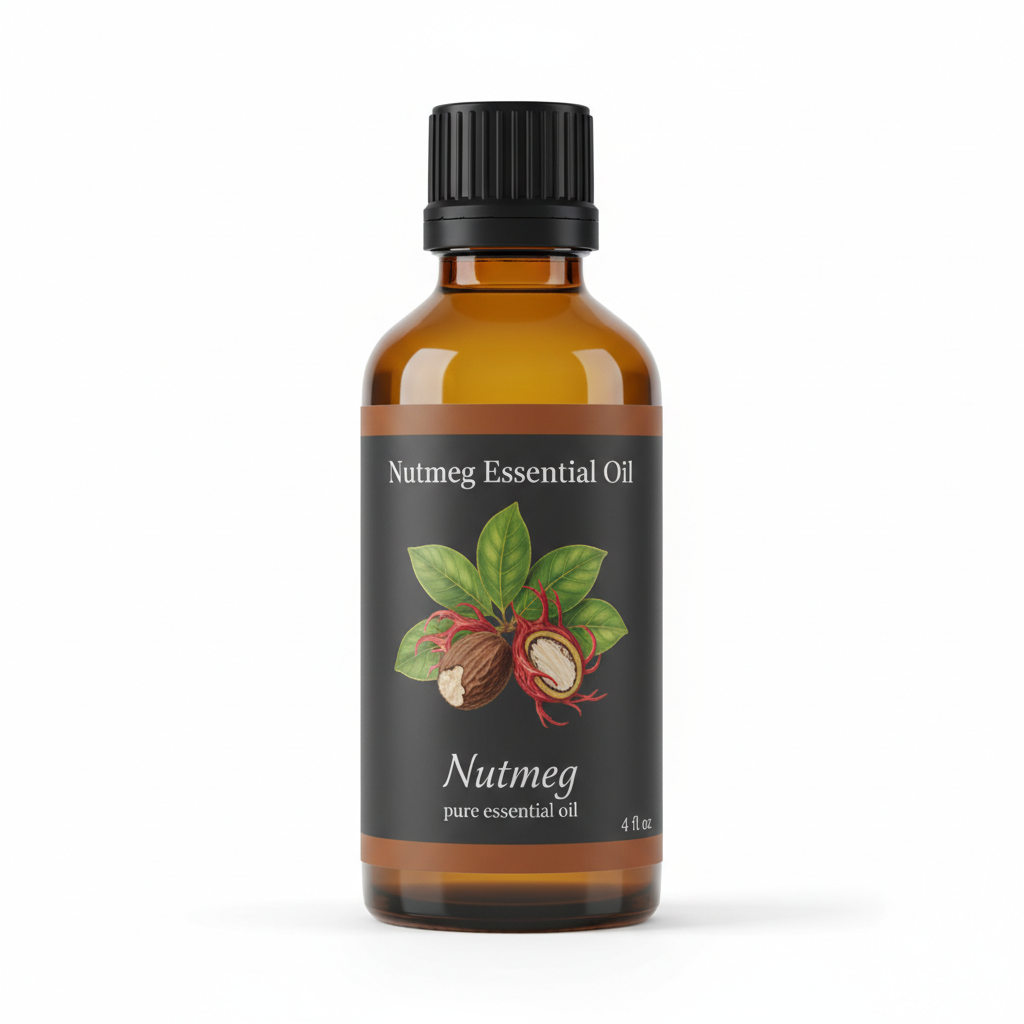
Nutmeg Essential Oil
Our own Nutmeg Essential Oil, in sizes from 0.5 oz to bulk.
From $10.99
Shop Now →What the nutmeg poison-centre record shows
The only nutmeg case series this search could read in full is from the Illinois Poison Center, covering 2001 to 2011 (Ehrenpreis et al., J Med Toxicol, 2014). It counted 32 nutmeg ingestions in people aged 2 to 30 (median 16). Seventeen were unintentional, and 10 of those 17 were in children under 13; four of the under-13 exposures were to the eye. The 15 intentional cases clustered in teenagers aged 13 to 19. Ten patients were treated in hospital, all aged 15 to 17, and there were no deaths. The paper does not say whether any exposure involved the oil, and the amounts that are reported are anecdotal (for example, a teenager who reported taking 25 g of ground nutmeg). The authors call for educating parents about household toxic items.
That is a small, regional, spice-focused series, and it describes children getting into something in the house. It is not a measure of what nutmeg oil does to a child, and no source found for this page gives a toxic amount of the oil for a child. A pharmacology review (Seneme et al., Molecules, 2021) records one fatal case in the literature, an 8-year-old boy who ate two nutmegs, from a 1908 report. Treat it as a historical case about whole spice, not a dose for anything.
What essential-oil guidance says about children and bottles
The Western Australia Department of Health's essential oils page (undated) says children are particularly susceptible, that as little as 2 mL (under half a teaspoon) of eucalyptus oil can cause significant poisoning in an infant, and that oils should be kept in a child-resistant container, out of reach. That is a different oil, so the 2 mL is not a nutmeg figure. For scale only, a half-ounce bottle holds about 14.8 ml, roughly 7 times that volume, and the largest retail sizes hold far more.
The Missouri Poison Center's essential oils page (undated) says that a small swallowed taste can cause vomiting from stomach irritation, and that some of the oil can slip into the lungs (aspiration) and cause serious symptoms such as chemical pneumonia, a risk it says rises with coughing, gagging or choking. The same page tells readers to call 1-800-222-1222 for instructions. Aspiration is the reason poison centres, not home remedies, are the first call, and it is why this page gives no home treatment.
EFSA's review of nutmeg oil as an animal-feed additive (EFSA, 2023) describes the oil as an irritant to skin and eyes and a skin and respiratory sensitiser. That was a feed-additive opinion, not child-specific, and it fits the Illinois eye-exposure cases without proving anything about them.
Does any law require a child-resistant cap?
For nutmeg oil, the rule found says no. The US Consumer Product Safety Commission's special-packaging list in 16 CFR 1700.14(a) names aspirin, methyl salicylate above 5%, turpentine at 10% or more, certain drugs and other products with thresholds. Nutmeg oil does not appear, and the phrase "essential oil" does not appear. The nearest relative is methyl salicylate (oil of wintergreen, over 5% by weight). Other CPSC rules were not searched. Our product pages do not state that our bottles have child-resistant closures, so assume they do not and plan storage accordingly. That is the practical consequence of a missing rule: the lock has to be yours.
Storage, in the order the sources put it
- Out of reach and out of sight: the Tisserand Institute's safety guidelines say to keep essential oils where young children cannot reach them; Western Australia adds a child-resistant container. A closed cabinet beats a high shelf for a climber (this is reasoning, not a quoted rule).
- Capped every time. Our copy says store tightly capped in a cool, dark place; a capped bottle is also a bottle that cannot be tipped.
- Decant working amounts only if you must. Our bulk page suggests smaller airtight bottles; each extra bottle is another one to lock away.
- Keep the original label. If a swallow happens, the product name and ingredients are what the Poison Help line will ask about, and MedlinePlus advises bringing the container to the hospital if possible.
If a child has swallowed it or got it in an eye
Call the Poison Help line, 1-800-222-1222 in the United States (poison.org describes the phone line and its web tool as free, expert and confidential). MedlinePlus's lavender-oil entry (reviewed 14 October 2025; a different oil, quoted for general oil guidance) says not to make the person throw up unless poison control or a provider says to, and to call the local emergency number (such as 911) in an exposure. Western Australia's page says the same about vomiting. For a rash or irritation from skin contact, stop using the oil and ask a pharmacist or the child's paediatrician. Our copy says to discontinue use if irritation occurs.
Diffusing and skin use around children
This search found no authority giving a child-specific diffusing time or room-size limit for nutmeg oil, so none is stated here. The Tisserand Institute's nutmeg post says moderate diffusion and diluted topical use fall within its guidelines, and the text does not address children, but the chart of recommended topical maximums on the same page (an image, posted November 2019) does: for East Indian oil it marks 3 to 24 months and 2 to 6 years with an X (do not use) and gives 0.2% for ages 6 to 15; for West Indian oil it marks 3 to 24 months with an X, gives 0.5% for 2 to 6 years and 1% for 6 to 15 (Tisserand Institute, 2019). Our pages do not say which type our oils are, and our process copy says nutmeg oil is unsuitable for children, which is why this site publishes no child dilution and does not treat the West Indian row as permission. Our process copy says nutmeg oil is unsuitable for children, which is why this site publishes no child dilution.
For adults, the one published fragrance limit that reaches this oil points below the top of our own 0.5% to 2% skin copy: IFRA's safrole standard, worked through on the medications page, implies about 0.4 to 0.6% for an oil of EFSA's reported composition. The chart's child rows are Tisserand's rather than IFRA's, and they differ by oil type, so a child is not a case to extrapolate. Ask a paediatrician before using any scented product on a child's skin.
Where to go
A child's doctor for symptoms and questions about products on a child's skin, a pharmacist for questions about what is in the house, and the Poison Help line for anything swallowed or splashed. FDA decides whether a product is a drug by intended use (FDA, 2024), and we sell a fragrance material with no medical claims, so nothing here is a remedy. See also the pregnancy page, the ingestion page and the safety basics.
Where a bottle of nutmeg oil belongs in a house with children is a closed, high cabinet, capped, with the label on.
Nutmeg Essential Oil
Nutmeg Essential Oil from our own shop, in sizes from 0.5 oz to bulk.
From $10.99
Shop Now →Sources & Further Reading
- Ehrenpreis J.E. et al., 2014. Nutmeg Poisonings: A Retrospective Review of 10 Years Experience from the Illinois Poison Center, 2001-2011. J Med Toxicol 10(2):148-151. PMC4057546
- Seneme E.F. et al., 2021. Pharmacological and Therapeutic Potential of Myristicin: A Literature Review. Molecules 26(19):5914. PMC8512857
- Government of Western Australia, Department of Health. Essential oils (HealthyWA). healthywa.health.wa.gov.au
- Missouri Poison Center. Essential oils. missouripoisoncenter.org
- EFSA FEEDAP Panel, 2023. Safety and efficacy of a feed additive consisting of an essential oil from the seeds of Myristica fragrans Houtt. (nutmeg oil). EFSA Journal 21(6):e08066. PMC10273060
- US Consumer Product Safety Commission. 16 CFR 1700.14, Substances requiring special packaging. ecfr.gov/16-CFR-1700.14
- Tisserand Institute. Safety guidelines; Assessing the Safety of Essential Oils: the Nutmeg Case. tisserandinstitute.org/safety, tisserandinstitute.org
- MedlinePlus, 2025. Lavender oil poisoning. medlineplus.gov/ency/002711
- Poison Control (poison.org). Poison Help line. poison.org
- FDA, 2024. Is It a Cosmetic, a Drug, or Both? (Or Is It Soap?) fda.gov
- Tisserand Institute, 2019. Nutmeg essential oil safety guidelines (chart of recommended maximum dilutions, posted with "Assessing the Safety of Essential Oils: the Nutmeg Case"). tisserandinstitute.org chart