
Nutmeg Massage Oil Recipe: Dilution, Carriers, Cautions
For 100 ml of nutmeg body oil, the number worked out here is 8 drops, which is about 0.4%. That is below the floor of our own 0.5% to 2% skin copy, and the rest of this post shows why, what the batch looks like in grams, and who should leave the bottle on the shelf. We have not made or tested this formulation. It is arithmetic built on the sources at the end, so make a small batch, patch test it, and treat it as a starting point and not a result.
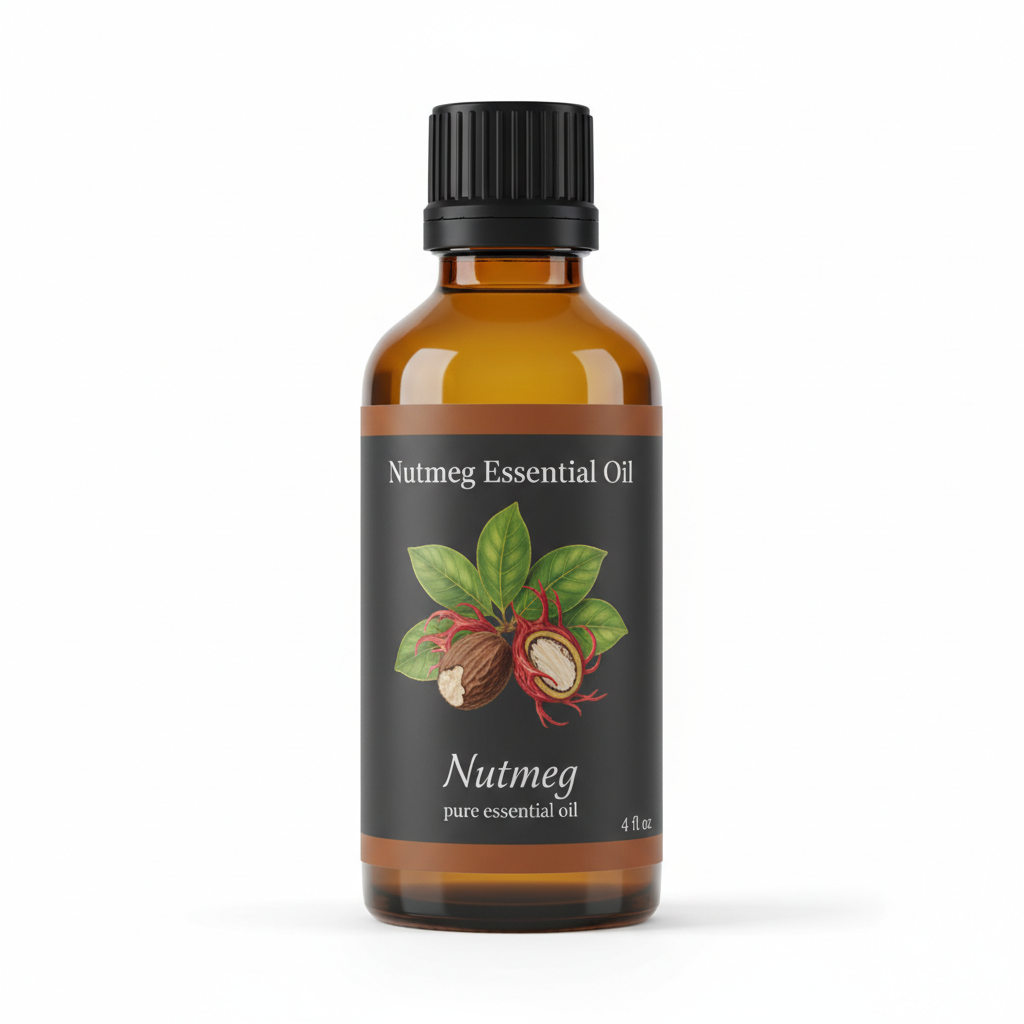
Nutmeg Essential Oil
Our own Nutmeg Essential Oil, in sizes from 0.5 oz to bulk.
From $10.99
Shop Now →Why the number sits under our own label copy
Our product pages say to dilute nutmeg oil to 0.5% to 2% in a carrier oil and to patch test first. Two outside sources put the ceiling lower than the top of that range, and one of them lands near the bottom.
- IFRA, safrole standard: IFRA Standards, 51st Amendment compilation (January 2024) has no standard named for nutmeg oil (a text search of the PDF found neither "nutmeg" nor "Myristica"). It does carry the 1987 standard on safrole, isosafrole and dihydrosafrole, with a note box: natural extracts are accepted only while the total of those three in the finished product stays at or below 0.01%, in every product category. Safrole is a constituent nutmeg oil contains.
- EFSA, composition: the EFSA FEEDAP Panel (2023) reported seven batches of one nutmeg oil, all from Indonesia, with safrole at 1.69% to 2.30% and methyl eugenol at 0.18% to 0.33%. That is one feed-additive dossier, not our oil. Our COA reports no constituent figures, so the cautious move is to borrow the worst case.
- Arithmetic: 0.01% divided by 2.30% is 0.43% oil. At 1.69% safrole it is 0.59%. For methyl eugenol, IFRA's 2023 standard allows 0.0015% in Category 5A (body lotion type, which IFRA's guidance of June 2023 uses for body-oil-like products); 0.0015% divided by 0.33% is 0.45% oil. Both constituents point at roughly 0.4% to 0.6%. This is our inference, not a figure IFRA publishes for nutmeg.
- Tisserand Institute: its nutmeg safety chart (an image on a page dated November 2019, based on Essential Oil Safety, 2nd edition) gives East Indian nutmeg oil a topical maximum of 0.8% for people over 15, 0.2% for ages 6 to 15 and 0.2% in pregnancy, with an X (do not use) under 6. West Indian oil is 5% for over 15. Our oil's origin is not stated on the COA, so the East Indian row is the cautious reading.
One caveat applies to all of it: IFRA's guidance puts aromatherapy applications outside the scope of its Standards, so these categories are the closest yardstick, not a rule that binds a home massage oil.
| Oil strength | Drops per 100 ml carrier | Where it sits |
|---|---|---|
| 0.2% | 4 | Tisserand, ages 6 to 15 and pregnancy (East Indian row) |
| 0.4% | 8 | Used here: under the 0.43% safrole arithmetic |
| 0.5% | 10 | Bottom of our copy; above the safrole arithmetic |
| 0.8% | 16 | Tisserand adult figure (East Indian row) |
| 2% | 41 | Top of our copy; 4.6 times the 0.43% figure |
Our recommendation follows: stay at or under 0.4%. If you read our 0.5% to 2% copy and the authority figures side by side, the authority figures win.
The batch, by weight
Our COA gives a relative density of 0.887 for the batch it covers, so 1 ml of the oil is about 0.887 g. At about 20 drops per ml (droppers vary, so weigh if you can), one drop is about 0.05 ml or 0.044 g. A typical carrier oil weighs about 0.91 g per ml (a sweet almond oil data sheet gives 0.90 to 0.91; an Ellisons grapeseed sheet 0.910 to 0.930), so 100 ml is about 91 g.
- Weigh 91 g of carrier oil into a clean glass bottle. That is 100 ml, give or take the carrier you chose.
- Add 8 drops of nutmeg oil: 0.4 ml, about 0.355 g. As a share of the 91 g that is 0.39%. Nine drops would be 0.44%, past the 0.43% line, so stop at eight.
- Cap, tilt gently, and label with the date, the percentage and the carrier.
For a smaller test batch, 1 oz of carrier (about 27 g) takes 2 drops, which is 0.33%. Three drops is 0.50%, which is why our own bottom-of-range figure already overshoots. A kitchen scale cannot weigh 0.36 g; a 0.01 g jeweller's scale can, or count drops into a small container first.
Nobody here has made, poured or tested this oil. Do a small batch first, and run a patch test before the oil goes anywhere near a larger area.
Picking the carrier
The carrier decides how long the bottle lasts and whether it suits the person receiving the massage. Our carrier-oil comparison works through shelf life and allergen status from data sheets. The short version for a batch this dilute: choose by shelf life and allergen status, buy small, and write the date on the bottle. We sell no carrier oils; a craft or soap-supply shop or a pharmacy does, and the thing to ask for is the supplier's data sheet or certificate of analysis showing the production date.
If anyone getting the massage has a tree-nut allergy, sweet almond oil needs a conversation with their allergist before it is used. FDA's food-allergen page (current as of March 2026) names almonds as a tree nut for food labelling; it says nothing about skin use either way.
Patch test, and what to do after a reaction
Our copy asks for a patch test on a small area. The American Academy of Dermatology, in a page last updated August 2021, describes a quarter-sized spot where the product will not be rubbed or washed off, such as the inside of the arm, with the product applied twice daily for seven to 10 days. If a reaction appears it says to wash the product off and not use it again, and to see a dermatologist if the reaction is severe or the cause is unclear. The NHS page on contact dermatitis (reviewed May 2023) sends persistent, recurrent or severe symptoms to a GP, and milder cases to a pharmacist.
The National Capital Poison Center adds that diluting in a carrier is the best way to avoid a bad reaction from direct skin contact, that essential oils should stay off damaged skin, and that any allergic reaction with trouble breathing is an emergency. If a child or pet gets into the bottle, or anyone swallows the oil, the poison help line is 1-800-222-1222.
Who should skip it
- Pregnant or nursing: our process page calls the oil unsuitable. Tisserand's East Indian figure for pregnancy is 0.2%, a quarter of the adult figure. The person to ask is an obstetric clinician. See the pregnancy post.
- Children: our copy says unsuitable, and Tisserand's chart shows X under age 6 for East Indian oil. A paediatrician is the right professional. See the children post.
- Anyone on medication that acts on the central nervous system: our process page says not to use the oil at all. Ask the pharmacist or prescriber; see the medications post.
- Pets: keep the bottle and the massaged skin away from them; a veterinarian is the contact if a pet has been exposed.
The reason for caution is documented even though none of it concerns skin. Safrole is IARC Group 2B (Supplement 7, 1987), and IARC placed methyl eugenol in Group 2A in June 2023, up from 2B in 2013. EFSA classifies nutmeg oil as a category 1B carcinogen on its safrole content and as an irritant to skin and eyes and a skin and respiratory sensitiser. Those are hazard classifications of the oil as supplied, and they are the reason IFRA's limits are expressed as percentages of constituents.
Poison-centre case series are about eating ground nutmeg, not skin. The Illinois Poison Center review (2001 to 2011) counted 32 ingestions, with no deaths; it did not separate spice from oil, and it is no evidence about massage either way. Our safety basics post covers the general picture.
What a massage oil may and may not say
Under FDA's cosmetic-or-drug page (current as of September 2024), a massage oil that is simply intended to lubricate the skin and impart fragrance is a cosmetic, and one intended for a therapeutic use is a drug. That is why this recipe makes no claim about comfort, warmth or muscle effects, and why the joint and muscle post reports evidence instead. A licensed massage therapist is the professional for anything done to clients; a home recipe is not a treatment protocol.
Our nutmeg oils are sold neat, so the dilution maths is yours; the batch above is a starting point you can cut further, never raise.
Nutmeg Essential Oil
Nutmeg Essential Oil from our own shop, in sizes from 0.5 oz to bulk.
From $10.99
Shop Now →Sources & Further Reading
- IFRA, 2024. IFRA Standards, 51st Amendment (complete compilation): Safrole, Isosafrole and Dihydrosafrole; Methyl eugenol. ifrafragrance.org
- IFRA, 2023. Guidance for the use of IFRA Standards, 51st Amendment. ifra-51st-amendment-guidance
- EFSA FEEDAP Panel, 2023. Safety and efficacy of nutmeg oil as a feed additive. EFSA Journal 21(6):e08066. PMC10273060
- Tisserand Institute. Assessing the Safety of Essential Oils: the Nutmeg Case (safety guidelines chart). tisserandinstitute.org
- IARC, 2023. Evaluation of methyleugenol and isoeugenol (Monographs Volume 134). iarc.who.int
- IARC, 1987. Safrole (Supplement 7), as listed by INCHEM. inchem.org
- Ehrenpreis JE et al., 2014. Nutmeg poisonings: Illinois Poison Center, 2001 to 2011. J Med Toxicol 10(2):148-151. PMC4057546
- FDA, 2024. Is It a Cosmetic, a Drug, or Both? (Or Is It Soap?) fda.gov/cosmetics
- FDA, 2026. Food Allergies (major food allergens). fda.gov/food-allergies
- American Academy of Dermatology, 2021. How to test skin care products. aad.org
- NHS, 2023. Contact dermatitis. nhs.uk/conditions/contact-dermatitis
- National Capital Poison Center. Essential oils. poison.org/articles/essential-oils
- Telic S.A.U., 2024. Technical data sheet, sweet almond massage oil. telic.group
- Ellisons. Grapeseed oil, cosmetic refined, safety data sheet. ellisons.co.uk