
Nutmeg Oil and Stress: What the Research Can and Cannot Say
A scent can change how a room feels, and that is as far as the evidence on nutmeg oil goes. The search found no trial in people of nutmeg oil for stress or anxiety, the animal studies disagree with each other, and at high doses nutmeg's effect on the nervous system is a poisoning, with agitation and anxiety on the symptom list. Our shop sells nutmeg oil as a warm spice scent, makes no stress claim, and has nothing to say about treating anything.
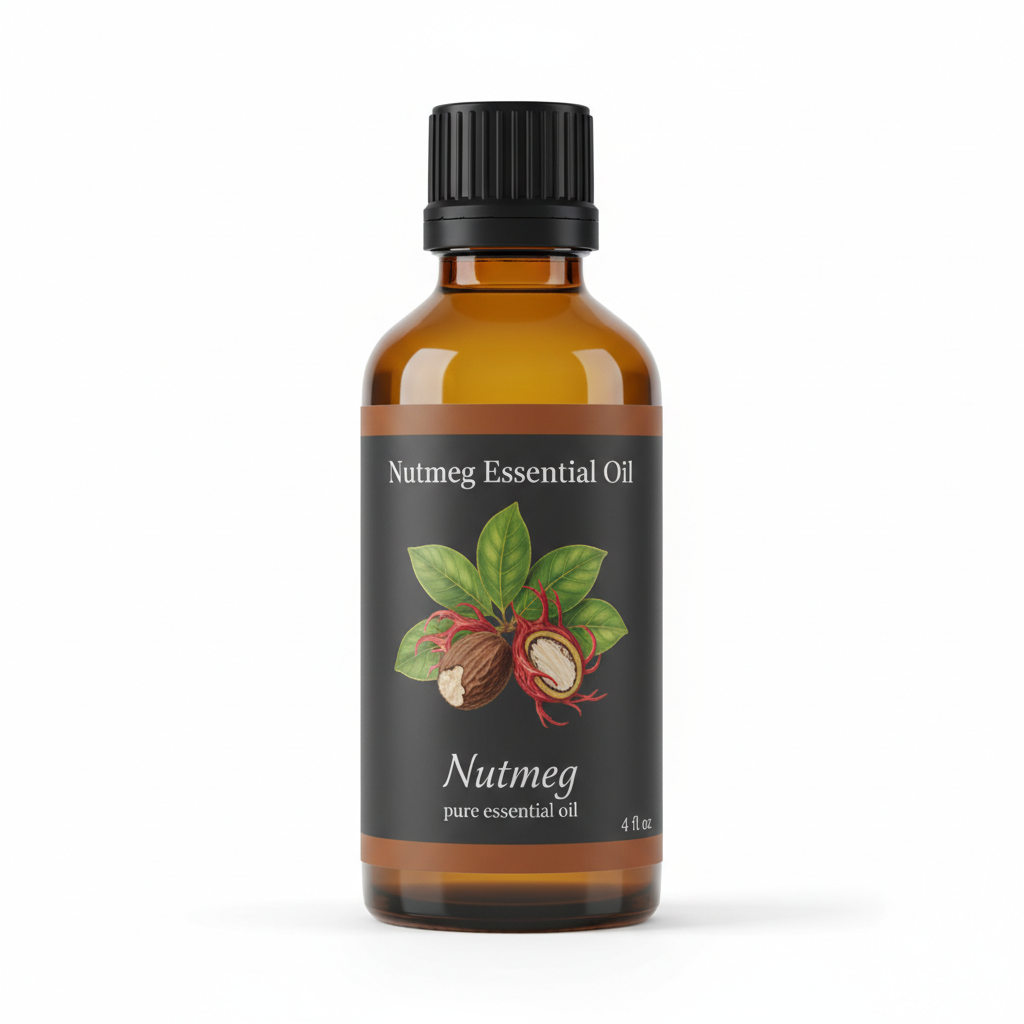
Nutmeg Essential Oil
Our own Nutmeg Essential Oil, in sizes from 0.5 oz to bulk.
From $10.99
Shop Now →Why smell and mood are linked, and what that does not prove
Rachel Herz's 2025 perspective in Brain Sciences argues that smell and emotion are fundamentally equivalent and that the essence of olfactory experience is emotion (Herz, 2025). It is a perspective piece, an argument built on neuroscience and earlier experiments, not a trial of any oil. It explains why a familiar spice smell can recall a kitchen or a holiday, and why a person's reaction to an aroma depends heavily on what that aroma means to them. That cuts both ways for an evidence review: if meaning drives the response, a trial must separate the oil's chemistry from the participant's beliefs about it, and that is exactly where aroma trials are weakest.
What reviews conclude about aroma trials
- Hedigan et al., 2023 reviewed inhalation aromatherapy for stress and anxiety in clinical settings: 628 studies retrieved, 76 selected, 6,539 patients. Because of high heterogeneity and bias they could only synthesize the results in narrative form. More than 70% of the studies reported a positive effect on anxiety, and the authors added that many were limited by the absence of safety data and by imprecise reporting of plant species and dose.
- Pehlivan et al., 2026 pooled 33 studies with 2,312 nursing and health-science students. Anxiety scores fell (standardized mean difference -0.46), but the abstract reports no significant effect on stress, pulse rate, respiratory rate or academic performance.
- Chen et al., 2025 (insomnia with other conditions; anxiety and depression scores were also pooled) flagged lack of blinding and no independent testing of the oils.
Three things follow. First, "anxiety" and "stress" are not the same outcome in these data. Second, a positive pooled number is common and the reviews themselves attribute much of it to trial design. Third, the reviews span lavender and other oils, and reported species and dose imprecisely, so a result for one oil cannot be carried across to another.
The nutmeg search
A PubMed search run on 28 October 2026 for nutmeg or Myristica fragrans with anxiety or stress, limited to randomized or clinical trials, returned 3 records: a review of nutmegs and wild nutmegs, a trial of nutmeg oil in the feed of chickens under heat stress, and a livestock feed-additive study in vitro. Not one was a human trial. A broader search that added antidepressant and anxiolytic terms returned 81 records, which fall into the animal and laboratory work below.
| Study | Material and route | Animal | Reported |
|---|---|---|---|
| Tran et al., 2023 | M. fragrans essential oil, 25 mg/kg intranasally | Mice | Less immobility in the tail suspension test and more time and entries in the open arms of the elevated plus maze (the abstract names it with one other oil) |
| Dhingra et al., 2006 | n-Hexane extract of seeds, 5 to 20 mg/kg by mouth for 3 days | Mice | Antidepressant-like effect in forced swim and tail suspension tests |
| Iwata et al., 2022 | n-Hexane extract, 10 mg/kg by mouth | Mice | Antidepressant-like effect; no deaths at 2,000 mg/kg in an acute toxicity test |
| Sonavane et al., 2002 | n-Hexane extract and trimyristin, 10 to 300 mg/kg intraperitoneally | Mice | Anxiogenic (anxiety-increasing) behavior in the elevated plus-maze |
| Leiter et al., 2011 | Myristicin, an isolated compound | Rats (55, in five groups) | Did not act as an anxiolytic via the GABA-A receptor; the authors say it "may promote anxiogenesis" |
These studies disagree. Tran's intranasal oil and the oral hexane extracts moved mouse behavior in the direction researchers read as antidepressant-like or anxiolytic-like, while Sonavane's and Leiter's materials moved it the other way. The materials differ (oil, solvent extract, an isolated fat, an isolated phenylpropanoid), as do routes and species, and a mouse on a plus-maze is a behavioral screen, not a stressed person. The honest summary is that nutmeg-derived materials have produced opposite results in the rodent tests that were run, and the intranasal oil study is one study, in mice, with the oil at 25 mg/kg.
At high doses it is a hazard
Mouse work with extracts given at 500 mg/kg by mouth found increased locomotor activity, with other effects depending on extract and route (El-Alfy et al., 2009). In people, the Missouri Poison Center lists agitation, restlessness, anxiety, panic, tremor and hallucinations among the effects of nutmeg ingestion, with onset typically 3 to 8 hours after the dose (Missouri Poison Center, 9 December 2022). MedlinePlus lists agitation, anxiety, brief euphoria, delirium, hallucinations and seizures under "Myristica oil poisoning," with aromatherapy products among the named sources, and says to call the Poison Help line, 1-800-222-1222, or the local emergency number (MedlinePlus, reviewed 14 October 2025). In the California series of 119 single-substance nutmeg exposures, patients who took it intentionally were more likely to have tachycardia and agitation than those exposed unintentionally (Carstairs et al., 2011). Those are ingestions, mostly of the spice. They are the reason our copy says the oil must never be swallowed and must not be used by anyone taking medication that acts on the central nervous system. Mood-active drugs and a material that acts on the central nervous system in animals are a pairing for a pharmacist to review, as the medications article explains.
The FDA line
The FDA states that a product's intended use decides whether it is a cosmetic or a drug, and that intent can be shown by claims on the label, in advertising or on the internet (FDA, content current as of 11 September 2024). On that page a fragrance sold for attractiveness is a cosmetic, while one sold with assertions that the scent will help the consumer sleep or quit smoking is a drug. A stress or anxiety promise would fall on the wrong side of the same line. We sell the first kind and say so.
Who to talk to
The NHS advises getting help if you are struggling to cope with stress or what you are trying yourself is not helping; NHS talking therapies accept self-referral for adults, and Samaritans answer on 116 123 (NHS, last reviewed 6 March 2026). In the United States the National Institute of Mental Health says it may be time to talk to a professional when you are struggling to cope or symptoms will not go away, and directs anyone in immediate distress or thinking about self-harm to call or text 988; its coping list includes journaling, relaxation exercises, exercise, regular meals, a consistent sleep routine and less caffeine (NIMH, I'm So Stressed Out; undated fact sheet). A physician or licensed therapist is the right professional, and a scent is not on either list.
Our position
Scent can shape the feel of a room, and the shop describes nutmeg as a warm, spicy room scent; the scent profile and the benefits article describe it in those terms. That is separate from the evidence questions above. For handling, our copy says diffuse sparingly, keep the oil from children and pets, and never swallow it; the safety basics cover the rest, and the sleep review covers the neighbouring question.
If stress or anxiety is affecting daily life, the useful step is a conversation with a physician or licensed therapist, and nutmeg oil should stay out of that decision.
Nutmeg Essential Oil
Nutmeg Essential Oil from our own shop, in sizes from 0.5 oz to bulk.
From $10.99
Shop Now →Sources & Further Reading
- Herz RS, 2025. Smell is emotion. Brain Sci. pubmed.ncbi.nlm.nih.gov/41594780
- Hedigan F et al., 2023. Benefit of inhalation aromatherapy as a complementary treatment for stress and anxiety in a clinical setting: a systematic review. Complement Ther Clin Pract. pubmed.ncbi.nlm.nih.gov/37031643
- Pehlivan S et al., 2026. Aromatherapy interventions in nursing and health sciences students: a meta-analysis. BMC Med Educ. pubmed.ncbi.nlm.nih.gov/41495795
- Chen HB et al., 2025. Inhalation aromatherapy for the treatment of comorbid insomnia. Front Psychiatry. pubmed.ncbi.nlm.nih.gov/40230824
- Tran KN et al., 2023. Screening for neuroprotective and rapid antidepressant-like effects of 20 essential oils. Biomedicines. pubmed.ncbi.nlm.nih.gov/37238920
- Dhingra D et al., 2006. Antidepressant-like activity of n-hexane extract of nutmeg seeds in mice. J Med Food. pubmed.ncbi.nlm.nih.gov/16579733
- Iwata N et al., 2022. Mechanisms and safety of antidepressant-like effect of nutmeg in mice. Biol Pharm Bull. pubmed.ncbi.nlm.nih.gov/35314522
- Sonavane GS et al., 2002. Anxiogenic activity of Myristica fragrans seeds. Pharmacol Biochem Behav. pubmed.ncbi.nlm.nih.gov/11812528
- Leiter E et al., 2011. Evaluation of the anxiolytic properties of myristicin in the male Sprague-Dawley rat. AANA J. pubmed.ncbi.nlm.nih.gov/21560973
- El-Alfy AT et al., 2009. Towards a better understanding of the psychopharmacology of nutmeg: activities in the mouse tetrad assay. J Ethnopharmacol. pubmed.ncbi.nlm.nih.gov/19703539
- Missouri Poison Center, 2022. Nutmeg abuse. missouripoisoncenter.org/nutmeg-abuse
- MedlinePlus, 2025. Myristica oil poisoning. medlineplus.gov/ency/article/002899
- Carstairs SD et al., 2011. The spice of life: an analysis of nutmeg exposures in California. Clin Toxicol. pubmed.ncbi.nlm.nih.gov/21495887
- FDA, 2024. Is It a Cosmetic, a Drug, or Both? (Or Is It Soap?). fda.gov/cosmetics
- NHS, 2026. Stress. nhs.uk/mental-health/stress
- NIMH. I'm So Stressed Out! fact sheet (NIH Publication 20-MH-8125). nimh.nih.gov