Pumpkin Spice Oil Blend: Ratios and Why Cinnamon Bark Is Out
Most pumpkin spice blends fail on the label before they fail on the nose: the cinnamon in the recipe is often bark oil, and bark oil is the one bottle in this family that dermatology and aromatherapy sources treat as a high skin-reaction risk. This post gives a four-oil diffuser concentrate by weight (ginger, cinnamon leaf, nutmeg, clove bud), says why leaf and not bark, and shows the arithmetic for what actually goes into a diffuser. We have not blended, smelled or tested it, so make a small bottle and run it in a ventilated room before you decide you like it.
Nutmeg Essential Oil
Our own Nutmeg Essential Oil, in sizes from 0.5 oz to bulk.
From $10.99
Shop Now →What the spice mix contains, and what that tells you about the oils
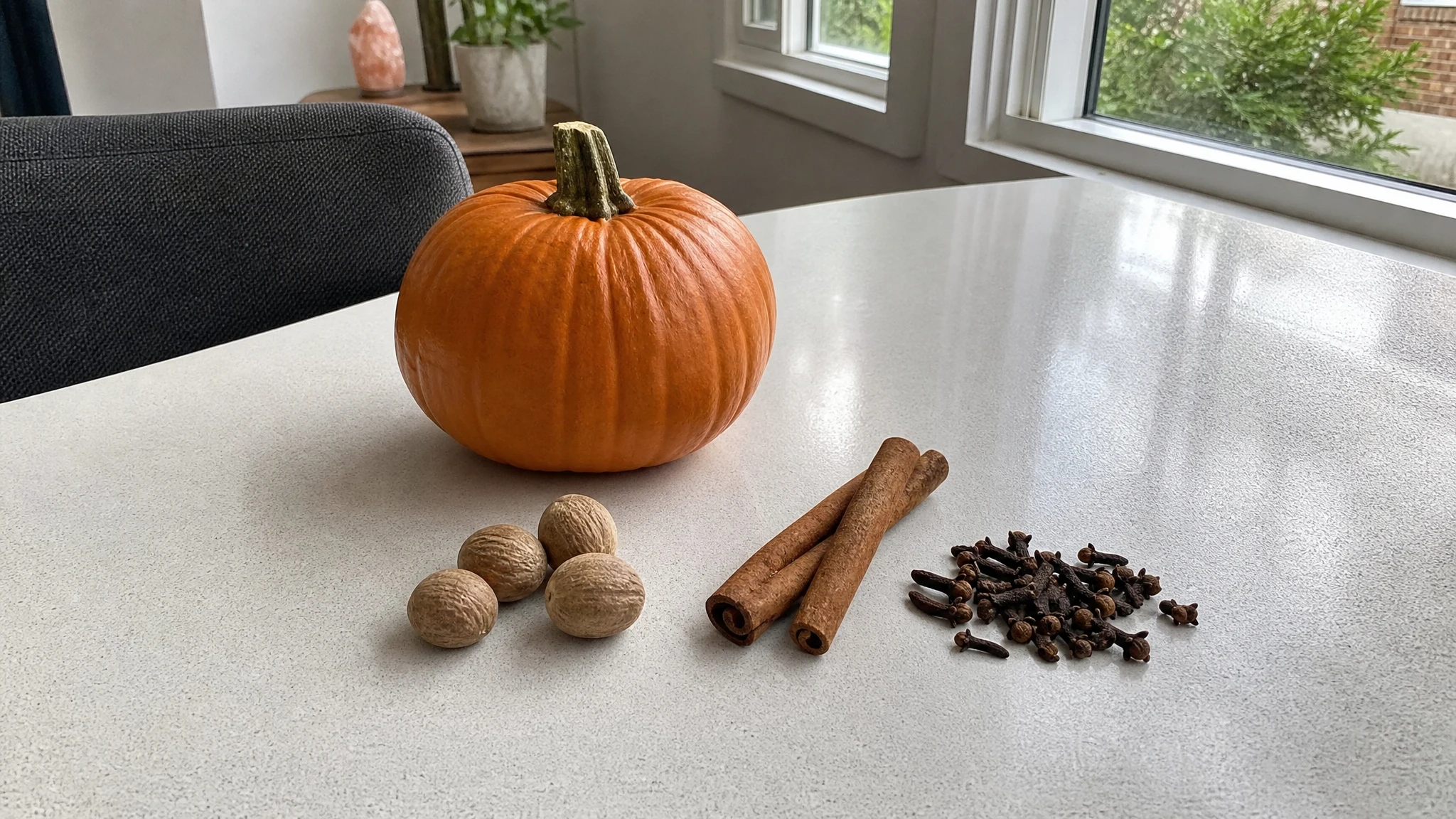
Pumpkin pie spice is, per the Wikipedia entry citing Sprudge (2022), generally a blend of ground cinnamon, nutmeg, ginger and cloves, and sometimes allspice; the entry credits McCormick & Company with introducing the blended product commercially in 1934. The entry gives no modern proportions, so any ratio you see is someone's preference, including ours. This recipe leaves out allspice because the sources read for this post gave no oil composition or limit for it.
The useful point is that these are spices, and their oils are not the spices. A pinch of ground cinnamon in a pie and a drop of cinnamon bark oil on skin are different exposures with different hazards, and nothing here suggests tasting or swallowing any of the oils. Our own copy says nutmeg oil is not for internal use, and Poison Control gives 1-800-222-1222 as the number to call about a swallowed essential oil.
The cinnamon trap: bark is not leaf
The Tisserand Institute's cinnamon report (Ablard, Carson and Tisserand, published October 2015) puts numbers on it. Cinnamon bark and cassia oils contain about 75% cinnamaldehyde; cinnamon leaf oil contains only about 1%. In an online survey run in May and June 2015, 345 responses came in, 55 were excluded from the analysis, and 27% of those who had used bark or cassia oil on skin reported an adverse reaction. The authors say that figure is probably somewhat high because of survey bias, and that the survey could not say what a safe dilution would be. They suggested a recommended maximum in the 0.1 to 1% range for these two oils.
The same report cites the fragrance-industry guideline of the time, no more than 0.05% cinnamaldehyde, which it translates to about 0.07% for bark oil, and says some respondents still reacted below that. In a patch-test table of 18 dermatitis patients already sensitive to 2% cinnamaldehyde, 3 of 18 reacted at 0.05%, 1 of 18 at 0.02% and none at 0.01%. That table is a different population from the general public and concerns the isolated compound, not the oil.
The current IFRA figure is a little looser. In the 51st Amendment compilation, cinnamic aldehyde (2020, Amendment 49) is capped at 0.064% in Category 5A (body lotion) and 0.25% in Category 4 (fine fragrance). Dividing by the 75% share gives a bark-oil ceiling of about 0.085% in 5A and 0.33% in Category 4. That division is our arithmetic. IFRA's compilation has no standard for cinnamon bark oil by name, and a diffuser has no category in the passages read, which is why this recipe uses leaf and keeps the concentrate off skin.
Clove bud and the eugenol overlap
Vanderbilt's poison-control note (December 16, 2025) says oil of cloves is about 60 to 90% eugenol, that exposures of as little as 5 to 10 ml have caused significant toxicity in infants and small children, and that its use for teething has not been recommended under age 2. Cinnamon leaf oil is also eugenol-rich; the Tisserand Institute's eugenol article (Robert Tisserand, undated) lists it as a major source alongside clove bud and gives topical maximums from Essential Oil Safety, 2nd edition, of 0.5% for clove bud and 0.6% for cinnamon leaf. IFRA's eugenol standard (2023, Amendment 51) is 0.64% in Category 5A and 2.5% in Category 4. So this blend has two oils that share a sensitiser, which is the reason clove is the smallest part.
Nutmeg's share, and why it is capped
Nutmeg is the one oil our shop sells, and it is also the one with the carcinogen-related constituent standards: IFRA's safrole note box (0.01% total in a finished product) and methyl eugenol table, described in our cleaning spray post and the safety basics post. The EFSA opinion on nutmeg oil as a feed additive (EFSA FEEDAP Panel, 2023) reports seven Indonesian batches with safrole 1.69 to 2.30% and methyleugenol 0.18 to 0.33%, and calls the additive a skin and respiratory sensitiser for people handling it. That describes those batches; our certificate of analysis gives no constituent data, so we cannot say where our oils fall.
For skin, Tisserand's nutmeg chart (Tisserand Institute, November 2019) gives adults 0.8% for East Indian nutmeg oil and 5% for West Indian, with 0.2% in pregnancy for East Indian, and an X (do not use) for ages 3 to 24 months. Our product pages say 0.5% to 2% in a carrier oil. Our oils' origin is not stated, so we read the East Indian row as the cautious one: 0.8% is lower than the top of our 2% copy, and for skin we recommend staying at or below 0.8%. That conflict does not apply to this recipe because the recipe is for a diffuser, but it explains the next section.
The concentrate, by weight
Parts by weight, making 9.0 g in a small dropper bottle (about a third of an ounce):
| Oil | Parts | Grams | Share |
|---|---|---|---|
| Ginger | 3 | 3.0 | 33% |
| Cinnamon leaf (not bark, not cassia) | 3 | 3.0 | 33% |
| Nutmeg | 2 | 2.0 | 22% |
| Clove bud | 1 | 1.0 | 11% |
Weigh rather than count drops: Tisserand Institute's review of drop-size studies found 20 drops weighing 0.66 g on average in three studies, and 20 to 40 drops per ml across them. For our nutmeg oil, 2.0 g is about 2.3 ml (relative density 0.887 on the batch on our COA), roughly 45 drops at 20 drops per ml, which is why a scale beats a dropper. We do not sell ginger, cinnamon leaf or clove bud oil. Buy them from an aromatherapy or craft supplier, ask for the botanical name and the plant part on the label (leaf, not bark), and ask for a data sheet with a GC-MS report and an IFRA certificate. The sources read for this post gave no numeric limits for ginger oil, so ask the supplier for theirs.
The ratio is a choice, not a finding. Clove bud has the lower skin maximum of the two eugenol-rich oils here (0.5% against 0.6% for cinnamon leaf, per the article above) and shares its sensitiser with the leaf oil, which is why it gets the smallest part. If you want less sensitiser load, drop the clove first and move its gram to ginger.
What goes in the diffuser
Robert Tisserand wrote in a reply under a Tisserand Institute page on peppermint and eucalyptus for children (March 9, 2020) that dilution rates do not apply to diffusion and that "2-3 drops over several hours is a reasonable guide". That is a comment about other oils and a general guide, not a nutmeg limit. His safety guidelines page advises diffusing for 30 to 60 minutes on and then 30 to 60 minutes off, with some fresh-air exchange. His nutmeg article says diffusing nutmeg oil in moderation is acceptable.
Taking 3 drops of the concentrate per session: at 0.033 g a drop (the average above) that is about 0.10 g of blend, and at 0.044 g a drop (20 per ml at about 0.9 g/ml) about 0.13 g. Nutmeg is 22% of that, so 0.022 to 0.029 g, about half a drop of straight nutmeg oil. A 9.0 g bottle covers roughly 70 to 90 such sessions.
Do not put the concentrate on skin. Even at a 2% skin dilution of the blend, cinnamon leaf would reach 0.66%, over the 0.6% maximum above, while nutmeg (0.44%) and clove bud (0.22%) would stay under theirs; the blend would fail on its cinnamon share first.
Who should skip it
Our process page says nutmeg oil is unsuitable for anyone pregnant or nursing, unsuitable for children, and not to be used at all with medication acting on the central nervous system, and to diffuse sparingly; our product pages say to keep it away from children and pets. Pet Poison Helpline's essential oil article says cats and birds are at the greatest risk and that oral exposure is the highest-risk route, then dermal, then respiratory. If a cat shows drooling, vomiting or lethargy, call a veterinarian. Pregnant or nursing readers and anyone on medication should ask their physician or pharmacist first. This post makes no claim about what the scent does to a mood or a body.
For ready-made autumn ideas that start from nutmeg and orange see autumn diffuser blends and the Spice Route blend; for how nutmeg sits beside clove and cinnamon see the comparison post and the pairing guide; a cardamom-led variant is in the chai blend post.
If you want the nutmeg for this, see the shop page for sizes and ask in writing for any constituent figure you need before you order.
Nutmeg Essential Oil
Nutmeg Essential Oil from our own shop, in sizes from 0.5 oz to bulk.
From $10.99
Shop Now →Sources & Further Reading
- Wikipedia. Pumpkin pie spice (cites Sprudge, 2022). en.wikipedia.org/wiki/Pumpkin_pie_spice
- Ablard K, Carson C, Tisserand R, 2015. Cinnamon Survey Special Report, Tisserand Institute. tisserandinstitute.org/Tisserand-Cinnamon-Report
- IFRA, 2024. IFRA Standards, 51st Amendment compilation (cinnamic aldehyde, eugenol, methyl eugenol, safrole). ifrafragrance.org/51st-amendment
- Vanderbilt Poison Control, 2025. What is the main toxic component of oil of cloves. vumc.org/poison-control
- Tisserand Institute. Eugenol: essential oil constituents in food, part 4. tisserandinstitute.org/eugenol
- EFSA FEEDAP Panel, 2023. Nutmeg oil as a feed additive. EFSA Journal 21(6):e08066. PMC10273060
- Tisserand Institute, 2019. Nutmeg essential oil safety guidelines. tisserandinstitute.org/assessing-safety-nutmeg
- Tisserand Institute. Drop size. tisserandinstitute.org/drop-size
- Tisserand Institute. Peppermint and eucalyptus for children (reader reply, March 9, 2020). tisserandinstitute.org/?p=5714
- Tisserand Institute. How to use essential oils safely. tisserandinstitute.org/safety-guidelines
- Poison Control (NCPC). Essential oils. poison.org/articles/essential-oils
- Pet Poison Helpline. Essential oils and pets. petpoisonhelpline.com/essential-oils