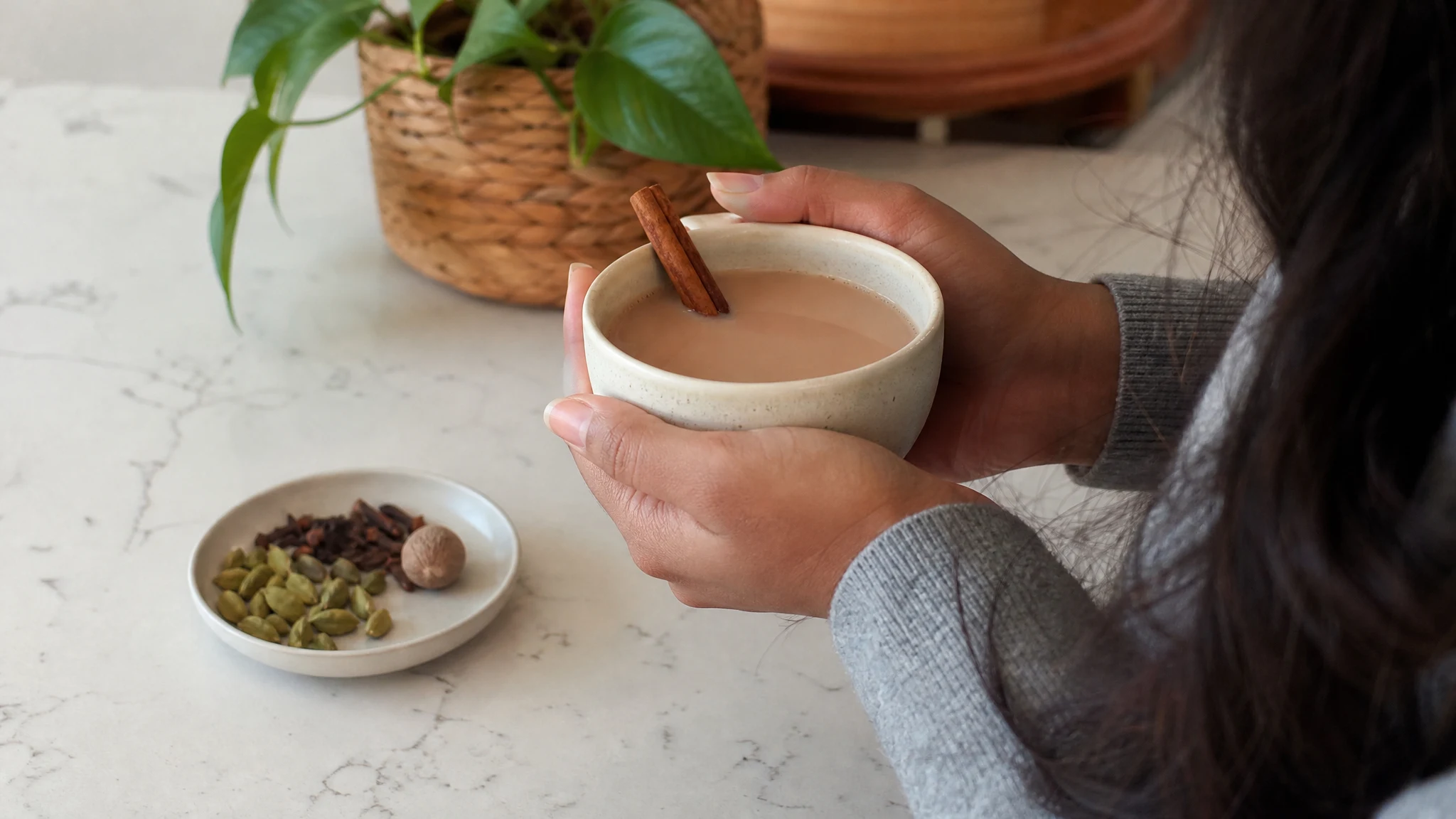
Chai Essential Oil Blend: Six Oils by Weight for a Diffuser
Chai is a food, and a chai oil blend is a different thing: the decision to make is not which oils smell like tea, but whether nutmeg belongs in the bottle at all. The sources read for this post list cardamom, ginger and cinnamon as the most common masala chai spices, and nutmeg is not on that list, so in this formulation nutmeg is the optional ten percent. This post builds a six-oil diffuser concentrate by weight, explains why the sensitisers (cinnamon leaf and clove bud) are kept small, and does the drop arithmetic. We have not blended, smelled or tested it, and it makes no claim about mood, so make a small bottle first.
Nutmeg Essential Oil
Our own Nutmeg Essential Oil, in sizes from 0.5 oz to bulk.
From $10.99
Shop Now →What the food contains
The Wikipedia entry for masala chai, citing the Tea Board of India and HowStuffWorks, says the spices used most often include cardamom, grated ginger and cinnamon, with cloves, star anise, black peppercorns, mint and lemongrass also used. It adds, without a citation, that masala chai in western India often leaves out cloves and black peppercorns. That is the whole of the food-culture evidence here: there is no single recipe, and nutmeg appears in none of the lists the entry gives. Treat nutmeg as a pumpkin-pie-spice ingredient that some chai drinkers add, not as the identity of chai; if you already made the pumpkin spice blend, this one is deliberately different in structure, with cardamom leading and cinnamon and clove reduced.
The oils in a diffuser are not the spices in the pot. Our own copy says nutmeg oil is not for internal use, and none of the oils discussed here belongs in tea or on a spoon. Poison Control gives 1-800-222-1222 as the number to call about a swallowed essential oil, and says bottles should be locked away from children and pets.
The sensitiser stack
The two chai oils most likely to cause a skin reaction are the cinnamon and the clove. de Groot and Schmidt's review of essential oil contact allergy (Dermatitis, 2016) reports that nearly 80 essential oils have caused contact allergy, and that 9 of the 55 oils tested in consecutive patients with suspected contact dermatitis gave positive patch tests in more than 2% of them. The abstract available for this post does not name the nine oils, so we do not claim which they are.
The Tisserand Institute's cinnamon report (Ablard, Carson and Tisserand, October 2015) says cinnamon bark and cassia oils are about 75% cinnamaldehyde and cinnamon leaf about 1%, and that 27% of survey users of bark or cassia oil on skin reported an adverse reaction (345 responses, 55 excluded; the authors expect some overstatement from survey bias). Hence leaf, not bark, in this recipe. For clove bud, the Tisserand Institute's eugenol article gives topical maximums from Essential Oil Safety, 2nd edition, of 0.5% for clove bud and 0.6% for cinnamon leaf, and Vanderbilt's poison-control note (December 16, 2025) says oil of cloves is about 60 to 90% eugenol. The sources fetched for this post gave no numeric limit for cardamom, ginger or black pepper oil, so we state none; the supplier's data sheet and IFRA certificate are where to look.
Nutmeg's limits
IFRA's compilation (51st Amendment, January 2024) has no standard naming nutmeg oil. Two constituent standards can apply: safrole and its isomers (a note box allowing natural extracts as long as the total in a finished product is 0.01% or less) and methyl eugenol (for example 0.0015% in Category 5A and 0.00062% in Category 10A, Amendment 51, 2023). EFSA's 2023 opinion (EFSA FEEDAP Panel) reports seven Indonesian nutmeg oil batches with safrole 1.69 to 2.30% and methyleugenol 0.18 to 0.33%, and describes the additive as a skin and respiratory sensitiser for those handling it. Our certificate of analysis gives no constituent figures, so we cannot say where our oils sit. Tisserand's nutmeg chart (November 2019) gives adults 0.8% for East Indian nutmeg oil and 5% for West Indian, 0.2% in pregnancy for East Indian, and marks ages 3 to 24 months as do not use. Our pages say 0.5% to 2% in a carrier for skin; with our origin unstated we read the East Indian row as the cautious one, and 0.8% is lower than the top of our range. We recommend 0.8% or less for skin. This blend is for a diffuser, not skin.
The concentrate, by weight
Parts by weight for 10.0 g in a small dropper bottle (about a third of an ounce):
| Oil | Grams | Share | Role |
|---|---|---|---|
| Cardamom | 3.0 | 30% | lead |
| Ginger | 2.5 | 25% | second |
| Black pepper | 1.5 | 15% | dry edge |
| Cinnamon leaf (not bark, not cassia) | 1.5 | 15% | sensitiser, kept small |
| Nutmeg | 1.0 | 10% | optional |
| Clove bud | 0.5 | 5% | sensitiser, kept small |
This is a formulation worked out from the food-mix list above, not a finding, so the proportions are a starting point you may change. Moving the nutmeg gram into cardamom gives a nutmeg-free version, which the evidence above suggests is closer to the food. Weigh the oils on a scale readable to 0.1 g. Tisserand Institute's review of drop-size studies found 20 drops weighing 0.66 g on average in three studies and 20 to 40 drops per ml across them, so counting drops would swing the nutmeg share widely. For our nutmeg oil, 1.0 g is about 1.1 ml (relative density 0.887 on the batch on our COA), roughly 23 drops at 20 per ml. We do not sell cardamom, ginger, black pepper, cinnamon leaf or clove bud oil; buy them from an aromatherapy or craft supplier and ask for the botanical name and plant part on the label, a GC-MS report and an IFRA certificate.
Diffuser arithmetic
Robert Tisserand, replying to a reader on a Tisserand Institute page about peppermint and eucalyptus for children (March 9, 2020), wrote that dilution rates do not apply to diffusion and that "2-3 drops over several hours is a reasonable guide". That is a comment about other oils, not a nutmeg limit. The institute's safety guidelines page advises 30 to 60 minutes on and then 30 to 60 minutes off, with some fresh air exchange.
At 3 drops of concentrate per session and 0.033 to 0.044 g a drop (0.66 g per 20 drops from the review above; 20 drops per ml at about 0.9 g/ml), a session uses 0.10 to 0.13 g of blend. Nutmeg at 10% is 0.010 to 0.013 g, a quarter of a drop of straight nutmeg oil. A 10.0 g bottle covers about 75 to 100 sessions. The cinnamon leaf share is 0.015 to 0.020 g a session, and the clove bud share about 0.005 to 0.007 g.
A skin version is a different formulation with different limits, and this post does not give one.
Who should skip it
Our process page says nutmeg oil is unsuitable for anyone pregnant or nursing, unsuitable for children, and not to be used at all with medication acting on the central nervous system, and to diffuse sparingly. Our product pages say to keep it away from children and pets. Pet Poison Helpline's essential oil article says cats and birds are at the greatest risk, with oral exposure the highest-risk route; a veterinarian is the person to call if a pet drools, vomits or is lethargic. Pregnant or nursing readers and anyone on medication should ask a physician or pharmacist first.
On labeling, the FDA's aromatherapy page (current as of 09/08/2023) says how an aromatherapy product is regulated depends mainly on its intended use, judged partly from claims in labeling, and lists claims such as helping you sleep or treating depression or anxiety as drug claims. So a gift label for this blend should name the scent and nothing about what it does to anyone.
For other directions from the same oil see the pairing guide, nutmeg versus ginger, the pregnancy post and the safety basics.
If you want the nutmeg, see the shop page for sizes, and ask in writing for any constituent figure you need before you order.
Nutmeg Essential Oil
Nutmeg Essential Oil from our own shop, in sizes from 0.5 oz to bulk.
From $10.99
Shop Now →Sources & Further Reading
- Wikipedia. Masala chai (cites Tea Board of India and HowStuffWorks). en.wikipedia.org/wiki/Masala_chai
- de Groot AC, Schmidt E, 2016. Essential Oils, Part IV: Contact Allergy. Dermatitis 27(4):170-175. doi.org/10.1097/DER.0000000000000197
- Ablard K, Carson C, Tisserand R, 2015. Cinnamon Survey Special Report, Tisserand Institute. tisserandinstitute.org/Tisserand-Cinnamon-Report
- Tisserand Institute. Eugenol: essential oil constituents in food, part 4. tisserandinstitute.org/eugenol
- Vanderbilt Poison Control, 2025. What is the main toxic component of oil of cloves. vumc.org/poison-control
- IFRA, 2024. IFRA Standards, 51st Amendment compilation (safrole, methyl eugenol). ifrafragrance.org/51st-amendment
- EFSA FEEDAP Panel, 2023. Nutmeg oil as a feed additive. EFSA Journal 21(6):e08066. PMC10273060
- Tisserand Institute, 2019. Nutmeg essential oil safety guidelines. tisserandinstitute.org/assessing-safety-nutmeg
- Tisserand Institute. Drop size. tisserandinstitute.org/drop-size
- Tisserand Institute. Peppermint and eucalyptus for children (reader reply, March 9, 2020). tisserandinstitute.org/?p=5714
- Tisserand Institute. How to use essential oils safely. tisserandinstitute.org/safety-guidelines
- Poison Control (NCPC). Essential oils. poison.org/articles/essential-oils
- Pet Poison Helpline. Essential oils and pets. petpoisonhelpline.com/essential-oils
- US FDA, 2023. Aromatherapy (current as of 09/08/2023). fda.gov/aromatherapy