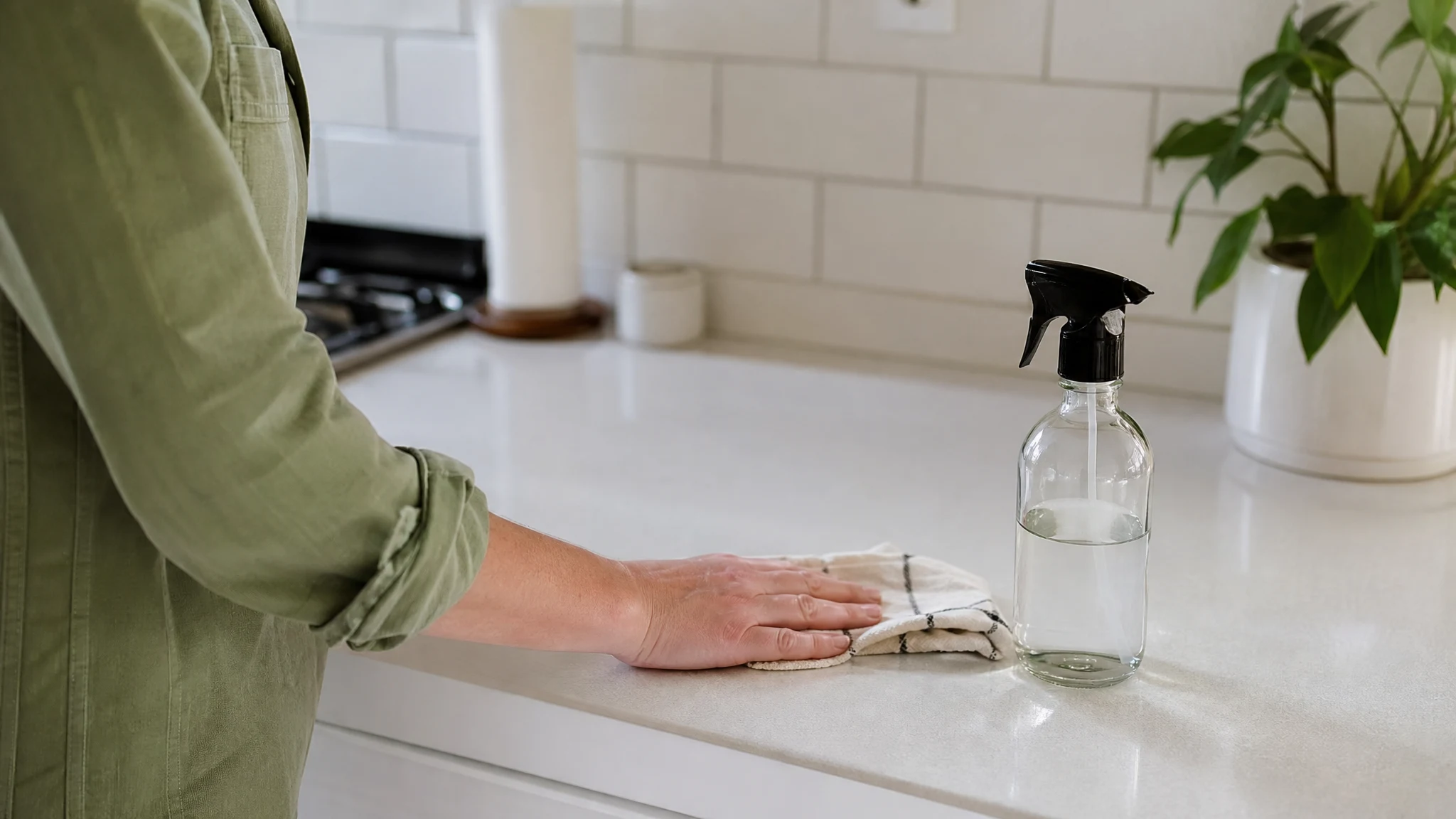
Nutmeg Oil in a Cleaning Spray: Soap Cleans, Oil Only Scents
Nutmeg oil is a poor lead scent for a household cleaner, and the reason is arithmetic, not taste. The fragrance industry's own limits for two constituents that nutmeg oil can carry, methyl eugenol and safrole, cap how much oil a hand-sprayed cleaner should hold, and at that cap the nutmeg note is faint. This post builds a 500 ml all-purpose spray around diluted liquid castile soap, uses nutmeg oil as an accent at a deliberately low load, and states plainly that the soap cleans and the oil only scents. We have not made or tested this formulation, so test a small bottle on a hidden patch of each surface before you commit.
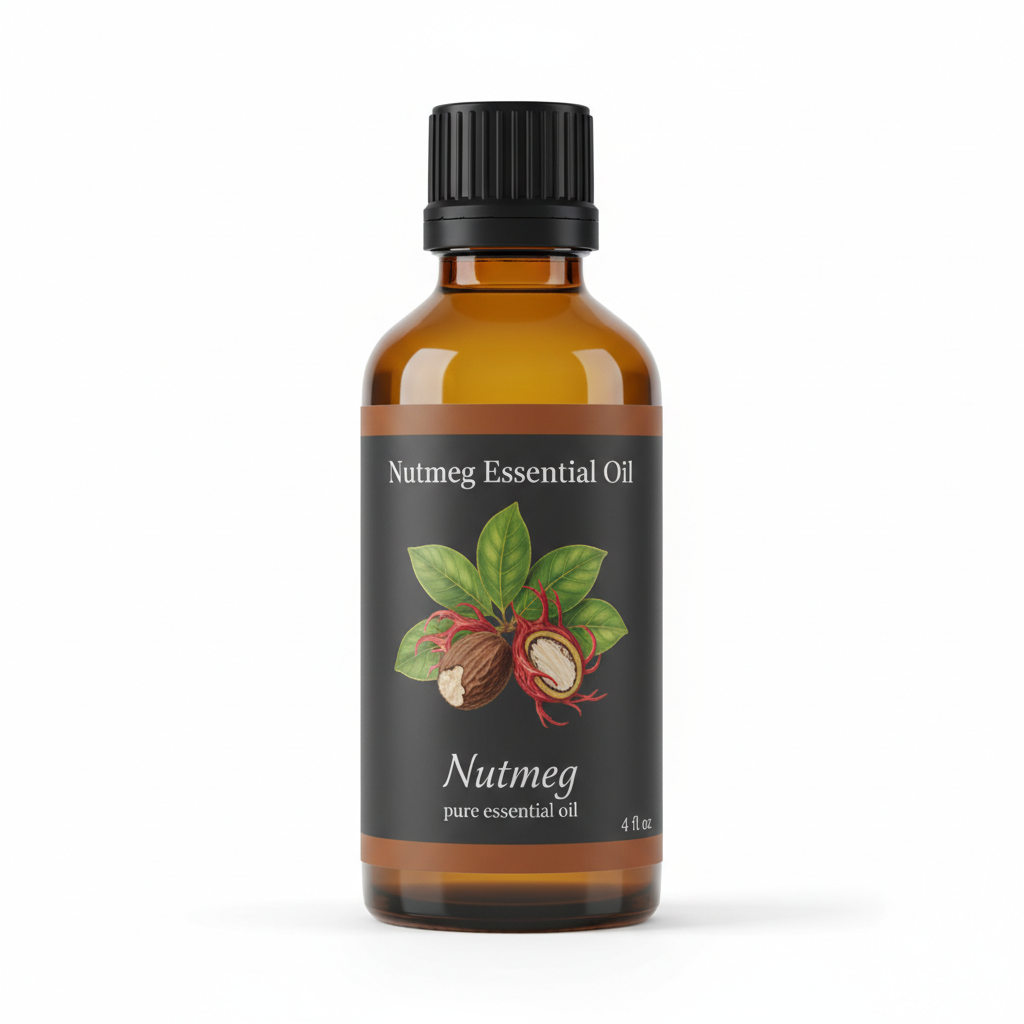
Nutmeg Essential Oil
Our own Nutmeg Essential Oil, in sizes from 0.5 oz to bulk.
From $10.99
Shop Now →What does the cleaning, and what the oil cannot claim
The CDC separates three jobs. Per its page dated June 3, 2025, cleaning is done with water, soap and scrubbing and removes germs, dirt and impurities from surfaces, while disinfecting products are chemicals that work by killing any remaining germs. The same page says disinfecting at home is likely not needed unless someone is sick or a sick person has recently visited. A soap-and-water spray belongs to the first job only.
The second job has a legal edge. EPA states that registered antimicrobial products may not make efficacy claims against pathogens unless the Agency has reviewed data to support the claim (EPA page last updated August 24, 2026), and that a surface must stay visibly wet for the whole contact time printed on a registered product's label. A homemade spray has no such data and no contact time, so this recipe makes no disinfection claim and neither should the label you stick on the bottle.
One regulatory detail is worth knowing if you ever think of selling a bottle. EPA exempts some "minimum risk" products from registration, and the active ingredients allowed are listed in 40 CFR 152.25(f). Cinnamon oil and clove oil are in that table, nutmeg is not, and a condition applies to every listed product: it must not bear claims to control or mitigate microorganisms that pose a threat to human health. That is a reason to take any plan to sell a cleaner to a regulatory consultant or product-safety attorney; this post is only about a bottle made for your own home.
The ceiling: how much nutmeg oil a cleaner can hold
IFRA has no standard that names nutmeg oil. A text search of the complete IFRA Standards compilation (up to the 51st Amendment, January 2024) found no entry for nutmeg or Myristica. Two constituent standards do apply to any oil that contains the constituents:
- Safrole, isosafrole and dihydrosafrole (Amendment 17, 1987): not to be used as such, but natural extracts are tolerated as long as the total of the three in the finished consumer product does not exceed 0.01%. The driver is carcinogenicity. The US National Toxicology Program lists safrole as reasonably anticipated to be a human carcinogen (Report on Carcinogens, 15th edition), on animal evidence, and names nutmeg among its spice sources.
- Methyl eugenol (Amendment 51, 2023): maximum in the finished product 0.00062% in Category 10A and 0.0021% in Category 10B. IARC classified methyleugenol as probably carcinogenic to humans (Group 2A) in June 2023, on sufficient animal evidence and strong mechanistic evidence, with no human studies.
Which category is a spray cleaner? IFRA's June 30, 2023 Guidance lists "hard surface cleaners of all types (bathroom and kitchen cleansers, furniture polish, etc.)" under Category 10A and manual air freshener sprays under 10B. A trigger-bottle surface cleaner is 10A, the tighter of the two for methyl eugenol.
The ceiling then depends on how much methyl eugenol the oil carries, which our published certificate of analysis does not state (it gives a relative density of 0.887, refractive index and optical rotation, nothing on constituents). Published analyses of other nutmeg oils vary widely. The EFSA feed-additive opinion (EFSA FEEDAP Panel, 2023) reports seven Indonesian batches with safrole 1.69 to 2.30% and methyleugenol 0.18 to 0.33%. A 2024 review table (Al-Rawi et al., 2024) gathers distilled-oil rows from other studies: methyl eugenol 0.38 to 0.74% in three, and 8.0% in one Indonesian steam distillation run for 180 minutes (Nikolic et al., 2021, as tabulated); safrole 0.72 to 3.07% across the distilled rows. These describe those samples, not our oils. The ceiling is the IFRA limit divided by the constituent's share of the oil:
| Methyl eugenol in the oil | Max oil in a 10A cleaner (0.00062% / share) | Max oil by safrole alone (0.01% / 3.07%) |
|---|---|---|
| 0.18% (EFSA low) | 0.34% | 0.33% |
| 0.33% (EFSA high) | 0.19% | 0.33% |
| 0.74% (review table) | 0.084% | 0.33% |
| 8.0% (one outlier row) | 0.0078% | 0.33% |
This is our arithmetic, not an IFRA instruction: IFRA's limits govern fragrance suppliers' formulas, and a home maker is not bound by them, but they are the only published numbers that bite for a hand-sprayed product. The practical reading: at 0.05% oil (the recipe below) every row passes except the 8.0% outlier, and at 0.1% the 0.74% row fails. Treat 0.1% as a ceiling you may use only if the seller gives you a written methyl eugenol share of 0.6% or less, and ask for it before you buy. With no figure in writing, stay at 0.05% or leave the nutmeg out.
The recipe, by weight
For a 500 ml spray bottle, using the dilution on Lisa Bronner's castile dilution cheat sheet (undated), which gives an all-purpose cleaning spray as a quarter cup (60 ml) of liquid castile soap in a quart of water. Scaled to 500 ml that is about 30 ml of soap.
- Weigh 0.25 g of nutmeg oil into a small cup. That is 0.05% of a 500 g batch. At about 20 drops per ml and 0.887 g/ml (the batch on our COA) it is roughly 6 drops, but Tisserand Institute's review of drop-size studies reports 20 to 40 drops per ml, so it could be 6 to 11 drops. Use a scale readable to 0.01 g, or make 1 kg and weigh 0.5 g.
- Stir the oil into the 30 ml of castile soap first. Reasoning, not a test result: oil does not dissolve in water, and the soap is the only thing in this recipe that can carry it.
- Add water to 500 ml, cap, and shake before every use, because the oil will separate on standing.
- Label the bottle with the contents and the date. Do not add a germ-killing claim.
A clear spray needs a solubilizer such as polysorbate 20 (one supplier lists it at HLB 16.7 and a recommended level of 1 to 20% of a formula, with no oil-to-solubilizer ratio on the product page). Ask the supplier for that ratio rather than guessing. We do not sell solubilizers, soap, spray bottles or any oil other than nutmeg.
If you want the bottle to smell of more than a hint, the arithmetic says the main scent has to come from another material, one whose own limits you have checked. Expect nutmeg at this load to read as a faint warm edge on a soap smell, and do not raise it to make up the difference.
Surfaces, soap and water
The Natural Stone Institute's care page says products containing lemon, vinegar or other acids may dull or etch calcareous stone, and recommends a neutral cleaner, stone soap or mild dishwashing detergent in warm water, noting that too much cleaner leaves a film. So leave vinegar and citrus out of this spray, and do not follow it with a vinegar rinse on marble, limestone or travertine. Test the spray on an out-of-sight spot of any stone, wood or sealed surface first.
Hard water changes the result. USGS says that in hard water soap reacts with calcium to form soap scum, so more soap is needed, and it classes water above 180 mg/L as calcium carbonate as very hard. The soap maker's own cheat sheet says to use more than the stated amount if your water is really hard, while the stone institute warns that extra cleaner leaves film; if the bottle turns cloudy or leaves white streaks, wipe with a damp cloth and consider water from a softer source rather than adding soap.
People and animals in the house
Our own safety copy says nutmeg oil is for external use only, never to be swallowed, and to be kept away from children and pets; our process page adds that it is unsuitable for anyone pregnant or nursing, unsuitable for children, and not to be used at all with medication acting on the central nervous system. A spray bottle that smells of food spice is easy for a child to mistake for something harmless, so store it out of reach, and keep the neat nutmeg bottle capped and away from the work surface.
Poison Control says that bottles of essential oils should be locked up out of the sight and reach of children and pets, and gives 1-800-222-1222 as the number to call for a swallowed essential oil. Pet Poison Helpline's essential oil article says cats and birds are at the greatest risk, with oral exposure the highest-risk route, then dermal, then respiratory, and lists drooling, vomiting, lethargy and anorexia among the common signs. If a cat walks through a wet floor and licks its paws, that is an oral exposure; call a veterinarian. Pregnant or nursing readers, and anyone on central-nervous-system medication, should ask their physician or pharmacist before using the spray at all.
The EFSA opinion above treats the nutmeg oil it assessed as a skin and respiratory sensitiser, in the context of handling the neat oil as a feed additive. That is a reason to measure the 0.25 g in a ventilated room and to wash hands afterwards, not a measure of what the finished spray does.
A note on our own skin copy
This spray is not a skin product, but because hands touch it, the skin figures are relevant. Our product pages say to dilute to 0.5% to 2% in a carrier oil for skin. The Tisserand Institute's nutmeg chart (Tisserand, posted November 2019, based on Essential Oil Safety, 2nd edition) gives adults 0.8% for East Indian nutmeg oil and 5% for West Indian, 0.2% in pregnancy and for ages 6 to 15 for East Indian oil, and marks both types as not for ages 3 to 24 months. Our oils' origin is not stated on our pages, so the cautious reading is the East Indian row, and 0.8% is lower than the top of our own 2% range. For skin we recommend staying at or below 0.8%, and the 0.05% in this spray sits below every numeric figure on that chart.
What to do next: if you want the nutmeg accent, see the shop page for current sizes, ask in writing for a methyl eugenol and safrole figure before ordering a larger size, and read the safety basics post and the GC-MS explainer first. For scenting air instead of surfaces see home fragrance, and for what lab germ studies do and do not show see the antimicrobial research review. Everyday uses are in the at-home guide.
A cleaner is clean because of the soap, the scrubbing and the rinse. Nutmeg oil at 0.05% is an accent, worth adding only if you have a scale and, ideally, a written constituent figure from the seller; see the shop page for current sizes.
Nutmeg Essential Oil
Nutmeg Essential Oil from our own shop, in sizes from 0.5 oz to bulk.
From $10.99
Shop Now →Sources & Further Reading
- CDC, 2025. Cleaning and Disinfecting. cdc.gov/hygiene/cleaning-disinfecting
- US EPA, 2026. Selected EPA-Registered Disinfectants. epa.gov/pesticide-registration
- 40 CFR 152.25(f), minimum risk pesticides. law.cornell.edu/cfr/text/40/152.25
- IFRA, 2024. IFRA Standards, 51st Amendment compilation (safrole, methyl eugenol). ifrafragrance.org/51st-amendment
- IFRA, 2023. Guidance for the use of IFRA Standards (June 30, 2023). ifrafragrance.org/guidance
- NTP, 15th Report on Carcinogens. Safrole. ntp.niehs.nih.gov/safrole
- IARC, 2023. Q&A on methyleugenol and isoeugenol, Monographs Volume 134. iarc.who.int/QA-methyleugenol
- EFSA FEEDAP Panel, 2023. Nutmeg oil as a feed additive. EFSA Journal 21(6):e08066. PMC10273060
- Al-Rawi et al., 2024. Nutmeg seed review, Saudi Pharmaceutical Journal. PMC11059288
- Tisserand Institute, 2019. Nutmeg essential oil safety guidelines. tisserandinstitute.org/assessing-safety-nutmeg
- Tisserand Institute. Drop size. tisserandinstitute.org/drop-size
- Lisa Bronner. Liquid castile soap dilutions cheat sheet. lisabronner.com/castile-dilution
- Natural Stone Institute. Care and cleaning. naturalstoneinstitute.org/consumers/care
- USGS. Hardness of water. usgs.gov/hardness-water
- Poison Control (NCPC). Essential oils. poison.org/articles/essential-oils
- Pet Poison Helpline. Essential oils and pets. petpoisonhelpline.com/essential-oils
- Lotioncrafter. Polysorbate 20 product page. lotioncrafter.com/polysorbate-20