
Nutmeg Oil and Digestion: Why the Spice Is Not the Oil
Nutmeg the kitchen spice, nutmeg as a traditional herbal preparation and nutmeg essential oil are three different materials, and the digestive literature belongs almost entirely to the first two. The search found no human trial of nutmeg oil, inhaled or on the skin, for any digestive purpose. Our oils are labelled not for internal use, our shop makes no digestive claim, and this article gives no ingestion instruction and no abdominal massage instruction.
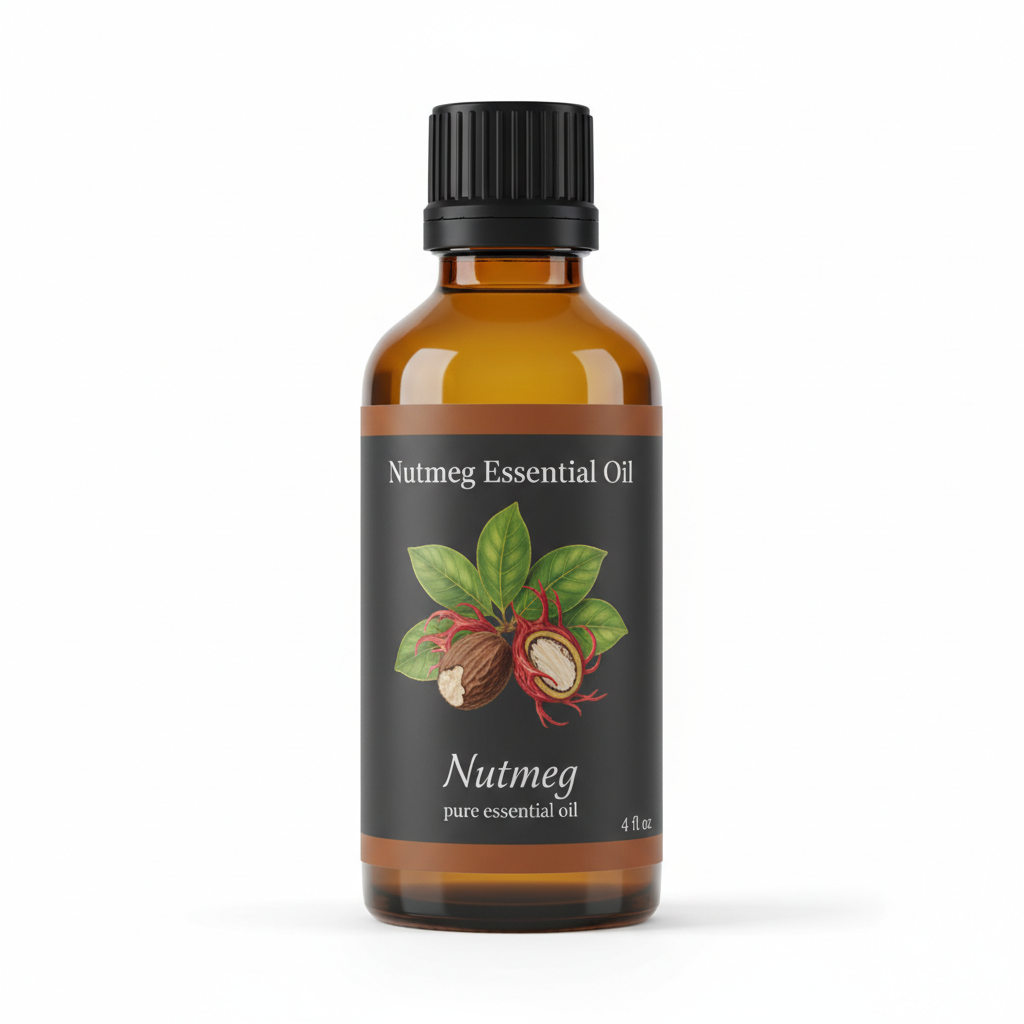
Nutmeg Essential Oil
Our own Nutmeg Essential Oil, in sizes from 0.5 oz to bulk.
From $10.99
Shop Now →Three materials that share one name
The Missouri Poison Center describes nutmeg as roughly 8% to 15% volatile (essential) oil and 20% to 40% fixed oil, and states that the volatile fraction is responsible for nutmeg's toxic effects, naming myristicin, elemicin, safrole and eugenol among the components (Missouri Poison Center, 9 December 2022). So the oil is the concentrated part of the spice that carries the compounds of concern, which is the reverse of what the phrase "natural digestive aid" suggests. The FDA's food rules list nutmeg (Myristica fragrans Houtt.) among substances generally recognized as safe for their intended use as essential oils, oleoresins and natural extractives (21 CFR 182.20); that is a food-flavoring status for the listed intended use, and it is not a statement about aroma products or digestive health. Mace, the aril around the seed, and CO2 extracts are separate again; see nutmeg oil versus mace oil and CO2 extract versus essential oil.
What traditional sources say
A 2026 systematic review of the botany, traditional uses and pharmacology of M. fragrans reports that nutmeg entered China around the 3rd to 4th centuries CE and that classical Chinese texts describe its functions as "warming the middle jiao to promote qi flow, and astringing the intestines to relieve diarrhea" (Luo et al., 2026). A 1989 Japanese paper records that mace has been used in Indonesian folk medicine as an aromatic stomachic (Ozaki et al., 1989). These are descriptions of what traditions did with the spice, in prepared forms, taken by mouth. They are historical records, not trial evidence, and none describes an essential oil on skin or in the air.
What the laboratory studies tested
| Study | Material and route | Model | Reported | What it is not |
|---|---|---|---|---|
| Grover et al., 2002 | Nutmeg crude suspension, petroleum-ether and aqueous extracts | Animal diarrhea models and isolated guinea pig ileum | Suspension and petroleum-ether extract (not the aqueous extract) reduced loose stools or lengthened latency; petroleum-ether extract blocked contractions induced by acetylcholine, histamine and prostaglandin | Extracts in animals; not oil, not people |
| Li et al., 2025 | Water extract, 182 and 364 mg/kg by mouth for 14 days before ethanol | Mice with ethanol-induced stomach ulcers | Lower inflammatory markers and signs of less oxidative stress; the authors propose it as a "promising therapeutic strategy" | A water extract (a decoction-type preparation), a protective-dosing design in mice |
| Ogawa et al., 2019 | Nutmeg oil, myristicin and methyl eugenol by inhalation | Mice | Increased appetite; methyl eugenol also reduced locomotion at the same dose | The one inhaled-oil result is about appetite, not digestion, in mice |
The inhalation row deserves one more sentence. A 2023 systematic review of essential oils and appetite found 41 studies, of which only two were clinical and 39 used animals (Effects of Essential Oils and Fragrant Compounds on Appetite, 2023). Appetite also sits upstream of digestion and does not amount to it, and the compounds that raised appetite in Ogawa's mice, myristicin and methyl eugenol, are constituents that the poison literature (myristicin) and IFRA's fragrance standards (methyl eugenol, IFRA, 2024) single out. A 2024 review of nutmeg seed pharmacology that screened 235 included articles listed gastric-secretion work in rabbits and an ethanol-ulcer study in rats, called for more clinical trials, and in the portion read cited no human digestive trial (Al-Rawi et al., 2024).
The search for people
A PubMed search run on 28 October 2026 for nutmeg or Myristica fragrans with digestion, bloating, dyspepsia or constipation, limited to randomized or clinical trials, returned one record, a 2019 in vitro study of herbal feed additives for livestock. A broader search with gastric, intestinal, diarrhea, carminative or gastrointestinal terms returned 127 records; the first 20 titles were laboratory studies, reviews, veterinary work and unrelated case reports. The search did not find a human trial of nutmeg oil by any route for digestion. Absence from PubMed does not prove an effect is absent; it does mean no sentence in a shop article could cite one.
When the stomach is the symptom of nutmeg
The poison literature reads the other way. Missouri lists burning pain in the upper abdomen and chest, nausea and vomiting as the first effects after nutmeg ingestion, with nervous-system symptoms following, usually 3 to 8 hours later. MedlinePlus lists abdominal pain, dehydration and nausea under "Myristica oil poisoning," names aromatherapy products among the sources, and gives the U.S. Poison Help line, 1-800-222-1222 (MedlinePlus, reviewed 14 October 2025). In a 10-year Illinois Poison Center review, 32 nutmeg ingestions were recorded, 17 of them unintentional, 10 of those in children under 13 (Ehrenpreis et al., 2014). A bottle of oil in a house with children is an ingestion risk first; our copy says to keep it away from children and pets and never to take it internally, and the ingestion article and the safety basics go further.
Where bloating and gut symptoms actually go
The NHS says a pharmacist can help with bloating and lists these thresholds (NHS, last reviewed 21 January 2026):
- See a GP if bloating is regular, if diet changes have not helped, if weight is being lost without trying, or if there is blood in the stool.
- Ask for an urgent GP appointment or call NHS 111 if bloating comes with vomiting, diarrhea or constipation, a fever, a lump or swelling in the abdomen, or an inability to pass stool or wind.
- Go to A&E or call 999 for bloating with a swollen stomach and severe sudden pain, vomiting blood, or severe difficulty breathing.
In the United States, the National Institute of Diabetes and Digestive and Kidney Diseases says gas symptoms warrant a conversation with a doctor if they occur often, bother you or affect daily activities, if they change suddenly, or if they come with abdominal pain, constipation, diarrhea or weight loss; it lists swallowed air and incompletely digested carbohydrates as ordinary causes (NIDDK, last reviewed June 2021). A physician or pharmacist is the right person to ask; a bottle of scent material is not.
What this means for our oil
The FDA decides whether a product is a cosmetic or a drug by its intended use, shown by claims on labels, advertising or the internet (FDA, content current as of 11 September 2024). Our shop sells nutmeg oil as a warm spice scent and states that it is not for internal use, so a digestive claim has no place in our copy. The one honest sentence the literature supports is narrow: in animals, extracts of the spice have been tested in digestive models, and nobody has shown that anything similar happens in a person who smells or touches the oil. For what the shop does say about use, see the benefits article and the FAQ.
Digestive symptoms that persist or arrive with the warning signs above belong with a pharmacist or physician, and nutmeg oil is something to keep capped and out of reach.
Nutmeg Essential Oil
Nutmeg Essential Oil from our own shop, in sizes from 0.5 oz to bulk.
From $10.99
Shop Now →Sources & Further Reading
- Missouri Poison Center, 2022. Nutmeg abuse. missouripoisoncenter.org/nutmeg-abuse
- 21 CFR 182.20. Essential oils, oleoresins (solvent-free), and natural extractives (including distillates). law.cornell.edu/cfr/text/21/182.20
- Luo J et al., 2026. Myristica fragrans: a comprehensive review of its botanical characterization, traditional uses, phytochemistry, and pharmacological properties. J Ethnopharmacol. pubmed.ncbi.nlm.nih.gov/41275940
- Ozaki Y et al., 1989. Antiinflammatory effect of mace, aril of Myristica fragrans Houtt., and its active principles. Jpn J Pharmacol. pubmed.ncbi.nlm.nih.gov/2487032
- Grover JK et al., 2002. Pharmacological studies on Myristica fragrans: antidiarrheal, hypnotic, analgesic and hemodynamic parameters. Methods Find Exp Clin Pharmacol. pubmed.ncbi.nlm.nih.gov/12616960
- Li X et al., 2025. Myristica fragrans water extract and anhydrous ethanol-induced gastric ulcers. J Ethnopharmacol. pubmed.ncbi.nlm.nih.gov/39708935
- Ogawa K et al., 2019. Appetite-enhancing effects of nutmeg oil. J Nat Med. pubmed.ncbi.nlm.nih.gov/30919203
- 2023. Effects of essential oils and fragrant compounds on appetite: a systematic review. Int J Mol Sci. pubmed.ncbi.nlm.nih.gov/37175666
- Al-Rawi SS et al., 2024. Therapeutic and pharmacological prospects of nutmeg seed: a comprehensive review. Saudi Pharm J. pmc.ncbi.nlm.nih.gov/PMC11059288
- MedlinePlus, 2025. Myristica oil poisoning. medlineplus.gov/ency/article/002899
- Ehrenpreis JE et al., 2014. Nutmeg poisonings: a retrospective review of 10 years experience from the Illinois Poison Center, 2001-2011. J Med Toxicol. pubmed.ncbi.nlm.nih.gov/24452991
- NHS, 2026. Bloating. nhs.uk/conditions/bloating
- NIDDK, 2021. Symptoms and causes of gas in the digestive tract. niddk.nih.gov
- IFRA, 2024. IFRA Standards, 51st Amendment: Methyl eugenol. ifrafragrance.org
- FDA, 2024. Is It a Cosmetic, a Drug, or Both? (Or Is It Soap?). fda.gov/cosmetics