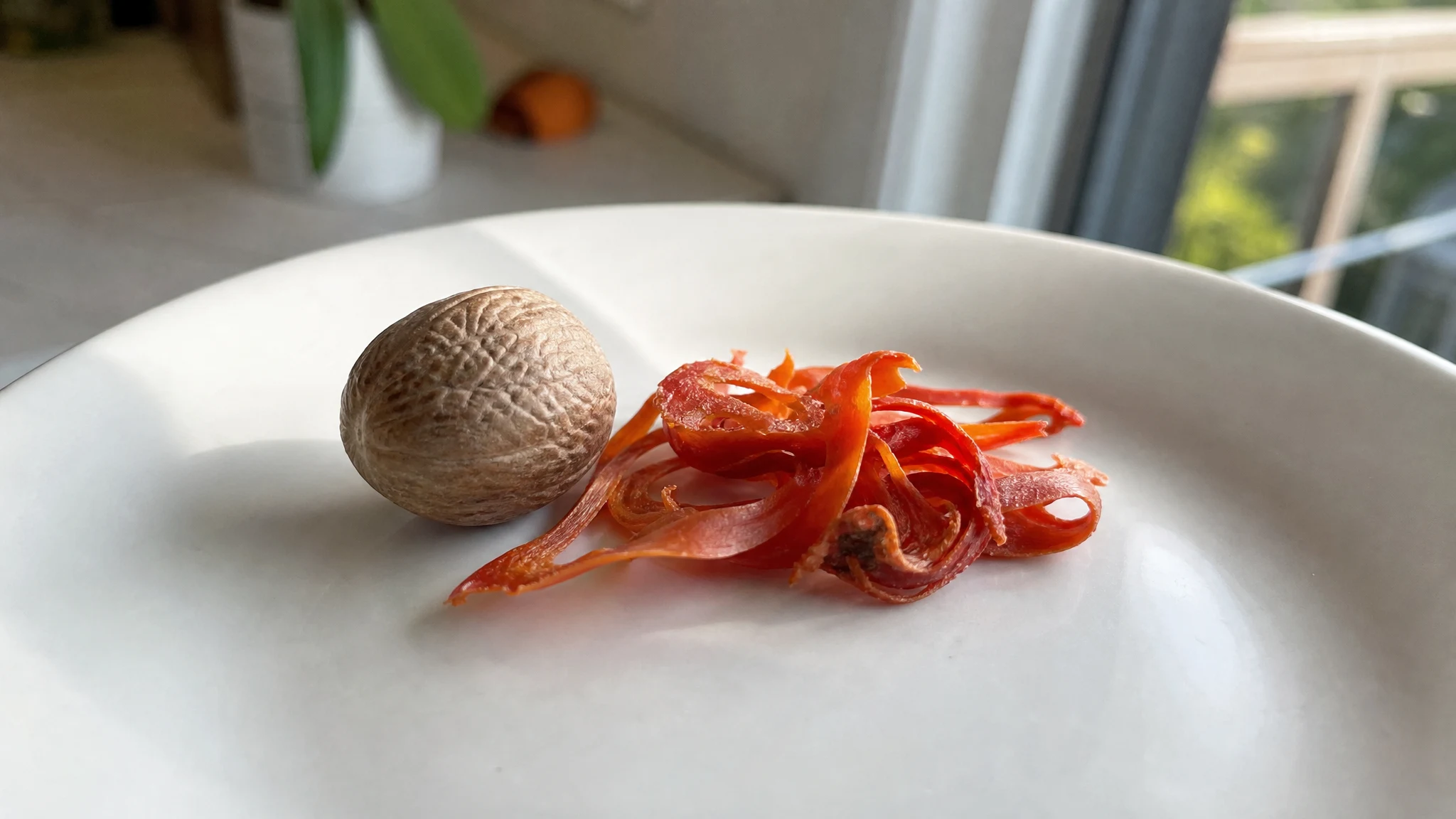
Nutmeg Oil vs Mace Oil: Same Tree, Different Part
Nutmeg and mace come from one tree, Myristica fragrans, but they are different parts of its fruit, and the oils made from them are different materials with overlapping but not identical chemistry. Our position is simple: do not swap one for the other in a formula or a safety calculation, and do not assume the mace oil is the milder one. We sell nutmeg oil only; this post compares the two on published numbers so that a buyer knows what to ask a mace supplier for.
Nutmeg Essential Oil
Our own Nutmeg Essential Oil, in sizes from 0.5 oz to bulk.
From $10.99
Shop Now →Seed and aril: what each oil starts from
GBIF's name-matching service lists Myristica fragrans Houtt. as an accepted species in the family Myristicaceae (GBIF, species match, fetched 2026). A 2024 case report describes mace as "the lacy red covering of fresh nutmeg" (Imtiaz et al., 2024): the aril wrapped around the seed, which is what nutmeg is. The oil from the ground seed kernel is nutmeg oil. The oil from the dried aril is mace oil.
Regulators keep them apart. The EFSA feed-additive opinion on nutmeg oil notes that the original application listed mace oil among its preparations and was split, so the opinion covers the seed oil only (EFSA FEEDAP Panel, 2023). The US food-flavouring list in 21 CFR 182.20 gives mace and nutmeg separate entries under the same botanical name (21 CFR 182.20). That list concerns use as a flavouring; it says nothing about skin or room-scent use, so it is not evidence for either here.
What the composition papers show
The most direct side-by-side is a Kerala Agricultural University study that ran GC/MS on kernel oil and mace oil from 17 morphologically distinct nutmeg types, selected from 46 accessions (Vikram et al., 2024). Set it beside the specification range EFSA used for seven Indonesian nutmeg oils.
| Constituent (% of oil) | Kernel oil, Kerala, 17 types | Mace oil, Kerala, 17 types | Seed oil, EFSA, 7 Indonesian batches |
|---|---|---|---|
| Sabinene | 1.06 to 11.75 | 4.89 to 16.20 | 14 to 29 (specification) |
| Myristicin | 2.98 to 12.84 | 1.57 to 18.87 | 5 to 12 (specification) |
| Elemicin | 4.31 to 22.48 | 1.39 to 27.86 | 0.31 to 0.40 (batches) |
| Safrole | 2.44 to 4.64 | 2.96 to 4.89 | 1.69 to 2.30 (batches) |
Three things follow. First, the mace ranges sit higher at the top for sabinene, myristicin, elemicin and safrole, but the bottoms are lower for myristicin and elemicin, so a single bottle of either oil could land almost anywhere in the other's range. A review of alkenylbenzenes in plants reports that mace oils can carry "eventually 2 to 3 times higher levels of myristicin" than kernel oil, and a Western Ghats paper it cites found safrole and methyleugenol highest in mace oils (Götz et al., 2023); the Kerala numbers show why that is a tendency and not a rule. Second, the elemicin figures differ more than tenfold between Kerala and the Indonesian batches, which reflects origin and type, not part. Third, the Kerala paper reports 24 constituents in mace oil against 20 in kernel oil, and volatile oil of 2.05% to 9.33% in mace against 1.57% to 7.67% in kernel. None of this is data on our oil: the certificate of analysis we publish for one batch (NUTLUBMFINC006A) lists density, refractive index and optical rotation, and no constituent percentages.
Where the toxicology concern sits
For both oils the constituents of concern are the same three: myristicin, elemicin and safrole. The US National Toxicology Program lists safrole as "reasonably anticipated to be a human carcinogen" on animal evidence (liver tumours in two rodent species) and names nutmeg and mace among the edible spices that contain it at low levels (NTP, Report on Carcinogens, safrole profile). EFSA classes nutmeg oil as a category 1B carcinogen under EU labelling rules because safrole is present at 0.1% or more, describes it as irritating to skin and eyes and as a skin and respiratory sensitiser, and records that the applicant supplied no user-safety data (EFSA FEEDAP Panel, 2023, link above).
The human poisoning literature is about swallowed spice, not oil, and that difference matters. Swiss poison-centre records from 2014 to 2023 hold 236 nutmeg enquiries, 78 of them children; among the 33 cases with documented severity, 24% had no symptoms, 48% minor, 27% moderate and none severe or fatal, with a median moderate-case dose of 22.5 g (Bleisch et al., 2026). Mace has far fewer reports. One 2024 case describes a previously healthy six-year-old who ate six pieces of dried mace, arrived with a Glasgow Coma Scale of 8/15, and recovered with supportive care alone (Imtiaz et al., 2024, link above). That is one child, not an incidence. Neither source studied the oils on skin or in air.
Our own copy says never to swallow the oil, keep it from children and pets, and not to use it with medication acting on the central nervous system, and that it is unsuitable in pregnancy. If anyone has swallowed nutmeg or mace oil, call the Poison Help line, 1-800-222-1222 (poison.org), or emergency services if the person cannot be woken.
What the rulebooks name, and what they do not
The IFRA Standards, 51st Amendment compilation (726 PDF pages), contain no entry for nutmeg oil, mace oil, myristicin or elemicin; a full-text search returned none (IFRA, 2024). Two Standards still bite through constituents. The safrole Standard (1987) tells perfumers not to use natural extracts as a back door to safrole and tolerates them only while the total of safrole, isosafrole and dihydrosafrole in the finished product stays at or under 0.01%. The methyl eugenol Standard (2023) sets, for body oils and lotions (Category 5A in IFRA's guidance, 2023), 0.0015% in the finished product.
The Tisserand Institute publishes a chart, based on Tisserand and Young's Essential Oil Safety 2e, for nutmeg oil only: East Indian, adults over 15, 0.8%; West Indian, 5%; East Indian in pregnancy 0.2%; marked X (do not use) for the East Indian row under age 6 (Tisserand Institute, 2019). The search found no equivalent published figure for mace oil, and the AFNOR listing of ISO 3215:1998 is titled "Oil of nutmeg, Indonesian type" and describes nutmeg oil only (ISO 3215:1998, AFNOR listing). A mace oil buyer therefore has less to check against.
The dilution arithmetic, and where it disagrees with our copy
Our product pages say 0.5% to 2% in a carrier oil for skin use. Two published authorities sit below the top of that range. Tisserand's adult figure for East Indian nutmeg oil is 0.8%, and our pages do not state an origin, so we read that row as the cautious one. And the IFRA safrole note, read across as inference (it is written for fragrance mixtures, not for hobby blends), gives a ceiling of 0.01 divided by the safrole share of the oil:
- Safrole 2.30% (top of the EFSA batches): 0.43% oil. At 1.69%: 0.59%.
- Safrole 4.64% (top of Kerala kernel oil): 0.22%. At 4.89% (top of Kerala mace oil): 0.20%.
- At 2% oil, a 2.30% safrole oil delivers 0.046% safrole, 4.6 times the 0.01% figure.
In practice, 1 oz of carrier holds about 591 drops, so 0.5% is about 3 drops and 0.2% about 1 drop. Our recommendation, which is stronger than our product copy: treat 0.5% as the ceiling for a leave-on body oil, and stay near 0.2% unless you hold a lot-specific GC-MS report showing safrole well below the ranges above. We have not made or tested any blend; do a patch test, and ask a physician or pharmacist first if you are pregnant, nursing or on medication.
Verdict, and what to ask a mace supplier
They are not interchangeable: different part, different published ranges, a standard and a safety chart that exist for nutmeg oil and not for mace oil. If you want mace oil, buy it from a supplier that sells it and ask in writing for the botanical name, the part used and a GC-MS report with myristicin, elemicin, safrole and methyl eugenol shares for the lot you receive. Our substitutes post covers swaps in scent terms, the label-reading post covers origin wording, and the aroma-compound post and safety basics cover the constituents. A buyer who needs constituent data for our nutmeg oils should ask in writing before ordering; the published COA does not contain it.
If you came for nutmeg oil itself, the shop lists both oils by size with the current price for each.
Nutmeg Essential Oil
Nutmeg Essential Oil from our own shop, in sizes from 0.5 oz to bulk.
From $10.99
Shop Now →Sources & Further Reading
- Vikram HC et al., 2024. Chemical profiling and constituent diversity in nutmeg genotypes (Kerala Agricultural University). arccjournals.com/a-5848
- EFSA FEEDAP Panel, 2023. Safety and efficacy of nutmeg oil as a feed additive, EFSA Journal 21(6):8066. PMC10273060
- Götz ME et al., 2023. Occurrence of alkenylbenzenes in plants, Plants 12(11):2075. PMC10255789
- Bleisch A et al., 2026. Intoxication with nutmeg: Swiss poisons information centre enquiries 2014 to 2023, Toxicology Reports. PMC13206746
- Imtiaz A et al., 2024. Mace poisoning: accidental toxic ingestion in a child, Cureus 16(12):e76284. PMC11754422
- National Toxicology Program. Report on Carcinogens, safrole profile. ntp.niehs.nih.gov/safrole.pdf
- IFRA, 2024. IFRA Standards, 51st Amendment compilation. ifrafragrance.org
- IFRA, 2023. Guidance for the use of IFRA Standards, 51st Amendment. d3t14p1xronwr0.cloudfront.net
- Tisserand Institute, 2019. Assessing the safety of essential oils, the nutmeg case (chart). tisserandinstitute.org
- US eCFR, 21 CFR 182.20. Essential oils, oleoresins (solvent-free) and natural extractives. law.cornell.edu/cfr/21/182.20
- ISO 3215:1998. Oil of nutmeg, Indonesian type, catalogue listing. boutique.afnor.org
- GBIF. Species match for Myristica fragrans. api.gbif.org
- National Capital Poison Center. Poison Help line. poison.org