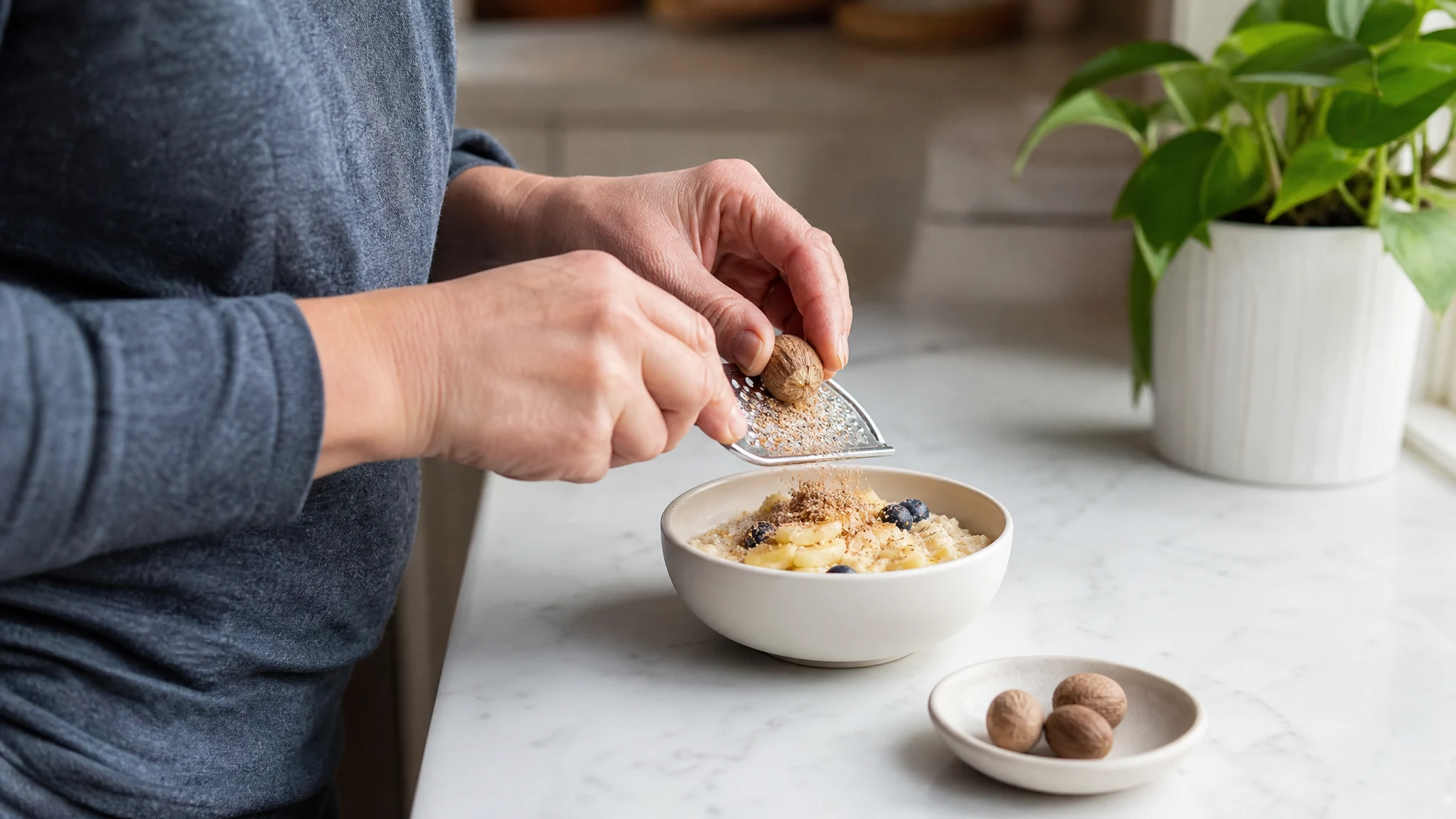
Can You Ingest Nutmeg Essential Oil? What the Sources Say
No. Nutmeg oil is not something to swallow, and our oils are labelled not for internal use. The question confuses people because two true statements sit close together: nutmeg is a kitchen spice, and nutmeg oil appears on a US list of flavouring substances. Neither statement makes a bottle of concentrated oil edible. This page reads the text behind both, and then what poison-centre and case-series literature report when nutmeg is swallowed in quantity.
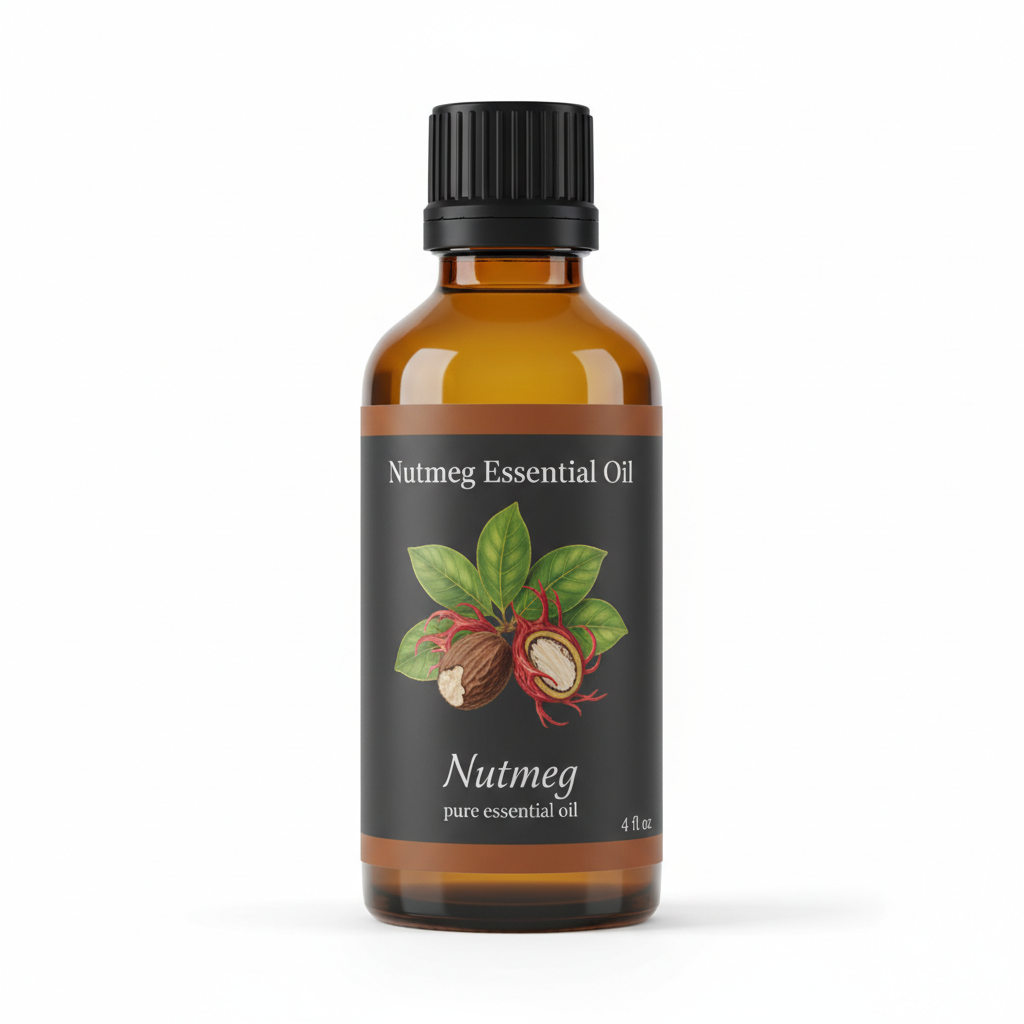
Nutmeg Essential Oil
Our own Nutmeg Essential Oil, in sizes from 0.5 oz to bulk.
From $10.99
Shop Now →What the flavouring list actually says
Title 21 of the Code of Federal Regulations, section 182.20, is headed "Essential oils, oleoresins (solvent-free), and natural extractives (including distillates)" and lists nutmeg (Myristica fragrans Houtt.) among substances generally recognised as safe for their intended use in food. The entry's last amendment shown is 22 May 1985, and the section dates from 1977. So the oil is on the list. What that means depends on the text around it. The general rule in section 182.1 ties the status to good manufacturing practice, which includes that the quantity added to food does not exceed the amount reasonably required to produce its intended effect.
Put plainly, the listing covers a flavour house adding a measured trace of oil to a food. It does not say that a consumer may swallow oil from a bottle, it is not an endorsement of any product, and it is not a statement about how much anyone can take. It also does not turn a bottle sold for scent into a food. FDA decides how a product is regulated by its intended use (FDA aromatherapy page, current as of 8 September 2023), and ours is intended as an aroma material, sold neat. We make no food-grade claim, and we do not offer cooking uses.
What swallowing nutmeg does: the spice record
Every dose figure in the literature is for ground spice, not oil. The Illinois Poison Center reviewed 2001 to 2011 (Ehrenpreis et al., J Med Toxicol, 2014) and found 32 nutmeg ingestions, ages 2 to 30. Fifteen were intentional and 17 unintentional (10 of those in children under 13). Reported symptoms across the cases included hallucination or paranoia (four, all intentional), agitation, drowsiness, dizziness, nausea, vomiting, fast heartbeat and one seizure. Ten patients were treated in hospital, all aged 15 to 17. Five intentional cases involved other drugs. The most serious was a 16-year-old ventilated for about 24 hours after combining nutmeg with several medicines. There were no deaths, and the authors list small numbers, likely under-reporting and incomplete follow-up as limits. Amounts were mostly anecdotal; one teenager reported 25 g of ground nutmeg.
A pharmacology review (Seneme et al., Molecules, 2021) puts the threshold for neuropsychological symptoms at 10 to 15 g of nutmeg, "or about 400 mg of myristicin" (6 to 7 mg/kg), with anticholinergic effects after 25 to 28 g; symptoms may begin 3 to 6 hours after the dose and last up to 72 hours. The Vanderbilt-affiliated Tennessee Poison Center, in a 23 November 2020 post, gives 15 to 20 grams for psychogenic effects and 3 to 8 hours for onset. Those two sources disagree on the numbers and on onset, which is itself informative: the timing and dose are not tidy, and delayed symptoms mean a person can feel fine after swallowing and then not be fine. The review also records one fatal case in the literature, an 8-year-old who ate two nutmegs, from a 1908 report.
Why a bottle is a different object
A pinch of nutmeg in a recipe is a small fraction of the 10 to 15 g that the review below ties to symptoms. A bottle holds a concentrated distillate. EFSA's feed-additive panel analysed seven batches of nutmeg oil, all from Indonesia, and reported myristicin at 8.3 to 10.7%, safrole at 1.69 to 2.30% and methyleugenol at 0.18 to 0.33% (EFSA, 2023). Take a half-ounce bottle: at the 0.887 relative density on our published COA batch it holds about 13.1 g of oil (0.5 oz is 14.79 ml). At EFSA's range that is roughly 1.1 to 1.4 g of myristicin, about 2.7 to 3.5 times the 400 mg the review ties to neuropsychological symptoms after swallowing nutmeg. This is reasoning from two sources, not a dose: it compares spice-derived figures with another oil's composition, we hold no constituent figure for our oils, and the review gives no oil dose. It tells you only that the contents of a small bottle are on a scale that the poison-centre literature treats as a medical event.
The classification of the constituents
The US National Toxicology Program lists safrole as reasonably anticipated to be a human carcinogen on liver tumours in two rodent species (first listed 1981), naming nutmeg among edible spices that contain it at low levels, and the methyleugenol profile (first listed 2002) rests on oral dosing in rats and mice and names nutmeg and mace oils as sources. EFSA classified the oil as a category 1B carcinogen on its safrole content. These are animal findings and a regulatory hazard class; neither measures the effect of one accidental swallow, and neither is a reason to panic. They are one reason the answer to "can I use it in food" cannot be a casual yes.
If someone has swallowed it
Call the Poison Help line, 1-800-222-1222 in the United States; poison.org describes the line and its web tool as free, expert and confidential. Two government pages on other oils give the same direction. Western Australia's essential oils page says oils are not to be consumed and advises not inducing vomiting. MedlinePlus's lavender-oil entry (reviewed 14 October 2025) says not to make a person throw up unless poison control or a provider says so and to call the emergency number (such as 911) in an exposure. The Missouri Poison Center's page explains the lung risk: oil that slips into the lungs can cause chemical pneumonia. Bring the bottle. After a swallow the clinician is a poison specialist or an emergency physician; a pharmacist can answer questions about medicines taken at the same time, which the medications page explains matters.
If what you want is the flavour
Use the spice from the grocery shelf in food, in the amounts the recipe gives. Nobody here sells a food-grade nutmeg oil, and we do not recommend swallowing ours in any amount or in any vehicle, including a drop in a drink or on a sugar cube. For scent, our oils are intended for diffusing, or for dilution into skin and craft products with care; read the safety basics and the skin-limit arithmetic first. For children in the house see the children's page, and for pregnancy the pregnancy page.
Our oils are sold neat, labelled not for internal use, and with a plain instruction on the product pages: never take it internally.
Nutmeg Essential Oil
Nutmeg Essential Oil from our own shop, in sizes from 0.5 oz to bulk.
From $10.99
Shop Now →Sources & Further Reading
- US Government. 21 CFR 182.20, Essential oils, oleoresins (solvent-free), and natural extractives (including distillates); 21 CFR 182.1. ecfr.gov/21-CFR-182.20, ecfr.gov/21-CFR-182.1
- FDA, 2023. Aromatherapy. fda.gov
- Ehrenpreis J.E. et al., 2014. Nutmeg Poisonings: A Retrospective Review of 10 Years Experience from the Illinois Poison Center, 2001-2011. J Med Toxicol 10(2):148-151. PMC4057546
- Seneme E.F. et al., 2021. Pharmacological and Therapeutic Potential of Myristicin: A Literature Review. Molecules 26(19):5914. PMC8512857
- Vanderbilt University Medical Center, Tennessee Poison Center, 2020. Nutmeg, a Potentially Uninvited Holiday Guest? vumc.org/poison-control
- EFSA FEEDAP Panel, 2023. Safety and efficacy of a feed additive consisting of an essential oil from the seeds of Myristica fragrans Houtt. (nutmeg oil). EFSA Journal 21(6):e08066. PMC10273060
- US National Toxicology Program. Report on Carcinogens, 15th edition: Safrole; Methyleugenol. ntp.niehs.nih.gov/safrole, ntp.niehs.nih.gov/methyleugenol
- Government of Western Australia, Department of Health. Essential oils (HealthyWA). healthywa.health.wa.gov.au
- Missouri Poison Center. Essential oils. missouripoisoncenter.org
- MedlinePlus, 2025. Lavender oil poisoning. medlineplus.gov/ency/002711
- Poison Control (poison.org). Poison Help line. poison.org