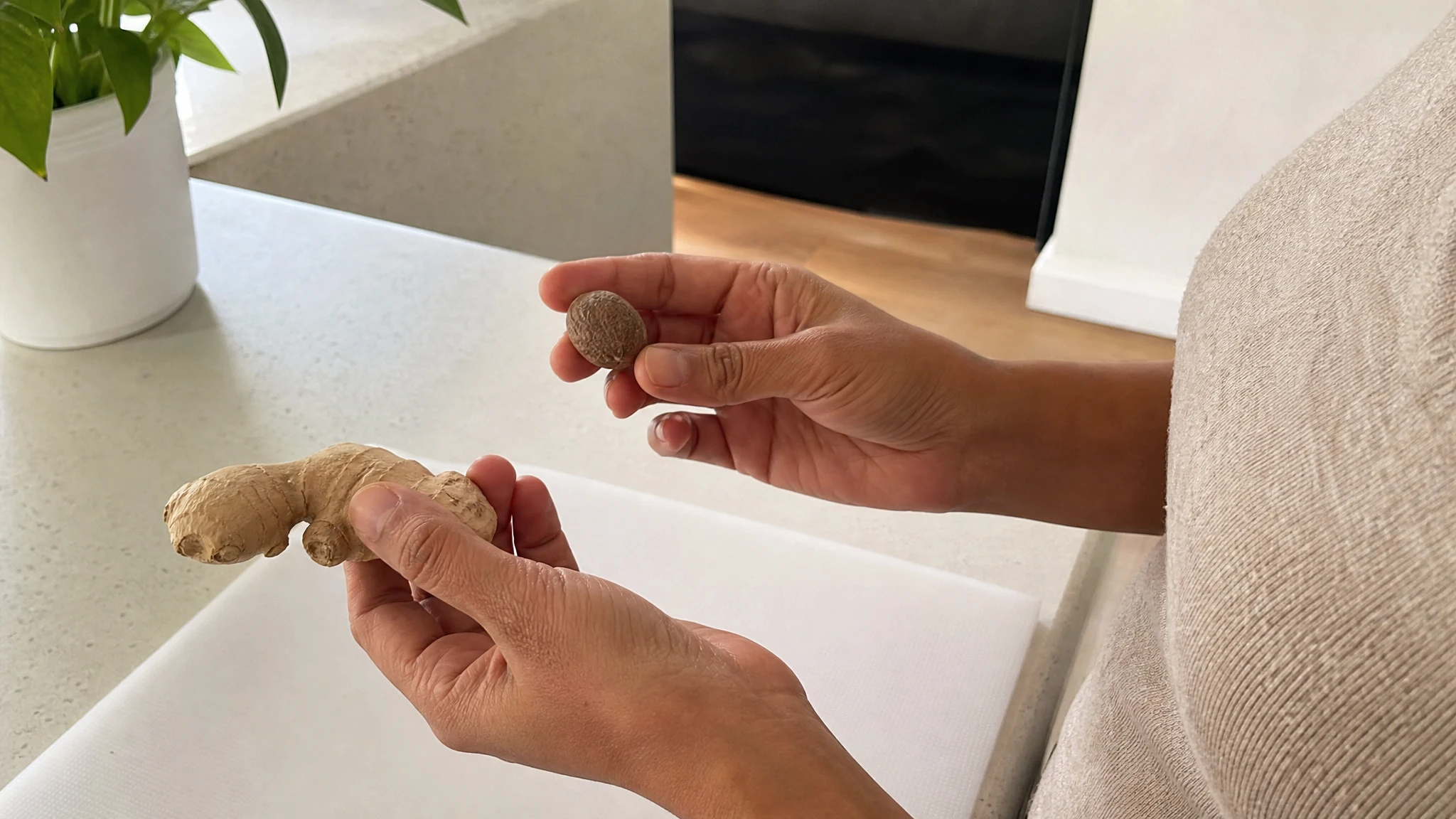
Nutmeg Oil vs Ginger Oil: What the Data Says
Nutmeg oil and ginger oil are both sold as "warming spice" oils and both appear in autumn blends, but on published data they are built from different molecules, filed under different botanical families, and carry different paperwork. This post sets the numbers side by side so a blender knows what can be swapped (the label on the bottle) and what cannot (the chemistry and the dilution ceiling). We sell nutmeg oil only, and our shop copy lists ginger as a blend partner that you buy elsewhere.
Nutmeg Essential Oil
Our own Nutmeg Essential Oil, in sizes from 0.5 oz to bulk.
From $10.99
Shop Now →Two families, two plant parts
GBIF's species match accepts Myristica fragrans Houtt. in Myristicaceae and Zingiber officinale Roscoe in Zingiberaceae (GBIF, Myristica; GBIF, Zingiber). Nutmeg oil comes from the seed. EFSA's opinion on ginger describes the oil as steam-distilled from dried rhizomes (EFSA FEEDAP Panel, 2020), underground stems, not seeds. The US flavouring list in 21 CFR 182.20 has separate entries for nutmeg (Myristica fragrans Houtt.) and ginger (Zingiber officinale Rosc.); it is a food-flavouring provision and says nothing about skin or room-scent use (21 CFR 182.20).
What the two oils are made of
EFSA assessed both oils as feed additives with the same method of describing them, which makes the comparison unusually clean. Each figure is a specification or batch range for that opinion's material, not our oil and not every oil sold under the name.
| Nutmeg seed oil (7 Indonesian batches, EFSA 2023) | Ginger rhizome oil (11 batches, China and India, EFSA 2020) | |
|---|---|---|
| Leading constituents | Sabinene 14% to 29%; alpha-pinene 15% to 28%; beta-pinene 13% to 18%; myristicin 5% to 12% | alpha-Zingiberene 29% to 40% (mean 36.78%); beta-sesquiphellandrene 8% to 14%; ar-curcumene 5% to 12%; alpha-farnesene 4% to 10%; camphene 2% to 10%; beta-bisabolene 2% to 9% |
| Constituents of toxicological interest | Safrole 1.69% to 2.30%; elemicin 0.31% to 0.40%; methyleugenol 0.18% to 0.33% | None reported in the figures read; the ginger oleoresin, not the oil, was limited by gingerols and shogaols |
Read the columns by chemical class. Nutmeg's leaders are monoterpene hydrocarbons (sabinene, the pinenes) plus a phenylpropanoid, myristicin. Ginger's leaders (103 constituents were detected in the 11 batches) are mostly sesquiterpene hydrocarbons (zingiberene, sesquiphellandrene, curcumene, farnesene, bisabolene), with camphene the one monoterpene on the list. That split in class is the reason the two oils are different materials and not a pair of variations; it is the author's classification of the named compounds, not a statement by the sources.
Ginger oil is also less uniform than that one table implies. A Malaysian study that hydrodistilled fresh rhizomes of common ginger and three variants found zingiberene always present but at only 3% to 17%, with common ginger led by zingiberene at 16.70%, (E,E)-alpha-farnesene at 13.10% and geranial at 7.60%, and two variants led by geranial at about 28% (Abd Malek et al., 2005). So "ginger oil" from dried Indian or Chinese rhizome and "ginger oil" from a fresh-rhizome variant can differ more than the EFSA table suggests. Buy by botanical name, plant part, fresh or dried, and a lot GC-MS report.
What the paperwork says about each
- IFRA. The 51st Amendment compilation (726 PDF pages) has no entry naming nutmeg, mace, ginger or Zingiber in a full-text search (IFRA, 2024). Nutmeg oil still meets the safrole Standard (natural extracts tolerated only while the safrole, isosafrole and dihydrosafrole total in the finished product stays at or under 0.01%) and the methyl eugenol Standard (0.0015% for body oils and lotions, Category 5A).
- EFSA, nutmeg. Carcinogen category 1B under EU labelling rules because of safrole at 0.1% or more; irritant to skin and eyes; skin and respiratory sensitiser (EFSA FEEDAP Panel, 2023).
- EFSA, ginger. Notified to the European chemicals agency as aspiration hazard, skin irritant, skin sensitiser, eye irritant and respiratory irritant, and EFSA says the additives should be considered irritants to skin, eyes and respiratory tract and skin sensitisers (EFSA FEEDAP Panel, 2020, link above). The ginger summary read does not report a carcinogen classification. It also does not mention phototoxicity. Silence in a feed opinion is not clearance for skin, so ask a ginger supplier for the safety data sheet and any IFRA documentation.
- Safrole in the spices. The US National Toxicology Program, which lists safrole as "reasonably anticipated to be a human carcinogen", names nutmeg, mace and ginger among the edible spices that contain it at low levels (NTP, safrole profile). That statement is about the spices, not their oils, and gives no ginger oil figure.
The point to remember: in the two EFSA texts read, both oils carry skin-irritant and skin-sensitiser statements, and nutmeg oil adds the safrole classification.
The dilution ceiling, and why ginger does not set it
Our product pages say 0.5% to 2% in a carrier oil for skin use. The Tisserand Institute chart (from Tisserand and Young, Essential Oil Safety 2e) gives adults over 15 a maximum of 0.8% for East Indian nutmeg oil and 5% for West Indian, 0.2% in pregnancy for East Indian, and a "do not use" mark for East Indian under age 6 (Tisserand Institute, 2019). Our pages do not state an origin, and the IFRA safrole arithmetic gives 0.43% to 0.59% for oil of EFSA-like composition (0.01 divided by safrole of 2.30% to 1.69%). So the top of our copy, 2%, is above both published figures. Our recommendation is 0.5% as the ceiling for nutmeg in a leave-on body oil, which is about 3 drops per ounce of carrier (591 drops per ounce). Our process-page copy adds that nutmeg oil is unsuitable in pregnancy and for children, and that anyone on medication acting on the central nervous system should not use it.
The ginger half of a blend is capped by ginger's own documents, not by nutmeg's. This post did not fetch a ginger dermal maximum, so it gives none. A split can still be worked out as reasoning: in 1 oz of carrier at a total of 1% (about 5.9 drops), nutmeg held to 0.33% is 2 drops and the remaining 0.67% is 4 drops of ginger. Whether 4 drops of ginger fits is for the supplier's data to say. The sum must satisfy the stricter of the two; we have not made or tested this blend, so patch test it, and ask a physician or pharmacist first if you are pregnant, nursing or on medication. Nobody should swallow either oil.
The "warming" question
Briefs and product copy often call both oils warming. None of the sources read gives a mechanism or a measurement for a warming sensation on skin from either oil, and this post makes no such claim for them. If a source ever does, ask what was studied (the oil, a rubefacient preparation or an isolated compound), on whom, and at what concentration, before it becomes a selling line.
For pairing ideas see the pairing guide, the clove and cinnamon comparison, nutmeg against mace and substitutes. Ginger oil is not the stand-in for nutmeg oil in any of them.
If nutmeg is the oil you need, the shop lists both of our oils by size, sold neat.
Nutmeg Essential Oil
Nutmeg Essential Oil from our own shop, in sizes from 0.5 oz to bulk.
From $10.99
Shop Now →Sources & Further Reading
- EFSA FEEDAP Panel, 2023. Safety and efficacy of nutmeg oil as a feed additive, EFSA Journal 21(6):8066. PMC10273060
- EFSA FEEDAP Panel, 2020. Safety and efficacy of essential oil, oleoresin and tincture from Zingiber officinale Roscoe as sensory additives in feed. PMC7448036
- Abd Malek SN et al., 2005. The essential oils of Zingiber officinale variants, Malaysian Journal of Science 24(2). ajba.um.edu.my/MJS/8306
- IFRA, 2024. IFRA Standards, 51st Amendment compilation. ifrafragrance.org
- National Toxicology Program. Report on Carcinogens, safrole profile. ntp.niehs.nih.gov/safrole.pdf
- Tisserand Institute, 2019. Assessing the safety of essential oils, the nutmeg case (chart). tisserandinstitute.org
- US eCFR, 21 CFR 182.20. law.cornell.edu/cfr/21/182.20
- GBIF. Species matches for Myristica fragrans and Zingiber officinale. api.gbif.org