Nutmeg Sustainability: What It Can Mean and What to Ask
"Sustainable nutmeg" is not one thing, and a label that says it without saying which thing is a claim you cannot check. This post collects what published sources say about where nutmeg supply is fragile, what the main certification schemes cover, and a list of questions to put to any supplier in writing. It makes no sustainability, fair-trade, organic or origin claim about our own oils, and nothing on our pages documents one.
Nutmeg Essential Oil
Our own Nutmeg Essential Oil, in sizes from 0.5 oz to bulk.
From $10.99
Shop Now →Start with the rule on environmental claims
In the United States the FTC's Green Guides, first issued in 1992 and revised in 1996, 1998 and 2012, are the reference for environmental marketing claims (FTC). They are guidance, and the FTC page does not describe their legal force. Two provisions are useful to a buyer reading a supplier's page. Under 16 CFR 260.4, marketers "should not make unqualified general environmental benefit claims", because it is highly unlikely they can substantiate every reasonable interpretation. Under 16 CFR 260.6, a seal that does not convey the basis for the certification likely conveys a general environmental benefit, so marketers should not use it. The practical test: "sustainably sourced" with no stated basis is the kind of sentence these provisions warn about, and "certified by X, certificate number Y, covering Z" is the kind you can verify.
Where nutmeg supply is fragile, from the sources
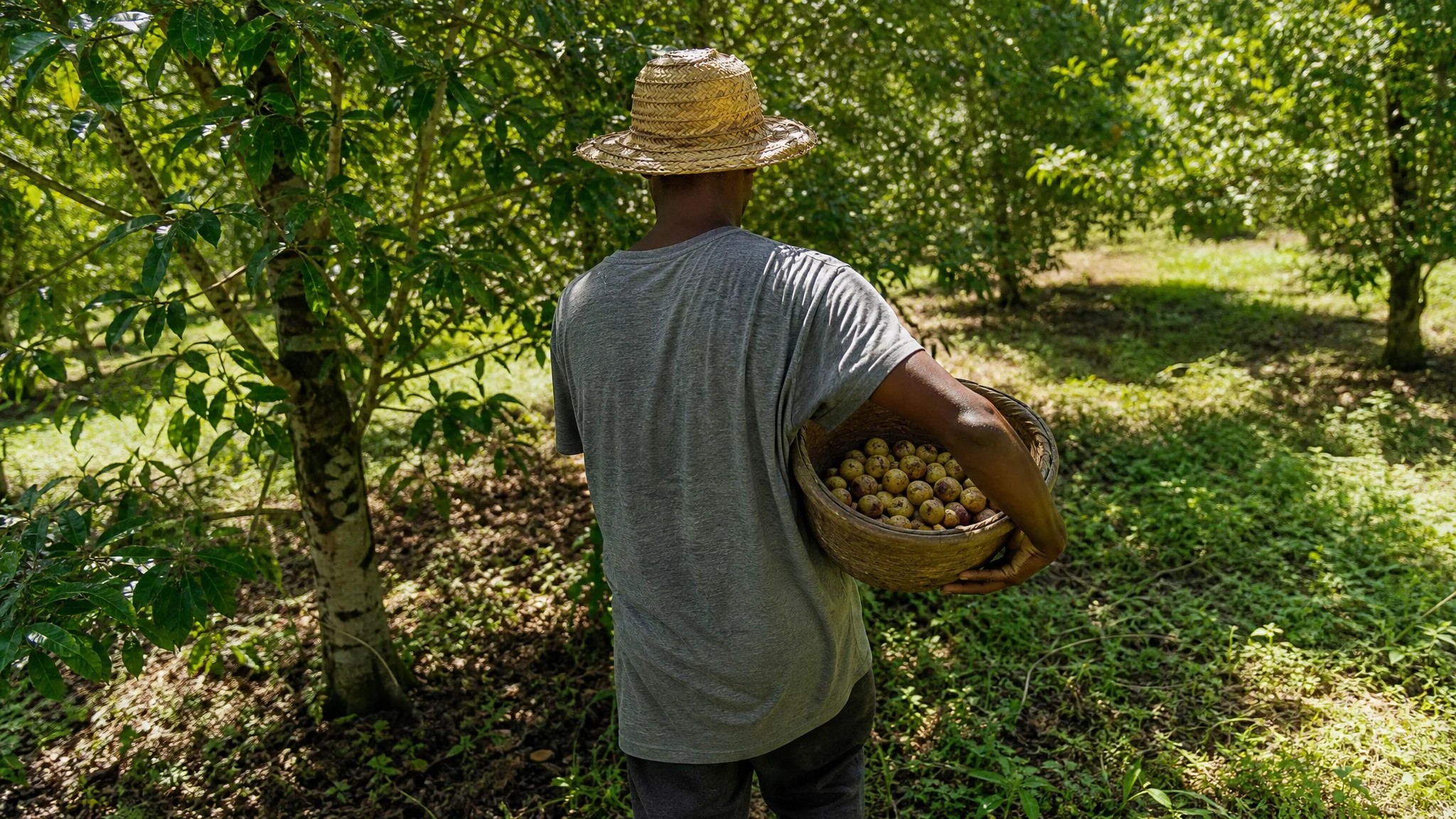
Smallholders and falling prices. A 2024 policy paper from the FFTC Agricultural Policy Platform reports that most nutmeg farms in Indonesia belong to smallholders (99.81%), that planted area averaged about 220,032 hectares in 2016 to 2020 (from 178,333 in 2016 to 254,699 in 2020), and that average production was 37,595 tons over those years (Rafani, FFTC, 2024). The same paper says the producer price fell by about 5.39% a year over 2015 to 2019. A 5.39% annual fall compounds to roughly 20% over four years (0.9461 to the fourth power is about 0.80). Reasoning from that, a grower facing a falling price has a weak case for replanting a tree that takes years to bear; the paper does not say so itself.
Debt tied to trees. A 2017 case study in Forest and Society describes a "tree mortgage" form of debt bondage in Moluccan agroforestry, in which agents exploit information farmers lack about nutmeg marketing prospects and can deny or change agreement terms (Salampessy, Febryano and Zulfiani, 2017). It is one case study built on interviews, and it contains no debt amounts. What it supports is a question, not a verdict: who is the buyer's seller buying from, and on what terms?
Storms and slow trees. A Government of Grenada, GIZ and UNDP brief says the tree takes 4 to 6 years to bear and has shallow roots, and that Hurricane Ivan destroyed 70% of 555,000 trees (ICCAS brief). Our Grenada post sets that against the assessment figure of 60 percent of the crop destroyed.
Mould and aflatoxin. The Dutch import-promotion agency CBI reports that RASFF, the EU food and feed alert system, recorded ten nutmeg cases out of 290 reported issues for all spices and herbs in 2022 (about 3.4%), all involving mycotoxins, and 44 nutmeg cases between January 2020 and October 2023, all related to mould (CBI, updated March 2024). It gives the limits as 5 micrograms per kilogram for aflatoxin B1 and 10 for total aflatoxins, which is 5 parts per billion for B1, and says Indian and Indonesian nutmeg face 30% border checks for aflatoxins. This is a food-safety record for whole spice. Whether anything carries into distilled oil is not something these pages answer, so it belongs on the question list rather than in an assumption.
What each scheme covers, and what it leaves open
| Scheme | What the fetched page or standard says | What it does not tell you |
|---|---|---|
| Fairtrade (herbs and spices page) | Some herbs and spices, vanilla and rooibos for example, have a Minimum Price; for others traders pay a 15 percent Premium on the commercial price. CBI counted 24 Fairtrade-certified nutmeg producers as of October 2023 (8 in India, 16 in Sri Lanka). | Whether a given lot of oil came from a certified producer; Indonesia and Grenada are not in CBI's count. |
| Organic (CBI, EU rules) | Growing and processing facilities audited by an accredited certifier; labels show the inspection body's name or code and the certification number. | Anything about farmer pay, tree age or storm resilience. |
| FairWild (Standard 3.0, approved 19 December 2023) | A standard for wild-collected plants, with seven principles across ecological, socio-cultural and business themes; its scope also names low-intensity agricultural production landscapes. | Whether a plantation or garden nutmeg operation falls inside its scope. That is a question for the certifier; the search found no nutmeg-specific entry. |
| Rainforest Alliance | CBI lists it among third-party schemes buyers may ask for. | The standard itself was not fetched, so nothing is claimed about its coverage here. |
One caution applies to every row. A certificate attaches to an operation and a scope, and chain of custody decides whether a bottle of oil can carry it. That last step is inference from how certification generally works, which is why the questions below ask for scope in writing.
Questions to put to any nutmeg or nutmeg oil supplier
- Which species and which part? Myristica fragrans kernel (nutmeg) and its aril (mace) give different oils; the ISO catalogue entry for ISO 3215:1998 covers "oil of nutmeg, Indonesian type" and states its purpose as facilitating assessment of quality (AFNOR catalogue); the catalogue page does not show its limits.
- Which country, region and harvest year, and how is that documented? A name on a label is not a record.
- What is the claim, exactly? Ask for the sentence in writing and the evidence behind it, using the FTC test above.
- If a certificate is cited: certifier, certificate number, scope, expiry, and does it cover the product and lot you are buying, not only a farm or a cooperative?
- Can the lot be traced? CBI says packing in origin countries is only possible if the supplier can ensure full traceability, and that labels should carry a batch code.
- Has the spice or oil lot been tested for aflatoxin or other contaminants, and by whom?
- What did the grower receive, and through whom? A cooperative, a collector and an agent are different answers.
- What analysis can you have for the lot, and will the supplier put it in writing? Our GC-MS reading guide says what to look for.
For the general label and buying questions, see the organic-versus-conventional post and the buying guide.
What we can say about ours
The COA we publish gives a batch number, the botanical name Myristica fragrans, kernel as the part used, a best-by date, and measured relative density, refractive index and optical rotation against stated ranges. It carries no origin, no certificate and no analysis of constituents, and we make no sustainability, fair-trade, organic or origin claim for our oils. If any of these matters to your product, ask us in writing before ordering and get the answer in writing; we do not promise a particular document. The same list applies to us as to anyone else.
Nutmeg Essential Oil
Nutmeg Essential Oil from our own shop, in sizes from 0.5 oz to bulk.
From $10.99
Shop Now →Sources & Further Reading
- FTC, 2012 revision. Green Guides. ftc.gov
- 16 CFR 260.4, general environmental benefit claims. law.cornell.edu
- 16 CFR 260.6, certifications and seals of approval. law.cornell.edu
- Rafani I., 2024. Policy Development of Indonesia's Nutmeg. FFTC Agricultural Policy Platform. ap.fftc.org.tw
- Salampessy M.L., Febryano I.G., Zulfiani D., 2017. Bound by debt: nutmeg trees and changing relations between farmers and agents in a Moluccan agroforestry system. Forest and Society 1(2):137-143. journal.unhas.ac.id
- Government of Grenada, GIZ and UNDP (ICCAS), undated. How to Protect Our Nutmeg from Climate Change. climateresilience.gov.gd
- CBI, 2024. Entering the European market for nutmeg. cbi.eu
- Fairtrade International. Herbs and spices. fairtrade.net
- FairWild Foundation, 2023. FairWild Standard: Version 3.0. fairwild.org
- ISO, 1998. ISO 3215:1998 Oil of nutmeg, Indonesian type (catalogue entry). boutique.afnor.org