How to Read a GC-MS Report for Nutmeg Oil
For nutmeg oil, a GC-MS report is useful mostly for three small lines near the bottom of the table: safrole, methyl eugenol and myristicin. The large peaks, sabinene and the pinenes, tell you about identity, not about how much oil is reasonable to put on skin. This post gives a reading order, works through published numbers, and shows what a safrole line does to a dilution. The COA we publish contains no GC-MS and no myristicin figure, so the last section says what to ask for.
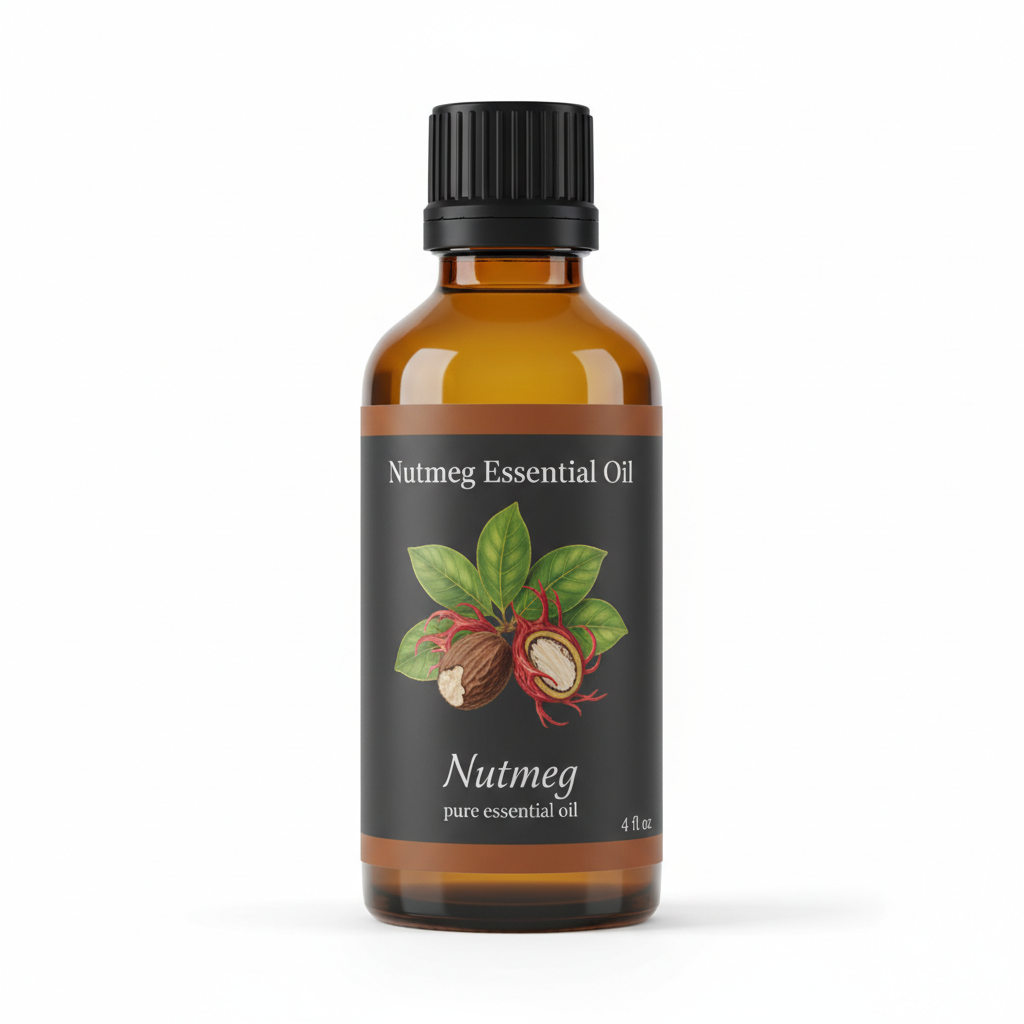
Nutmeg Essential Oil
Our own Nutmeg Essential Oil, in sizes from 0.5 oz to bulk.
From $10.99
Shop Now →Three documents that get mixed up
A certificate of analysis (COA) lists whatever tests the supplier chose for a batch. A GC-MS report is one analysis: the oil is vaporised, its components are separated along a column, and a mass spectrometer identifies each as it leaves. A safety data sheet (SDS) is a different, regulated document with sixteen fixed sections, from identification and hazards to composition, handling and toxicology (29 CFR 1910.1200(g)(2)). An SDS is organised around hazards and handling; a composition table may or may not appear in it.
The batch on our published COA (NUTLUBMFINC006A) lists the botanical name, kernel as the part used, a best-by date of 07/31/2027, and three measured physical values at 20 C against stated ranges: relative density 0.887 (stated 0.860 to 0.910), refractive index 1.478 (1.470 to 1.488) and optical rotation +11.80 degrees (+5 to +30). Each value sits inside its printed range. That is all it shows. It has no GC-MS, no myristicin, safrole, sabinene or other constituent percentage, no laboratory name and no origin.
Wide windows are weak screens. For comparison, EFSA's 2023 opinion on a nutmeg oil feed additive set its specification at density 862 to 922 kg/m3, refractive index 1.475 to 1.488 and optical rotation 8 to 18 degrees, based on ISO 3215:1998, and its seven batches measured 897 to 905, 1.480 to 1.483 and 12.96 to 14.20 degrees (EFSA, 2023). A 25-degree rotation window is wider than that 10-degree one. These constants can flag gross dilution with something very different; they cannot tell you a myristicin or safrole figure. The ISO catalogue entry states only that the standard specifies characteristics of Indonesian-type nutmeg oil to facilitate assessment of quality (AFNOR catalogue), and does not show its limits.
Read the header before any percentage
Look for the batch number (it must match your bottle), the date, the laboratory, the column, the oven program, the detector and the identification method. A percentage with no method is a number without units. As a model of a complete header, Matulyte et al. (2019) report an RTX-5MS column (30 m by 0.25 mm), helium carrier, an oven held at 40 C for 2 minutes then raised 3 C per minute to 210 C and held 10 minutes, electron ionisation at 70 eV, identification by NIST library search and literature spectra, and retention indices from C9 to C22 n-alkanes (Molecules 24(6):1062). Not every paper does this: Trifan et al. (2023) give the column in a table footnote and refer to an earlier paper for the rest (Plants 12(9):1741). A commercial report that lacks these items is harder to trust than a paper that lacks some.
Retention index: why a library hit is not enough
A mass spectrum matches a library entry; a retention index (RI) says where on the column the peak came out, relative to a series of alkanes. Both are needed because several nutmeg compounds are close neighbours. NIST's compilation of 505 essential oil compounds gives average indices on a 5% phenyl column (Babushok, Linstrom and Zenkevich, 2011):
| Compound | NIST average RI (5% phenyl) | RI reported by Trifan et al. 2023 (ZB-5MS) |
|---|---|---|
| alpha-Pinene | 936.1 | 935 |
| Sabinene | 973.0 | 974 |
| beta-Pinene | 977.7 | 979 |
| Limonene | 1029.5 | 1030 |
| Terpinen-4-ol | 1177.1 | 1183 |
| Safrole | 1286.7 | 1291 |
| Methyl eugenol | 1401.8 | not listed |
| Myristicin | 1518.4 | 1524 |
| Elemicin | 1553.6 | not reported |
Sabinene and beta-pinene are 4.7 index units apart on average, while the NIST table gives beta-pinene a standard deviation of 7.1 across 643 measurements. The two ranges overlap, so index alone cannot separate them and a lab must lean on the spectrum and a reference run. Myristicin and elemicin are 35 units apart, which is separable but not by much. This is why "identified by library match only" on a report is a caution flag for the safety-relevant lines.
Percent area is not percent weight
Most nutmeg tables give "%" that is really the share of total peak area. A technical editorial by Chaintreau, Bicchi and Rubiolo says that with MS detection, area percentages are not repeatable over time and are not accepted in that journal, and that with a flame ionisation detector they are "inaccurate and therefore discouraged", except when comparing samples of identical matrix prepared and run under the same conditions (Flavour and Fragrance Journal editorial, 2019). Regulators live with this: EFSA tested specification compliance by GC-FID expressed as percent GC area, and also received a full GC-MS characterisation, but its panel disregarded the GC-MS values for myristicin and took 12% as the highest expected value (EFSA, 2023). So when you see 2.30% safrole, read it as "about 2.3% of the detected area", which is a good estimate but not a weighed amount.
The method also moves the table. Matulyte et al. ran the same Grenada seeds through four hydrodistillations (one conventional, three with an added silicate excipient). Sabinene came out at 6.53%, 49.64%, 61.42% and 47.10%; beta-pinene at 26.61%, 4.03%, 4.32% and 3.84%; myristicin at 3.26%, 2.34%, 2.15% and 2.16%. That experiment varied a processing aid, so it shows what method alone can do to a table, not how nutmeg oil varies in trade. A review of nutmeg oil attributes differences to soil type, location, origin, extraction methods and environmental conditions (Ashokkumar et al., 2022).
The lines that carry limits, in reading order
- Safrole. IARC's Supplement 7 (1987) lists safrole as Group 2B, possibly carcinogenic to humans, after its 1976 volume found liver tumours in mice and rats given it orally and no human studies (IARC via INCHEM). EFSA notes that nutmeg oil is classified as a category 1B carcinogen under the EU CLP Regulation on the basis of safrole, which it ties to a typical concentration of 0.1% or more. IFRA prohibits safrole as a fragrance ingredient but tolerates it in natural extracts as long as total safrole, isosafrole and dihydrosafrole in the finished consumer product does not exceed 0.01% (IFRA Standards, 51st Amendment, 2024, pp. 466 to 468). Published values: 1.69 to 2.30% in EFSA's seven Indonesian batches; 2.55% in the Trifan seed oil (origin not named); 4.3% for West Java and 6.2% for Pakistan in the review's table; not reported in Matulyte's table.
- Methyl eugenol. IARC reclassified it as Group 2A, probably carcinogenic to humans, after a meeting of 6 to 13 June 2023, citing sufficient evidence in animals, strong mechanistic evidence and inadequate human evidence (IARC, 2023). IFRA's 2023 standard sets maximum levels in finished products by category, for example 0.0015% in category 5A, 0.011% in category 4 and 0.00021% in category 5B. EFSA's batches ran 0.18 to 0.33%.
- Myristicin and elemicin. IFRA's compilation has no standard naming either, and none naming nutmeg or Myristica (the full text was searched). They matter as markers: EFSA used alpha-pinene and myristicin as its phytochemical markers, with myristicin up to 12% and elemicin 0.31 to 0.40%. Published myristicin values spread widely: 2.15 to 3.26% in Grenada seed oils (Matulyte), 13.39% in Trifan's, 10.6% for West Java and 20.3% for the Andaman and Nicobar Islands (review table).
- Sabinene, pinenes, limonene, terpinen-4-ol. These are the large peaks and the identity fingerprint, not safety lines. The review's table has sabinene from 9.1 to 52.8% across origins and studies.
Worked example: what a safrole line does to a dilution
If a finished product may contain at most 0.01% safrole, the highest share of oil is that cap divided by the safrole share of the oil. This is arithmetic from published figures, not an IFRA limit for nutmeg oil, and it treats area percent as weight percent.
| Constituent and cap | Share in oil | Highest oil share in product |
|---|---|---|
| Safrole, 0.01% total | 2.55% | 0.39% |
| Safrole, 0.01% total | 2.30% | 0.43% |
| Safrole, 0.01% total | 1.69% | 0.59% |
| Methyl eugenol, category 5A 0.0015% | 0.33% | 0.45% |
| Methyl eugenol, category 5A 0.0015% | 0.18% | 0.83% |
| Methyl eugenol, category 4 0.011% | 0.33% | 3.3% |
Our own safety copy says to dilute to 0.5% to 2% in a carrier oil. At 2% and 2.30% safrole, the product would hold 0.046% safrole, 4.6 times the 0.01% figure; at 0.5% it would hold 0.0115%, just over it. Our recommendation, going below our own copy: until a written safrole and methyl eugenol figure exists for the lot in your hands, treat about 0.4% as the ceiling for leave-on skin products. On the highest published values above, 0.4% gives 0.0092% safrole and 0.0013% methyl eugenol, inside both lines. In a one-ounce (29.57 ml) bottle of carrier, 0.4% is roughly 2 to 3 drops at about 20 drops per ml; weigh instead of counting where you can. Which IFRA category applies depends on the product, so check IFRA's category list for yours. Tisserand's own guidance (Robert Tisserand, undated Tisserand Institute article) says East and West Indian oils contain quite different amounts of safrole and methyleugenol, and its dilution chart (an image on the same page, posted November 2019) gives East Indian oil 0.8% for adults over 15, 0.2% for ages 6 to 15 and in pregnancy, and West Indian oil 5% for adults (Tisserand Institute, 2019). A formulator or regulatory consultant should confirm anything you sell.
What GC-MS cannot prove
One chromatogram describes one sample and is tied to your bottle only by the batch number. It says nothing about aflatoxin, pesticide residue or freshness. It cannot settle origin, because the same seeds gave a ninefold spread in sabinene when the method changed. And a table that looks complete can still hide a missing line: Matulyte's table reports no safrole value at all, so "not reported" and "not present" are different statements. See our posts on aroma compounds and quality checks before you pay for the sensory side, and safety basics for the household summary.
What to ask for, from us or anyone
Ask in writing, before ordering, for a GC-MS or GC-FID report for the lot you will receive, with the laboratory name, date, column, oven program, identification method (library plus retention index), whether percentages are area percent, and explicit lines for safrole, methyl eugenol, myristicin and elemicin, including "not detected" where that is the result. Get the answer in writing. For our oils, the published COA is the document that exists, and it contains none of this; we do not promise a particular report. If you need one, an independent analytical laboratory can run it on a sample you send.
Nutmeg Essential Oil
Nutmeg Essential Oil from our own shop, in sizes from 0.5 oz to bulk.
From $10.99
Shop Now →Sources & Further Reading
- OSHA, 29 CFR 1910.1200(g)(2), safety data sheet sections. law.cornell.edu
- EFSA FEEDAP Panel, 2023. Safety and efficacy of a feed additive consisting of an essential oil from the seeds of Myristica fragrans (nutmeg oil). EFSA Journal 21(6):e08066. PMC10273060
- ISO, 1998. ISO 3215:1998 Oil of nutmeg, Indonesian type (catalogue entry). boutique.afnor.org
- Matulyte I. et al., 2019. GC-MS analysis of the composition of the extracts and essential oil from Myristica fragrans seeds using magnesium aluminometasilicate as excipient. Molecules 24(6):1062. PMC6471610
- Trifan A. et al., 2023. Essential oils and sustainability: in vitro bioactivity screening of Myristica fragrans post-distillation by-products. Plants 12(9):1741. PMC10181112
- Babushok V.I., Linstrom P.J., Zenkevich I.G., 2011. Retention indices for frequently reported compounds of plant essential oils. J Phys Chem Ref Data 40(4):043101. nist.gov
- Chaintreau A., Bicchi C., Rubiolo P., 2019. Quantifying the constituents of flavors, fragrances and essential oils (technical editorial). Flavour and Fragrance Journal, DOI 10.1002/ffj.3465. iris.unito.it
- Ashokkumar K. et al., 2022. Nutmeg essential oil: a review on its composition, biological, and pharmacological activities. Phytotherapy Research 36(7):2839-2851. PMC9541156
- IARC, 1976 and 1987. Safrole (Volume 10; Supplement 7), via INCHEM. inchem.org
- IARC, 2023. Evaluation of the carcinogenicity of aspartame, methyleugenol and isoeugenol. iarc.who.int
- IFRA, 2024. IFRA Standards, 51st Amendment (safrole, isosafrole and dihydrosafrole; methyl eugenol). ifrafragrance.org
- Tisserand R., undated. Assessing the safety of essential oils: the nutmeg case. Tisserand Institute. tisserandinstitute.org
- Tisserand Institute, 2019. Nutmeg essential oil safety guidelines (chart of recommended maximum dilutions, posted with "Assessing the Safety of Essential Oils: the Nutmeg Case"). tisserandinstitute.org chart