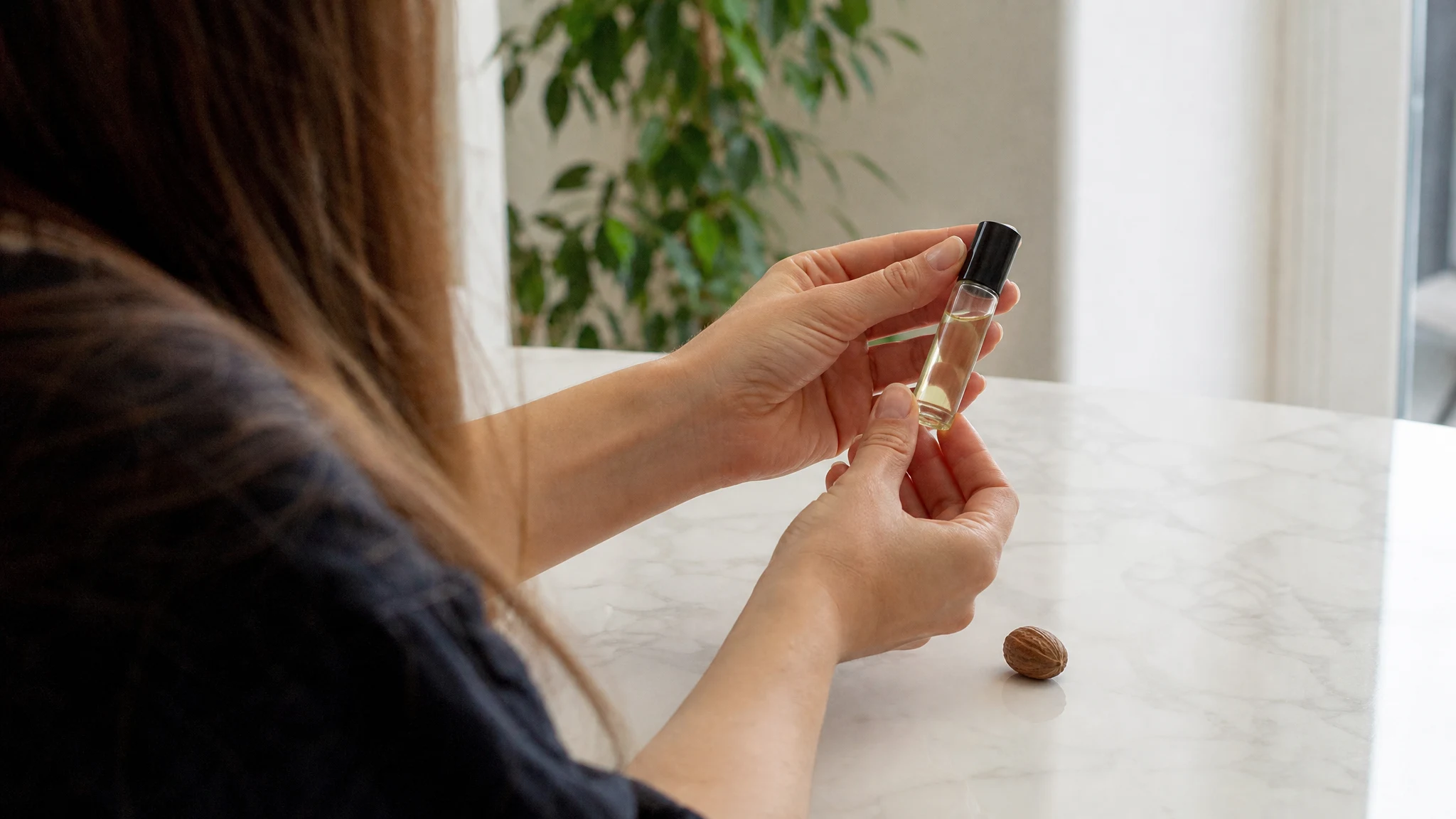
Nutmeg Roller Blends: Why One Drop Is Too Much
A single drop of nutmeg oil in a 10 ml roller bottle (0.33 oz) already overshoots the strength worked out in our massage oil recipe. The carrier in that bottle weighs about 9.1 g; one drop of our oil is about 0.044 g; 0.044 divided by 9.1 is 0.49%, against a working ceiling of about 0.4%. So the practical recipe is to make an ounce of stock and fill rollers from it. We have not made or tested any of the three structures below. They are arithmetic from the sources at the end, so make a small batch and patch test before you roll anything on.
Nutmeg Essential Oil
Our own Nutmeg Essential Oil, in sizes from 0.5 oz to bulk.
From $10.99
Shop Now →Why a roller bottle is the wrong place to count drops
The batch on our published COA has a relative density of 0.887, so 1 ml is about 0.887 g, and at about 20 drops per ml (droppers vary) a drop is 0.05 ml. A typical carrier runs about 0.91 g per ml (a sweet almond data sheet gives 0.90 to 0.91). The ceiling itself comes from the same place as in the massage post: IFRA's safrole note box (0.01% safrole in any finished product) applied to the 1.69% to 2.30% safrole range EFSA (2023) reported for one Indonesian nutmeg oil, which gives 0.43% to 0.59% oil. Our oil's COA has no constituent figures, so we take the cautious end. Our own copy says 0.5% to 2%; that top figure is about five times the working ceiling.
| Container | Carrier | Nutmeg drops | Strength |
|---|---|---|---|
| 10 ml roller | about 9.1 g | 1 | 0.49%, over the ceiling |
| 10 ml roller | about 9.1 g | 0.8 (cannot be dropped) | 0.4% |
| 1 oz stock | about 27 g | 2 | 0.33% |
| 1 oz stock | about 27 g | 3 | 0.50%, over the ceiling |
One ounce is 29.57 ml, enough for three 10 ml rollers with a little left over in the stock bottle for losses.
Three structures, per ounce of stock
The Tisserand Institute's dilution page lists generic ranges for adults, including 1% to 3% for body oils and lotions, and says to start low. Nutmeg is the limiting oil here, so the partners are added in small amounts and the totals below stay well under that generic range.
| Structure | Per 1 oz (about 27 g) carrier | Strengths | Reasoning |
|---|---|---|---|
| A. Nutmeg alone | 2 drops nutmeg | 0.33% total | Under the 0.4% ceiling |
| B. Nutmeg with orange | 2 drops nutmeg, 6 drops orange | 0.33% nutmeg, about 1.0% orange, about 1.3% total | Orange kept under IFRA's lowest orange-type figure (see below) |
| C. Nutmeg with clove bud | 2 drops nutmeg, 1 drop clove bud | 0.33% nutmeg, about 0.17% clove bud | Each oil kept to a fraction of its own ceiling |
B: why 6 drops of orange, and which orange
Orange oils split on how they are made. IFRA's Amendment 49 standard on citrus oils and other furocoumarin-containing oils exists because of phototoxicity, and its list of restricted oils names angelica root, bergamot, bitter orange, cumin, grapefruit, lemon, lime and rue. Sweet orange is not on that list, and a text search of the compilation found no standard named for sweet orange, ginger, lavender, cedarwood or vanilla. For the oils that are listed, the leave-on figures (Category 5A) are bergamot expressed 0.40%, lime expressed 0.70%, bitter orange expressed 1.25%, lemon cold pressed 2.0% and grapefruit expressed 4.0%. Six drops per ounce is about 1.0%, which clears bitter orange at 1.25% but not bergamot or lime. The practical rule: read the botanical name on the bottle (IFRA's bitter orange entry lists Citrus aurantium L. subsp. amara), confirm with the supplier which orange you hold and whether it is cold-pressed, and if the label is vague, skip the orange. The reasoning that sweet orange needs no cap rests on the absence of an IFRA standard, and it is only that; ask the supplier for its IFRA certificate. Our Spice Route post and the pairing guide cover the scent side.
C: clove, and why not cinnamon bark
Clove and cinnamon bark are the two warm-spice partners with the lowest published limits. A 2013 Tisserand slide on irritation and allergy lists clove bud oil at 0.5% (IFRA, for eugenol), clove leaf and stem at 0.6%, cinnamon bark at 0.06% (IFRA, for cinnamaldehyde) and cassia at 0.05%. Its footnote refers to the older IFRA category numbering, so treat the slide as a 2013 reading. The current standards agree in direction: Amendment 51 caps eugenol at 0.64% and Amendment 49 caps cinnamaldehyde at 0.064% in Category 5A. One drop of cinnamon bark in an ounce is about 0.17%, nearly three times the slide figure, so structure C uses clove bud and drops cinnamon bark altogether. One drop of clove bud is about 0.17%, a third of the 0.5% figure.
No authority publishes a rule for adding nutmeg's limit to clove's. Halving or thirding each oil's allowance when two oils share one patch of skin is our reasoning, not a published method, and it is conservative on purpose.
Making it
- Pour 29.57 ml (1 oz) of your chosen carrier into a clean glass bottle. Our carrier comparison sets out shelf life and allergens.
- Add the drops from one structure above, nutmeg first. Count drops over a clean dish if you want to be sure.
- Cap and tilt the bottle gently for a minute. Fill three 10 ml rollers. Label each with the date and structure.
Roller bottles, fitments and carriers come from packaging and craft suppliers; we do not sell them. Ask for glass with a roller ball fitting, and for the carrier's production date.
Where not to roll it
IFRA's category for face moisturiser (5B) sets methyl eugenol at 0.00021%. Using EFSA's top figure of 0.33% methyl eugenol, 0.00021 divided by 0.33% is 0.064% oil, about a third of a drop per ounce. That is the arithmetic behind keeping a nutmeg roller off the face. IFRA's Category 4, fine fragrance, allows far more methyl eugenol, so wrist-type use is governed by the safrole figure used above. These are IFRA categories applied by analogy: IFRA's own guidance excludes aromatherapy applications from the scope of its Standards.
Our copy asks for a patch test on a small area first. The American Academy of Dermatology describes one on a quarter-sized spot on the inner arm, applied twice daily for seven to 10 days, and says to wash the product off and stop if a reaction appears. See the dermatologist if it is severe or you cannot tell which ingredient caused it.
Who should skip it, in our own words: anyone who is pregnant or nursing, children, and anyone on medication that acts on the central nervous system. Tisserand's nutmeg chart shows 0.2% for ages 6 to 15 and in pregnancy on the East Indian row and an X under 6; the right people to ask are a pediatrician, an obstetric clinician or a pharmacist. See the safety basics post. Keep bottles away from pets; the poison help line is 1-800-222-1222 as published by poison.org. This recipe makes no claim about mood, focus or comfort, and neither do our pages.
Our nutmeg oils are sold neat, so the strength of every roller is yours to set, and the arithmetic says to set it low.
Nutmeg Essential Oil
Nutmeg Essential Oil from our own shop, in sizes from 0.5 oz to bulk.
From $10.99
Shop Now →Sources & Further Reading
- IFRA, 2024. IFRA Standards, 51st Amendment (complete compilation): Safrole, Isosafrole and Dihydrosafrole; Methyl eugenol; Eugenol; Cinnamic aldehyde; Citrus oils and other furocoumarin-containing essential oils; Bergamot, Bitter orange, Lemon, Lime and Grapefruit oils. ifrafragrance.org
- IFRA, 2023. Guidance for the use of IFRA Standards, 51st Amendment (scope; product categories). ifra-51st-amendment-guidance
- EFSA FEEDAP Panel, 2023. Safety and efficacy of nutmeg oil as a feed additive. EFSA Journal 21(6):e08066. PMC10273060
- Tisserand R, 2013. Essential Oils and the Skin, part 4: irritation and allergy (slide notes). Complete-Skin-Series-4-Notes.pdf
- Tisserand Institute. Dilution guidelines for essential oils. tisserandinstitute.org
- Tisserand Institute. Assessing the Safety of Essential Oils: the Nutmeg Case (safety guidelines chart). tisserandinstitute.org
- American Academy of Dermatology, 2021. How to test skin care products. aad.org
- Telic S.A.U., 2024. Technical data sheet, sweet almond massage oil. telic.group
- National Capital Poison Center. Essential oils. poison.org/articles/essential-oils