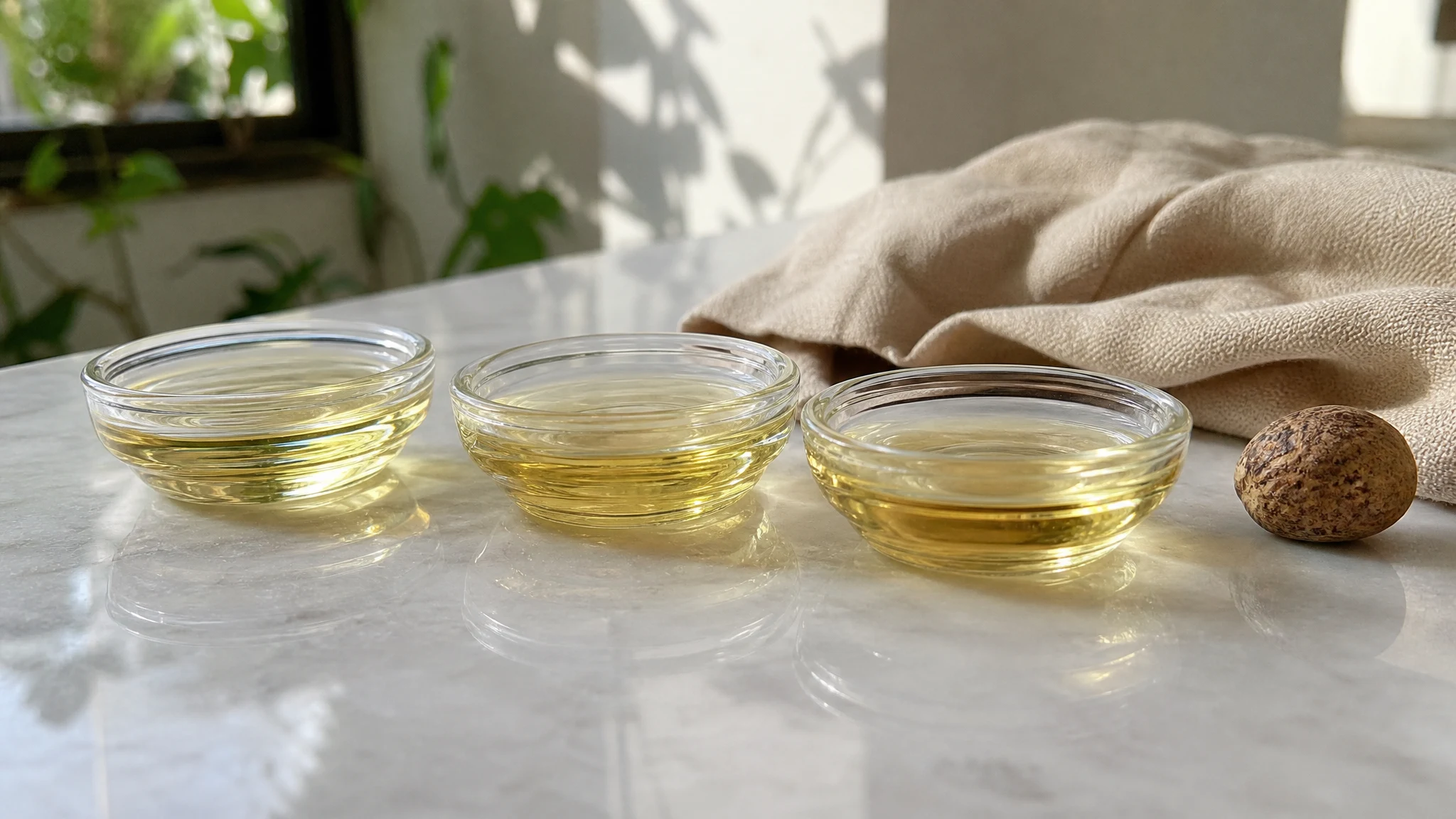
Best Carrier Oils for Nutmeg Oil: Shelf Life and Allergens
In a nutmeg blend made at the strengths worked out in our massage oil recipe, about 99.6% of the bottle is carrier. That makes the carrier's age and allergen status matter more than any claim about how it feels on the skin, and it is how this comparison is ordered. We sell no carrier oils and have made no blends with any of them. Every figure below comes from a data sheet, certificate or paper listed at the end, and the sheets disagree with each other in useful ways.
Nutmeg Essential Oil
Our own Nutmeg Essential Oil, in sizes from 0.5 oz to bulk.
From $10.99
Shop Now →Start with the arithmetic of the bottle
Our skin copy says to dilute to 0.5% to 2%. The published figures worked out in the massage post sit lower: about 0.4% (IFRA's safrole limit applied to the composition EFSA reported, and the Tisserand Institute's 0.8% adult figure for East Indian oil). Our oil's COA reports density only (0.887 on the batch it covers), so the drop maths uses that and about 20 drops per ml. One ounce of carrier is 29.57 ml and, at roughly 0.91 g per ml, about 27 g.
| Oil strength in 1 oz carrier | Drops | Comment |
|---|---|---|
| 0.33% | 2 | Under the 0.4% working ceiling |
| 0.50% | 3 | Bottom of our copy; over the ceiling |
| 1.0% | 6 | Inside our copy; 2.5 times the ceiling |
| 2.0% | 12 | Top of our copy; about 5 times the ceiling |
Two drops of nutmeg oil in an ounce of carrier means the carrier sits on the shelf for the life of the blend with almost nothing else in it. If the carrier goes off, the blend goes off with it.
What the data sheets say, carrier by carrier
| Carrier | What it is | Stated shelf life | Source |
|---|---|---|---|
| Jojoba (golden) | Liquid wax monoesters, not a triglyceride oil | 1 year from date shipped (one supplier); at least 24 months nitrogen-flushed (another) | Tsuchimoto 2022; Lebermuth; Ellisons |
| Fractionated coconut (caprylic/capric triglyceride) | Triglyceride of C8 and C10 saturated acids, about 70:30; iodine value max 0.5 | 18 months, no antioxidants added (one manufacturer) | BASF Myritol 318 |
| Sweet almond | Oleic above 58%, linoleic below 30% | 3 years from manufacture, 12 months after opening (one supplier) | Telic 2024; Soap & More lot certificate |
| Grapeseed (cosmetic grade) | Linoleic 62% to 76%, oleic 10% to 27%; iodine value 133 to 143 | At least 12 months, nitrogen-flushed (one supplier) | Parchem; Ellisons |
Jojoba
Jojoba is the odd one out chemically. A 2022 paper by Tsuchimoto, Sakai and Fukui in BPB Reports describes it as mainly liquid wax monoesters, and heated jojoba oil, olive oil and squalene at 60 C for 60 days. The abstract reports acid value unchanged in jojoba and rising in the others, with the lowest peroxide and carbonyl values in jojoba, and concludes jojoba was the most stable of the three. It also reported that oxidative stability and antioxidant activity varied between crude jojoba oils, and that deodorized or refined oils showed lower antioxidant activity. That is two comparison oils at one temperature, not a shelf-life test of any retail bottle. The sheets themselves disagree: Lebermuth's golden jojoba specification (issued December 2024) says 1 year from date shipped, while an Ellisons safety data sheet says a minimum of 24 months nitrogen-flushed. Sheets describe a product and a packing method, not a carrier species.
Fractionated coconut oil
The BASF technical information for Myritol 318 (valid from July 2017), a caprylic/capric triglyceride, lists an iodine value of at most 0.5 g I/100 g, 18 months of shelf life, storage between 0 C and 30 C, and no antioxidants or preservatives. Iodine value counts double bonds, and double bonds are where oils oxidise (that link is general chemistry, not something the sheet argues), so a value that low fits a long-lived material. One brand's sheet is not every bottle labelled fractionated coconut oil, and the 18-month figure is a manufacturer's storage statement, not a measured rancidity date. The usual claim that this oil feels light is not stated by any sheet read here, so it is not repeated. On allergens, FDA's food-allergen Q&A (March 2025) says coconut is no longer one of the tree nuts considered a major food allergen. That is a food-labelling rule and says nothing about skin.
Sweet almond
A Telic data sheet for a sweet almond massage oil (January 2024) gives oleic acid above 58%, linoleic below 30%, a period after opening of 12 months and expiry three years from manufacture. A lot certificate from Soap & More (lot 00401/24, produced January 2024) shows oleic 63.6%, linoleic 26% and a peroxide value of 0.2 meq/kg on a 5.0 limit, with three years expected unopened at 15 C to 30 C under nitrogen, and a note that opened containers should be tested at least yearly. The same oil, then, carries 12 months once opened on one sheet and a yearly test on the other. Almonds are tree nuts under FDA's food-allergen page (current as of March 2026), which gives almonds as an example. Whether a tree-nut-allergic person should put almond oil on skin is a question for their allergist, not a data sheet.
Grapeseed
Parchem's cosmetic-grade specification lists linoleic acid at 62% to 76%, iodine value 133 to 143 and peroxide value at most 2, with the instruction to keep containers full and away from light. Set beside the 0.5 maximum on the coconut sheet, that iodine value is more than 250 times higher, which is the reasoning behind treating grapeseed as the carrier to buy smallest and use first. The Ellisons sheet says a minimum of 12 months when nitrogen-flushed.
Our position
For a dilute spice blend, jojoba and fractionated coconut oil have the strongest case on stability, grapeseed the weakest, and sweet almond sits between them with the allergen question attached. That ranking is reasoning from composition and sheets, not from a test, and the sheet for the bottle in your hand outranks it. Shelf life in the tables varies by a factor of three between suppliers of the same oil, so the rule that holds across all four is: buy the smallest bottle you will finish, ask for the production date, and write the blend date on the label. Our storage post covers the oil itself, and our own copy says to store it tightly capped, cool and dark.
What to ask the supplier
- The production or best-by date for the lot you will receive.
- Peroxide value on a certificate of analysis (the almond certificate above lists 0.2 against a limit of 5.0).
- Whether the bottle was nitrogen-flushed, and how long after opening the supplier will stand behind it.
- Refined or cold-pressed, and the INCI name, so an allergist can read the ingredient.
Carriers come from craft and soap-supply shops, cosmetic ingredient suppliers or a pharmacy; we do not sell them. The same goes for a skin condition: a dermatologist, not a carrier oil comparison, is where that goes. A 2017 review of plant oils on skin in the International Journal of Molecular Sciences says jojoba exhibits high oxidative stability, but it is a review of oils alone and does not address nutmeg blends. For the blend itself, see the roller recipes and the safety basics post.
Our nutmeg oils are sold neat, so whichever carrier you pick, the percentage is yours to set; two drops in an ounce is where the published figures point.
Nutmeg Essential Oil
Nutmeg Essential Oil from our own shop, in sizes from 0.5 oz to bulk.
From $10.99
Shop Now →Sources & Further Reading
- Tsuchimoto S, Sakai H, Fukui K, 2022. Oxidative stability and antioxidant activity of crude jojoba oil. BPB Reports 5(6):121-124. jstage.jst.go.jp
- Lebermuth Company, 2024. Technical data specification, jojoba oil, golden. docs.lebermuth.com
- Ellisons. Jojoba oil, golden, safety data sheet. ellisons.co.uk
- BASF, 2017. Technical information, Myritol 318 (caprylic/capric triglyceride). promo.basf.com
- Telic S.A.U., 2024. Technical data sheet, sweet almond massage oil. telic.group
- Soap & More, 2024. Certificate of analysis, almond oil sweet, lot 00401/24. COA_AlmondOilSweet_00401-24
- Parchem. Grapeseed oil (cosmetic grade), typical specifications. parchem.com
- Ellisons. Grapeseed oil, cosmetic refined, safety data sheet. ellisons.co.uk
- FDA, 2025. Frequently asked questions, food allergen labeling guidance for industry (coconut and tree nuts). fda.gov/food-allergen-labeling-faq
- FDA, 2026. Food Allergies (major food allergens). fda.gov/food-allergies
- Lin T-K, Zhong L, Santiago JL, 2017. Anti-inflammatory and skin barrier repair effects of topical application of some plant oils. Int J Mol Sci 19(1):70. PMC5796020