Nutmeg Oil Price Guide: Why Costs Vary and What Fair Value Looks Like
A quick search for nutmeg oil turns up bottles priced anywhere from $5 to well over $80. That spread is not random. It reflects real differences in origin, distillation method, purity, and supplier standards. Understanding what drives nutmeg oil price means you can stop guessing and start buying with confidence.
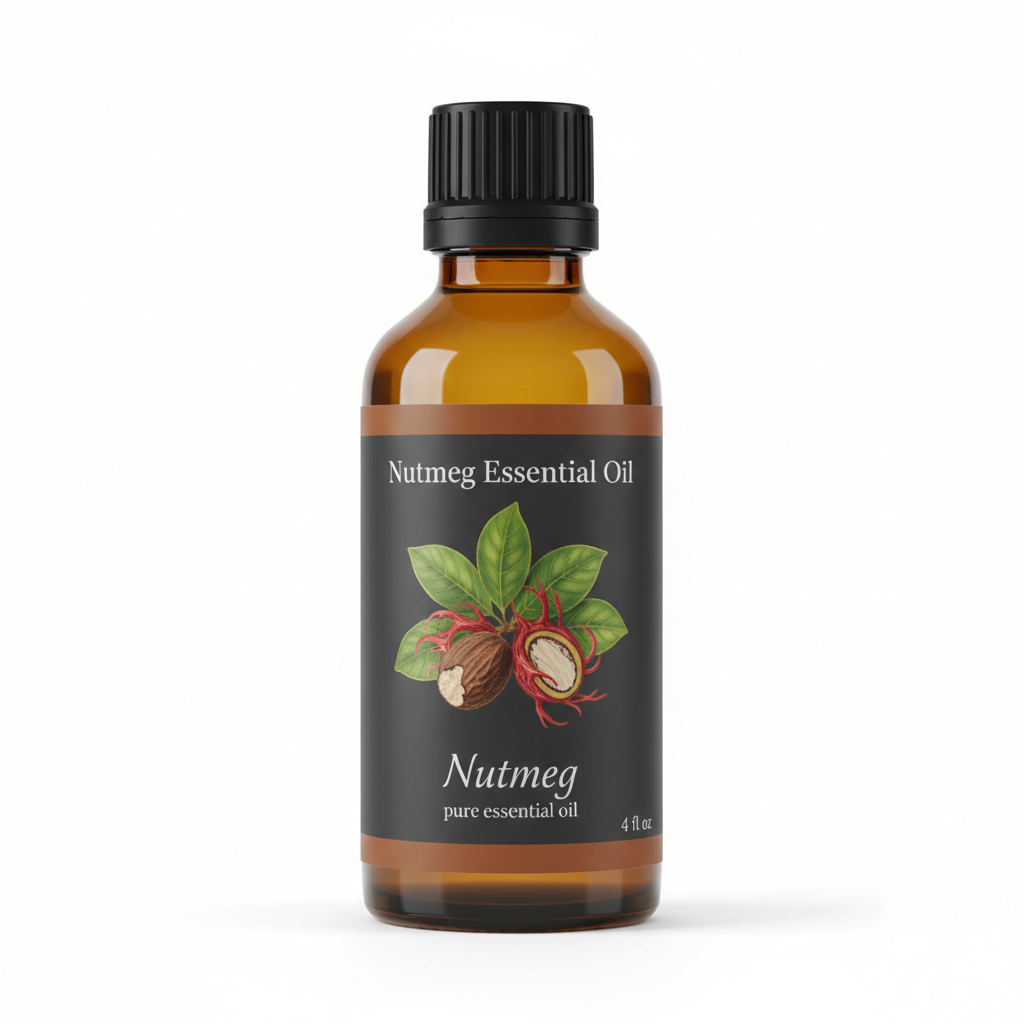
Nutmeg Essential Oil
Our own Nutmeg Essential Oil, in sizes from 0.5 oz to bulk.
From $10.99
Shop Now →This guide walks through the key factors behind nutmeg oil cost, what quality actually looks like at each price tier, and the warning signs that a bargain is not really a bargain at all.
What Drives Nutmeg Oil Price?
Nutmeg essential oil is steam-distilled from the dried seed of Myristica fragrans, a tree native to the Banda Islands of Indonesia. Getting a high-quality oil to your shelf involves more steps, and more judgment calls, than most buyers realize.
Origin and Terroir
East Indian nutmeg oil, sourced primarily from Indonesia, is considered the benchmark for fragrance and cosmetic work. West Indian nutmeg oil, produced largely in Grenada, has a slightly different chemical profile and aroma character. Neither is inherently inferior, but they are distinct, and pricing often reflects supply chain complexity. Indonesian oil tends to be more widely available and competitively priced. Grenadian oil, produced in smaller volumes, can command a modest premium.
If you want to go deeper on these regional differences, the guide to reading a nutmeg oil label covers the practical differences between East Indian and West Indian varieties in detail.
Distillation Method and Quality
Steam distillation is standard. The question is how carefully it is done. Slower distillation at lower pressure preserves a more complete aromatic profile. Rushed distillation at high pressure cuts costs but can produce a flatter, harsher oil. Reputable suppliers document their distillation parameters. Most inexpensive mass-market oils do not.
Batch Testing and Documentation
GC/MS testing (gas chromatography/mass spectrometry) is the industry standard for verifying that an oil is what it claims to be. A certificate of analysis (COA) should list the chemical constituents, their percentages, and the batch number. Oils sold with publicly available, batch-specific COAs cost more to produce because the testing is not cheap. That cost is reflected in the price, and it is worth paying.
Packaging
Amber or cobalt glass protects essential oils from light degradation. A proper orifice reducer allows controlled dispensing. Some suppliers also use nitrogen flushing to reduce oxidation in the headspace. These are not cosmetic details. They directly affect shelf life and value over time. Cheap plastic bottles or clear glass are a cost-cutting measure that shortens the oil's useful life.
Volume and Concentration
Nutmeg oil is sold both as a pure essential oil and as a diluted blend pre-mixed in a carrier oil. Pure essential oil at 5 ml is genuinely more concentrated, and therefore more expensive per ml, than a 10 ml blend that is 3% nutmeg in jojoba. Always check whether you are comparing like for like before drawing conclusions about nutmeg oil cost.
Price Tiers: What You Actually Get
Budget Tier: Under $10 for 10 ml
Oils in this range exist, and some are perfectly serviceable for casual aromatic use. However, the lack of documentation is almost universal at this price point. COAs are rarely available. Origin is vague or unlisted. Adulteration with synthetic fragrance compounds or cheaper carrier oils is a genuine risk. If you are blending for a hobby diffuser project and quality consistency is not critical, this tier may suit you. For skin application or cosmetic formulation, it is not worth the risk.
Mid-Range: $10 to $30 for 10 ml
This is where most reputable small-batch and artisan suppliers operate. At this price point, you should reasonably expect a batch-specific COA, amber glass packaging, a stated country of origin, and a clearly labeled botanical name (Myristica fragrans). Many excellent oils live in this range. A 10 ml bottle of well-sourced Indonesian nutmeg oil from a transparent supplier at $18 to $25 represents solid nutmeg oil value for most buyers.
Premium Tier: $30 to $60+ for 10 ml
Premium pricing is driven by a few specific factors: certified organic status, small-batch artisan distillation, rare origin specificity (single-estate or single-island sourcing), and extensive third-party testing. Some suppliers in this range also offer carbon-neutral shipping, fair-trade sourcing documentation, or direct farmer partnerships. These are real supply chain distinctions, not just marketing language. Whether the premium is worth it depends on your formulation goals and your values as a buyer.
Wholesale and Bulk: Variable
Purchasing 100 ml, 500 ml, or 1 kg quantities changes the price-per-ml calculation significantly. Reputable wholesale suppliers often price 100 ml of quality nutmeg oil in the $40 to $80 range, which works out to less than $1 per ml. This is excellent value for formulators, candle makers, or soap crafters. Bulk buying from an unfamiliar source without documentation, however, amplifies the risk of a poor-quality batch.
| Price Tier | Typical Cost (10 ml) | What to Expect | Best For |
|---|---|---|---|
| Budget | Under $10 | Limited documentation, variable quality | Casual diffuser use only |
| Mid-Range | $10 to $30 | COA available, stated origin, amber glass | Most buyers and applications |
| Premium | $30 to $60+ | Organic certified, small-batch, extensive testing | Serious formulators, ethical sourcing priority |
| Bulk Wholesale | $40 to $80+ per 100 ml | Lower per-ml cost, COA essential | Cosmetic formulators, artisan makers |
Quality Indicators to Look For
Price is a signal, not a guarantee. Here is what to check before committing to any bottle.
- Full botanical name on the label: It should read Myristica fragrans. A label that just says "nutmeg oil" or "nutmeg fragrance" tells you very little.
- Country of origin: Indonesia, Sri Lanka, and Grenada are the primary producing regions. "Various origins" or no origin listed is a red flag.
- Batch-specific COA: The certificate should match the batch number on your bottle. A generic COA with no batch reference is nearly meaningless.
- Distillation method: Steam distillation is standard for essential oil. CO2 extraction produces a different profile and is sometimes available at a premium.
- Amber or cobalt glass packaging: UV protection matters for shelf life.
- Third-party testing: Independent lab testing carries more weight than in-house testing alone.
Red Flags That Signal Poor Value
Some warning signs are easy to spot once you know what to look for.
- Uniform pricing across all oils: A supplier charging exactly $9.99 for every essential oil in their catalog, from lavender to rose, is almost certainly not selling genuine single-origin oils. Genuine rose absolute and genuine nutmeg oil have wildly different production costs.
- "Pure" and "natural" without documentation: These words have no regulatory definition in the essential oil market. They are not substitutes for a COA.
- No botanical name listed: This is a basic transparency failure.
- Fragrance oil labeled as essential oil: Synthetic fragrance compounds can legally be sold as "nutmeg oil" if the label does not specify "essential oil." Read carefully.
- No contact information or return policy: A reputable supplier stands behind their product. Anonymous listings with no customer service path are a risk.
- Implausibly long shelf life claims: Pure nutmeg essential oil has a realistic shelf life of two to three years when stored correctly. Claims of five or more years should prompt questions.
Where to Buy Nutmeg Oil
Specialty Essential Oil Retailers
Companies that focus specifically on essential oils (rather than selling them as a sideline to supplements or cleaning products) tend to invest more in sourcing and documentation. Look for suppliers who publish their COAs online, name their distillers or farms, and have a clear sourcing philosophy. Plant Therapy, Florihana, and Eden Botanicals are examples of suppliers with transparent documentation practices, though availability and pricing shift seasonally.
Direct from Distillers or Importers
Buying closer to the source often improves both price and traceability. Some Indonesian and Grenadian cooperatives sell directly to international buyers at wholesale or near-wholesale prices. This requires more research upfront but can deliver exceptional nutmeg oil value, particularly for bulk purchases.
General Marketplaces (Amazon, Etsy)
These platforms host both excellent small-batch suppliers and deeply problematic resellers. The platform itself does not vet essential oil quality. Always click through to the seller's own website, look up their COA availability, and check reviews for specific feedback on scent consistency and documentation, not just shipping speed.
Health Food and Natural Grocery Stores
Aura Cacia and similar brands available in physical retail are generally reliable for basic quality and safety, though they rarely offer the origin specificity or batch-level documentation that serious formulators want. For general aromatic use, they are a convenient and reasonably priced option.
Nutmeg Oil in Context: Comparing Cost to Similar Oils
Nutmeg oil sits in an interesting position in the warm spice oil category. It is generally more affordable than clove bud or cinnamon bark oil, both of which require more careful handling in formulation and tend to command slightly higher prices per ml. If you are building a warm spice blend and weighing your options, the comparison of nutmeg, clove, and cinnamon oils lays out the aromatic and practical differences clearly.
Nutmeg oil also blends well with citrus oils, cedarwood, and black pepper, which means a small quantity goes a long way in complex formulations. From a cost-per-use perspective, a 10 ml bottle used at a 1 to 2 percent dilution in a carrier oil stretches considerably further than buyers sometimes expect.
Making the Decision: What Fair Value Looks Like
Fair value in nutmeg oil is not the lowest price. It is the price at which you receive a documented, correctly labeled, properly packaged oil from a supplier who can answer your questions about its origin and testing. For most buyers, that falls comfortably in the $15 to $30 range for a 10 ml bottle of pure essential oil.
If you are formulating at scale, bulk pricing from a verified wholesale supplier shifts the math considerably. If you are exploring nutmeg oil for the first time, a mid-range bottle with a publicly available COA is the lowest-risk starting point.
For a full walkthrough of what to examine before any purchase, the ultimate guide to buying nutmeg oil covers every checkpoint from label reading to supplier vetting in one place.
The best nutmeg oil purchase is not necessarily the cheapest or the most expensive. It is the one where you know exactly what you are getting and why it costs what it does.
Take your time, request documentation, and trust suppliers who make transparency easy rather than difficult. The spice that once moved empires deserves at least that much respect on your shelf.