
Nutmeg Oil and Toothache: Why the Answer Is a Dentist
Do not put nutmeg oil in your mouth or on a tooth. Our nutmeg oils are for scent and craft use, our own safety copy says never to take them internally, and a toothache is a symptom that needs a dentist to find the cause: the sources below list abscess, decay and referred pain from other parts of the body, and none of them is helped by guessing. This page reports what the dental and poison-centre sources say, what the nutmeg literature in dentistry actually is, and the thresholds for urgent care. It gives no home remedy.
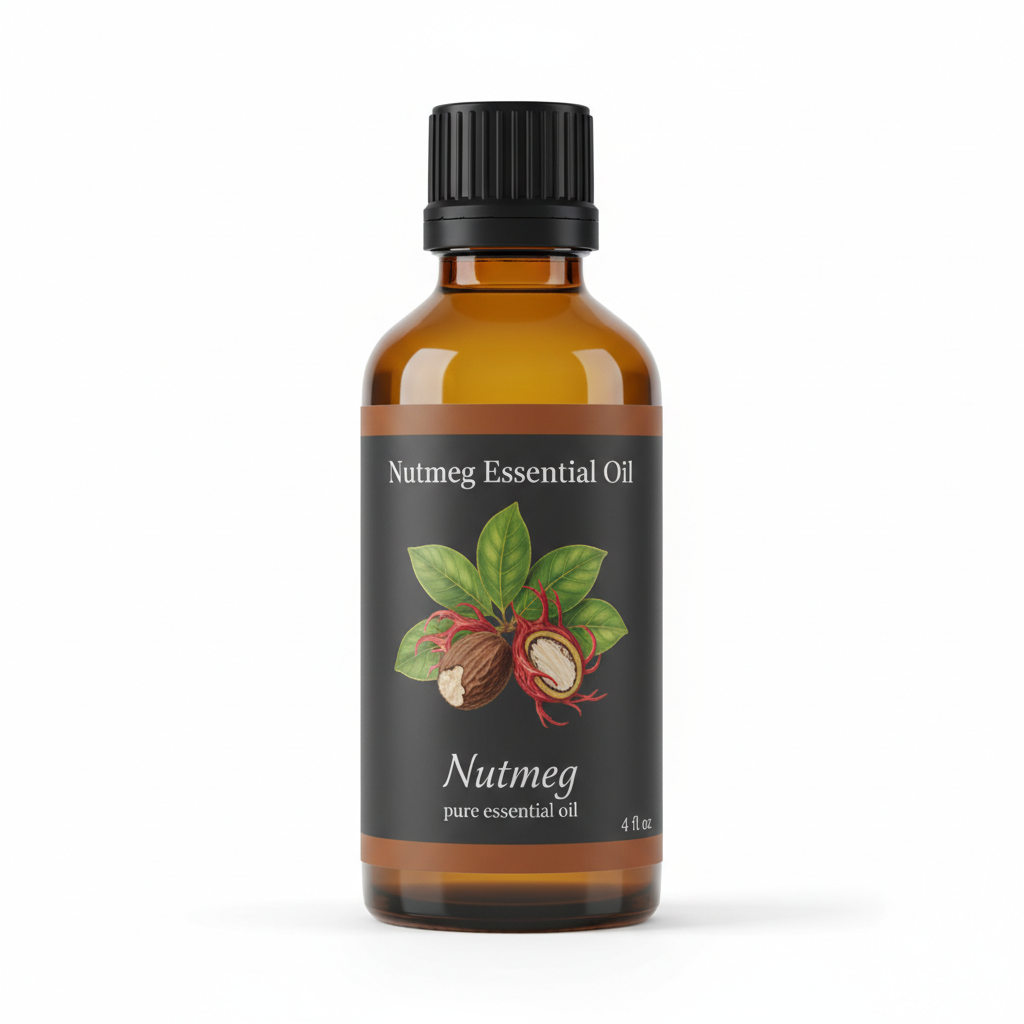
Nutmeg Essential Oil
Our own Nutmeg Essential Oil, in sizes from 0.5 oz to bulk.
From $10.99
Shop Now →What a toothache can be, and who to call
MedlinePlus lists the causes of toothache as an abscessed tooth, tooth decay, tooth trauma such as wear, injury or fracture, and pain referred from elsewhere, naming an earache, a sinus infection and a heart attack. It advises seeing a dentist for a severe toothache or one that lasts longer than a day or two, and says the dentist first works out the source of the pain before any treatment, which may include filling cavities, root canal therapy, antibiotics or extraction (MedlinePlus, reviewed 5 February 2026). The NHS, in the UK, gives a similar threshold: see a dentist if the toothache lasts more than 2 days or does not go away with painkillers, or comes with a high temperature, pain when biting, or a swollen cheek or jaw (NHS, page last reviewed 1 July 2024). The same page says a pharmacist can advise on the interim, and says not to go to a GP, who cannot give dental treatment.
The urgent line is also set out. The NHS says to go to A&E if the area around the eye or the neck is swollen, or if swelling in the mouth or neck makes it difficult to breathe, swallow or speak, and to call 999 rather than drive. MedlinePlus, on tooth abscess, calls a swollen jaw a very serious symptom, mentions a bubble or pimple on the gums, and warns that untreated abscesses can get worse and lead to life-threatening complications, including spread of infection to the jaw bone and a blood infection; treatment may be antibiotics, a root canal, removal of the tooth or surgery to drain the abscess, and some people are admitted to hospital (MedlinePlus, reviewed 5 February 2026). The American Dental Association's emergency page says for any dental emergency to visit your dentist or an emergency room as soon as possible (ADA MouthHealthy, undated).
What the dentist can do that an oil cannot is the point of the list: look at the tooth and probe it, drain an abscess, fill, root-canal or extract, and prescribe. An aroma material cannot do any of those. Reasoning from the abscess description above: anything that dulls the pain for a few hours risks delaying the examination that an abscess needs.
What the nutmeg literature in dentistry is
A PubMed search on 28 October 2026 for nutmeg or Myristica fragrans with toothache, dental, dentistry, oral health, caries or periodont* returned 11 records. A narrower search for nutmeg with toothache, tooth pain, dental pain or analgesic in a dental or tooth context returned none. By title and abstract, the records fall into three kinds, and none is a test of nutmeg oil for toothache pain in people.
- Laboratory studies on bacteria. Shafiei and colleagues tested ethyl acetate and ethanol extracts of the flesh, mace and seed against six oral bacteria; MICs ranged from 1.25 to 640 mg/mL and 0.075 to 40 mg/mL across extracts and species, the flesh ethyl acetate extract was strongest, and no extract was active against Fusobacterium nucleatum (Shafiei et al., 2012). Chung and colleagues isolated a single compound, macelignan, from a methanol extract; its MIC against Streptococcus mutans was 3.9 ug/mL, compared in the same paper with 250 ug/mL for eucalyptol, 500 for menthol and thymol and 1000 for methyl salicylate, and 20 ug/mL inactivated S. mutans in one minute (Chung et al., 2006). These are extracts and an isolated compound in a dish. They say nothing about oil on a tooth.
- One oil study. Setty and colleagues hydrodistilled nutmeg oil and measured its MIC against nine strains thought relevant to root-canal infection, reporting in the abstract that it was effective against all of them (Setty et al., 2020). The abstract prints no concentrations, and a dish result is not a dental treatment; the how-to-read-an-MIC arithmetic is on the antimicrobial research post.
- One small clinical study of a different thing. Mali and colleagues compared a nutmeg gel with a myrobolan gel and formocresol as pulpotomy medicaments in primary molars, in 20 children with follow-up to 12 months, and found no significant difference among the three (Mali et al., 2018). That is a dentist placing a herbal gel inside a tooth during a procedure, in a small sample, and the abstract does not say the gel was an essential oil. It is not evidence that oil from a bottle is suitable for anyone to use.
The brief for this article also asked for the traditional dental use of nutmeg or clove oil as a historical record. The search did not retrieve a source for that that could be read and verified, so no historical claim is made here rather than an unsourced one.
Clove is a different oil, and not an endorsement
Clove oil, with eugenol as its main constituent, is the oil most often named alongside toothache. It is a different material from nutmeg oil, with its own record, and this page does not recommend it. One data point from the fetched sources: in de Groot and Schmidt's review of essential oils and contact allergy, clove was one of nine oils that gave more than 2% positive patch test reactions in consecutive patients, and most reactions followed application of undiluted oils or high-concentration products (de Groot and Schmidt, 2016). Putting an oil in the mouth is a use our own copy rules out. For how nutmeg and clove differ as scent materials, see the clove and cinnamon comparison.
Why the mouth is a poison-centre question
The National Capital Poison Center's page on essential oils says that if someone swallows an essential oil, or a product containing one, the thing to do is use the webPOISONCONTROL tool or call 1-800-222-1222, which is free, confidential and available 24 hours a day. It says some oils can be poisonous if absorbed through the skin or swallowed, that aspirating an essential oil can cause pneumonia, that children have thin skin and immature livers that may make them more susceptible, and that oils should be locked up out of the sight and reach of children and pets (poison.org, undated).
The nutmeg-specific toxicology is mostly about swallowed spice, which is a different exposure from oil but shows what the constituents can do. A Swiss poisons information center analysis recorded enquiries for 236 patients over 2014 to 2023, peaking in 2020 and 2021 (30 enquiries), and describes a 23-year-old who swallowed 75 g of nutmeg and had a fast heart rate and dilated pupils, becoming somnolent about 14 hours later, with symptoms resolved within 26 hours (Bleisch et al., 2026, Toxicology Reports). A 2024 case report describes a six-year-old who unintentionally swallowed six pieces of mace and had an altered level of consciousness and respiratory acidosis, recovering with supportive care and leaving hospital after 36 hours (Imtiaz et al., 2024, Cureus). Those are spice and mace, not oil, and two cases do not give a rate. The EFSA panel's 2023 opinion treats nutmeg oil itself as an irritant to skin and eyes and a skin and respiratory sensitizer, and classifies it as a category 1B carcinogen on safrole content (EFSA FEEDAP Panel, 2023). Our own copy says nutmeg is toxic in quantity and must never be swallowed; for ingestion questions in more depth, see the ingestion post and the safety basics post.
Where claims fit
The FDA says whether a product is a cosmetic or a drug is decided by intended use, shown by label claims, advertising and consumer perception, and defines drugs as articles intended for the diagnosis, cure, mitigation, treatment or prevention of disease (FDA, content current as of 11 September 2024). That is why this article reports and does not recommend: we sell no dental product and no remedy, and the shop pages carry the FDA statement that the oils are not intended to diagnose, treat, cure or prevent any disease. If a toothache is the reason someone is reading, the order is: dentist, then pharmacist for the interim, then emergency care for the warning signs above, and poison control if anything has been swallowed. Related questions are collected on the FAQ post.
Nutmeg oil belongs on a shelf as a warm spice scent and out of the mouth; the dentist is the answer to the tooth.
Nutmeg Essential Oil
Nutmeg Essential Oil from our own shop, in sizes from 0.5 oz to bulk.
From $10.99
Shop Now →Sources & Further Reading
- MedlinePlus Medical Encyclopedia, 2026. Toothache; Tooth abscess. medlineplus.gov/ency/article/003067
- NHS, 2024. Toothache. nhs.uk/conditions/toothache
- American Dental Association. Dental emergencies (MouthHealthy). mouthhealthy.org
- Shafiei Z et al., 2012. Antibacterial activity of Myristica fragrans against oral pathogens. Evid Based Complement Alternat Med 2012:825362. pubmed.ncbi.nlm.nih.gov/23049613
- Chung JY et al., 2006. Anticariogenic activity of macelignan isolated from Myristica fragrans against Streptococcus mutans. Phytomedicine 13(4):261-266. pubmed.ncbi.nlm.nih.gov/16492529
- Setty JV et al., 2020. In vitro evaluation of antimicrobial effect of Myristica fragrans on common endodontic pathogens. J Indian Soc Pedod Prev Dent 38(2):145-151. pubmed.ncbi.nlm.nih.gov/32611860
- Mali S et al., 2018. Efficacy of Myristica fragrans and Terminalia chebula as pulpotomy agents in primary teeth. Int J Clin Pediatr Dent 11(6):505-509. pubmed.ncbi.nlm.nih.gov/31303738
- de Groot AC, Schmidt E, 2016. Essential oils, part IV: contact allergy. Dermatitis 27(4):170-175. pubmed.ncbi.nlm.nih.gov/27427818
- National Capital Poison Center. Essential oils. poison.org
- Bleisch A et al., 2026. Intoxication with nutmeg: a case presentation and analysis of Swiss poisons information center enquiries 2014-2023. Toxicol Rep 16:102274. pubmed.ncbi.nlm.nih.gov/42205531
- Imtiaz A et al., 2024. Mace poisoning: accidental toxic ingestion in a child leading to a reversible coma. Cureus 16(12):e76284. pubmed.ncbi.nlm.nih.gov/39850188
- EFSA FEEDAP Panel, 2023. Nutmeg oil as a feed additive. EFSA Journal 21(6):e08066. pmc.ncbi.nlm.nih.gov/PMC10273060
- FDA, 2024. Is It a Cosmetic, a Drug, or Both? (Or Is It Soap?) fda.gov