Nutmeg Oil and Sleep: What the Research Does and Does Not Show
The only sleepiness that nutmeg reliably produces in the literature is a symptom of poisoning. No trial in people was found that tested nutmeg oil for sleep, the large aromatherapy-and-sleep reviews are built on other oils, and the animal work that points toward sedation also points toward the constituents that make nutmeg a poison-centre topic. Our shop sells nutmeg oil as a scent material and makes no sleep claim, so there is no bedtime routine in this article.
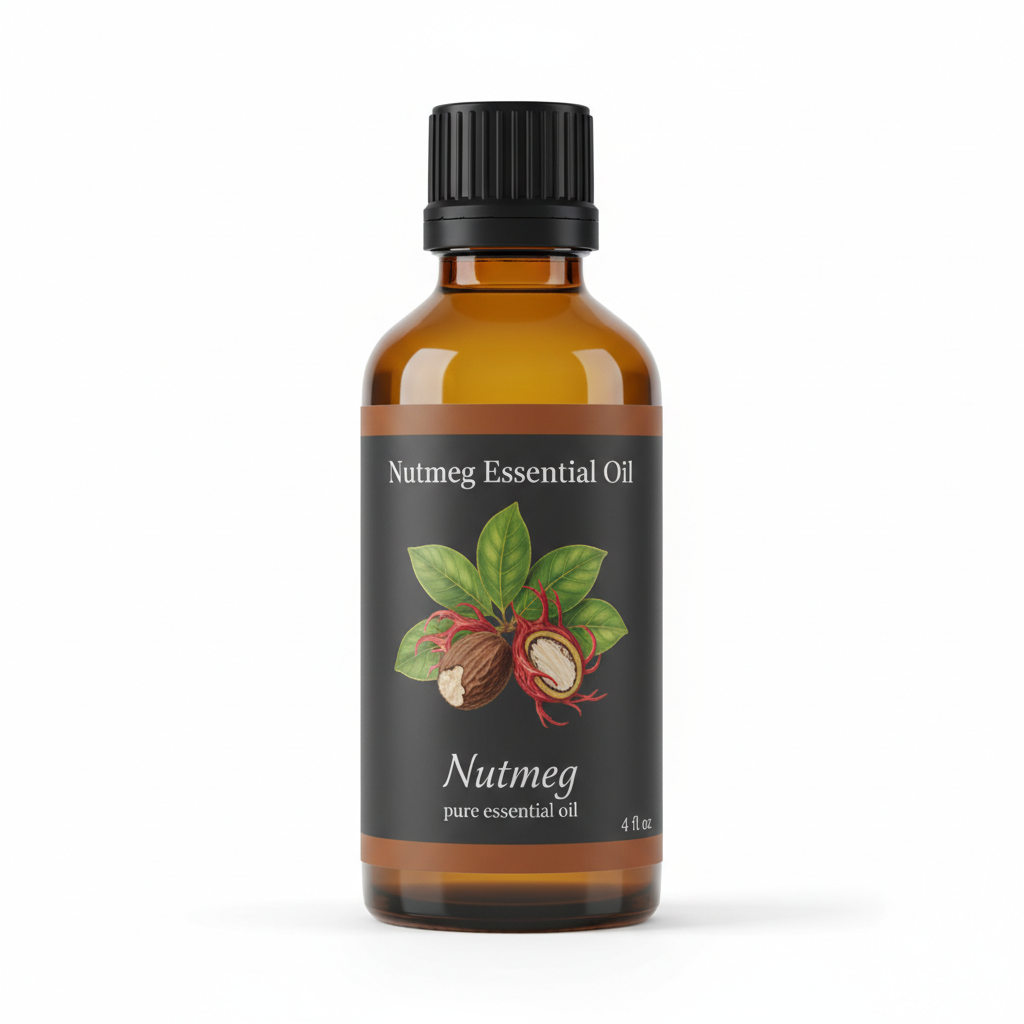
Nutmeg Essential Oil
Our own Nutmeg Essential Oil, in sizes from 0.5 oz to bulk.
From $10.99
Shop Now →The search, and what it found
A PubMed search run on 28 October 2026 for nutmeg or Myristica fragrans together with sleep or insomnia, limited to randomized or clinical trials, returned a single record: the 2013 Trinidad trial of a nutmeg-containing rub for painful diabetic neuropathy (Motilal et al., 2013). Sleep there was one of several "interference" scores in 74 adults, and it improved within both groups with no statistically significant difference between the nutmeg rub and the comparison rub. That is a study of nerve pain, not of sleep. Widening the terms to include sedative and hypnotic returned 18 records, which on inspection were animal pharmacology, toxicology case reports and ethnobotany.
What the aromatherapy-sleep reviews pooled
- Lin et al., 2019: 31 randomized trials of aromatherapy and sleep quality, pooled Hedges's g of 1.103. Of the 31, four had low risk of bias and 26 were uncertain; heterogeneity was I2 91%, and the authors found evidence of publication bias.
- Chen et al., 2025: 27 publications, 2,072 patients, inhalation aromatherapy for insomnia that accompanies another condition. The authors flag a lack of blinding and no independent testing of the oils' purity or potency.
- Cheng et al., 2022: 10 trials, 933 cancer patients. Single oils pooled at SMD -0.94, with lavender best at -1.06; blends of oils showed no effect (-0.21, confidence interval crossing zero).
The abstracts of these reviews do not name nutmeg. That matters for the reader deciding what a pooled number means: an effect size built mostly from lavender says nothing about a different oil, and the reviews themselves say the underlying trials are weak on blinding. A scent is hard to blind, because a participant who smells lavender knows it is not nothing. These reviews also studied people who were already unwell, often in hospital, so even the pooled figure is not a statement about healthy sleepers at home.
What the animal studies tested
| Study | Material and route | Animal | Reported | Limits |
|---|---|---|---|---|
| Sherry, 1978 | Whole nutmeg oil, 200 mg/kg (route not stated in the abstract), with ethanol 1 to 4 g/kg | Young chickens | Longer ethanol-induced sleep, especially deep sleep | It prolonged sleep caused by alcohol; it did not induce sleep alone |
| Grover et al., 2002 | Nutmeg suspension and extracts (route varied by test and is not fully stated in the abstract) | Rodents and isolated guinea pig ileum | Petroleum-ether extract lengthened sleeping time with phenobarbitone and pentobarbitone; the abstract calls the sedative property "significant" | Extracts, not oil; prolonged drug-induced sleep, not natural sleep |
| Muchtaridi et al., 2010 | Nutmeg seed essential oil by inhalation, 0.1, 0.3 and 0.5 ml per cage | Mice in a wheel cage | Locomotion fell 62.8% to 68.6%; plasma myristicin reached 3.7, 5.2 and 7.1 micrograms/ml at 0.5, 1 and 2 hours after 1 ml per cage; safrole 1.28 at 2 hours | Less running is not sleep; the dose is an oil load in an enclosed cage, not a room |
The Muchtaridi result is the one closest to the way people use an oil, because the route was inhalation, and it is also the one that needs the most care. Mice ran less, and the compound that dominated their blood was myristicin, followed by safrole. For scale only: a series from the Erfurt Poison Information Centre reported a myristicin blood level of 2 micrograms/ml eight hours after a person swallowed 14 to 21 g of nutmeg powder, and a fatal case with 4 micrograms/ml in post-mortem serum, where flunitrazepam was also present and the authors judged death probably due to the combined effect (Stein et al., 2001). Different species, route and timing make the numbers non-comparable, and the cage study says nothing about a diffuser in a bedroom. What the pair does show is that the sedating signal in animals and the toxic signal in people come from overlapping constituents, so a sleep claim would be built on the part of nutmeg that poison centres warn about.
Drowsiness as a toxic sign
The Missouri Poison Center lists drowsiness, lethargy and stupor among the effects of nutmeg ingestion, notes that patients alternate between delirium and stupor, and says nervous-system symptoms usually begin 3 to 8 hours after ingestion and resolve over 24 to 36 hours (Missouri Poison Center, 9 December 2022). MedlinePlus, under "Myristica oil poisoning," names aromatherapy products among the sources and lists drowsiness with hallucinations, agitation and seizures (MedlinePlus, reviewed 14 October 2025). In the California series of 119 single-substance nutmeg exposures, 72.3% were intentional, no deaths occurred, and clinically significant effects were common (Carstairs et al., 2011). Those were mostly spice ingestions. They are the reason our copy says never to swallow the oil, and the reason it advises against use with medication that acts on the central nervous system: in the Grover study above, nutmeg extract lengthened the sleep produced by barbiturates, which is reasoning for caution rather than a measured interaction with any product. For the U.S. Poison Help line, call 1-800-222-1222.
What sleep medicine puts first
The American College of Physicians' 2016 guideline recommends cognitive behavioral therapy for insomnia (CBT-I) as the initial treatment for chronic insomnia disorder in all adults, graded a strong recommendation on moderate-quality evidence, and reserves a shared decision about medication for people in whom CBT-I alone was unsuccessful (Qaseem et al., 2016). The NHS advises seeing a GP if changed sleeping habits have not helped, if sleep trouble has lasted months, or if insomnia makes daily life hard to cope with (NHS, last reviewed 19 March 2024). A physician or sleep specialist is the right professional for persistent insomnia. An aroma is not on either source's list.
The FDA line, and where our oil stands
The FDA's page on cosmetics and drugs gives this very example: a fragrance sold for attractiveness is a cosmetic, while one carrying assertions that the scent will help the consumer sleep is a drug because of its intended use (FDA, content current as of 11 September 2024). That is a plain reason this shop will not describe nutmeg oil as a sleep material. Our position: nutmeg oil is a warm spice scent, the evidence does not support a sleep use, and the NHS page above starts with changing sleeping habits, not with a scent. If you scent a room at all, diffuse sparingly, keep the oil away from children and pets, and read the safety basics and the medications article first. The stress question is covered in its own review, and the benefits article sets out what a scent does offer.
Persistent sleep trouble is a medical question with a tested first-line answer, and nutmeg oil is not part of it.
Nutmeg Essential Oil
Nutmeg Essential Oil from our own shop, in sizes from 0.5 oz to bulk.
From $10.99
Shop Now →Sources & Further Reading
- Motilal S, Maharaj RG, 2013. Nutmeg extracts for painful diabetic neuropathy. J Altern Complement Med. pubmed.ncbi.nlm.nih.gov/23098698
- Lin PC et al., 2019. Effects of aromatherapy on sleep quality: a systematic review and meta-analysis. Complement Ther Med. pubmed.ncbi.nlm.nih.gov/31331554
- Chen HB et al., 2025. Inhalation aromatherapy for the treatment of comorbid insomnia. Front Psychiatry. pubmed.ncbi.nlm.nih.gov/40230824
- Cheng H et al., 2022. Aromatherapy with single essential oils and sleep quality of cancer patients: a meta-analysis. BMC Complement Med Ther. pubmed.ncbi.nlm.nih.gov/35836211
- Sherry CJ, 1978. Enhancement of ethanol-induced sleep by whole oil of nutmeg. Experientia. pubmed.ncbi.nlm.nih.gov/565298
- Grover JK et al., 2002. Pharmacological studies on Myristica fragrans: antidiarrheal, hypnotic, analgesic and hemodynamic parameters. Methods Find Exp Clin Pharmacol. pubmed.ncbi.nlm.nih.gov/12616960
- Muchtaridi et al., 2010. Compounds in the essential oil of nutmeg seeds that inhibit locomotor activity in mice. Int J Mol Sci. pubmed.ncbi.nlm.nih.gov/21151471
- Stein U et al., 2001. Nutmeg (myristicin) poisoning: report on a fatal case and a series of cases recorded by a poison information centre. Forensic Sci Int. pubmed.ncbi.nlm.nih.gov/11343860
- Carstairs SD et al., 2011. The spice of life: an analysis of nutmeg exposures in California. Clin Toxicol. pubmed.ncbi.nlm.nih.gov/21495887
- Missouri Poison Center, 2022. Nutmeg abuse. missouripoisoncenter.org/nutmeg-abuse
- MedlinePlus, 2025. Myristica oil poisoning. medlineplus.gov/ency/article/002899
- Qaseem A et al., 2016. Management of chronic insomnia disorder in adults: a clinical practice guideline from the American College of Physicians. Ann Intern Med. pubmed.ncbi.nlm.nih.gov/27136449
- NHS, 2024. Insomnia. nhs.uk/conditions/insomnia
- FDA, 2024. Is It a Cosmetic, a Drug, or Both? (Or Is It Soap?). fda.gov/cosmetics