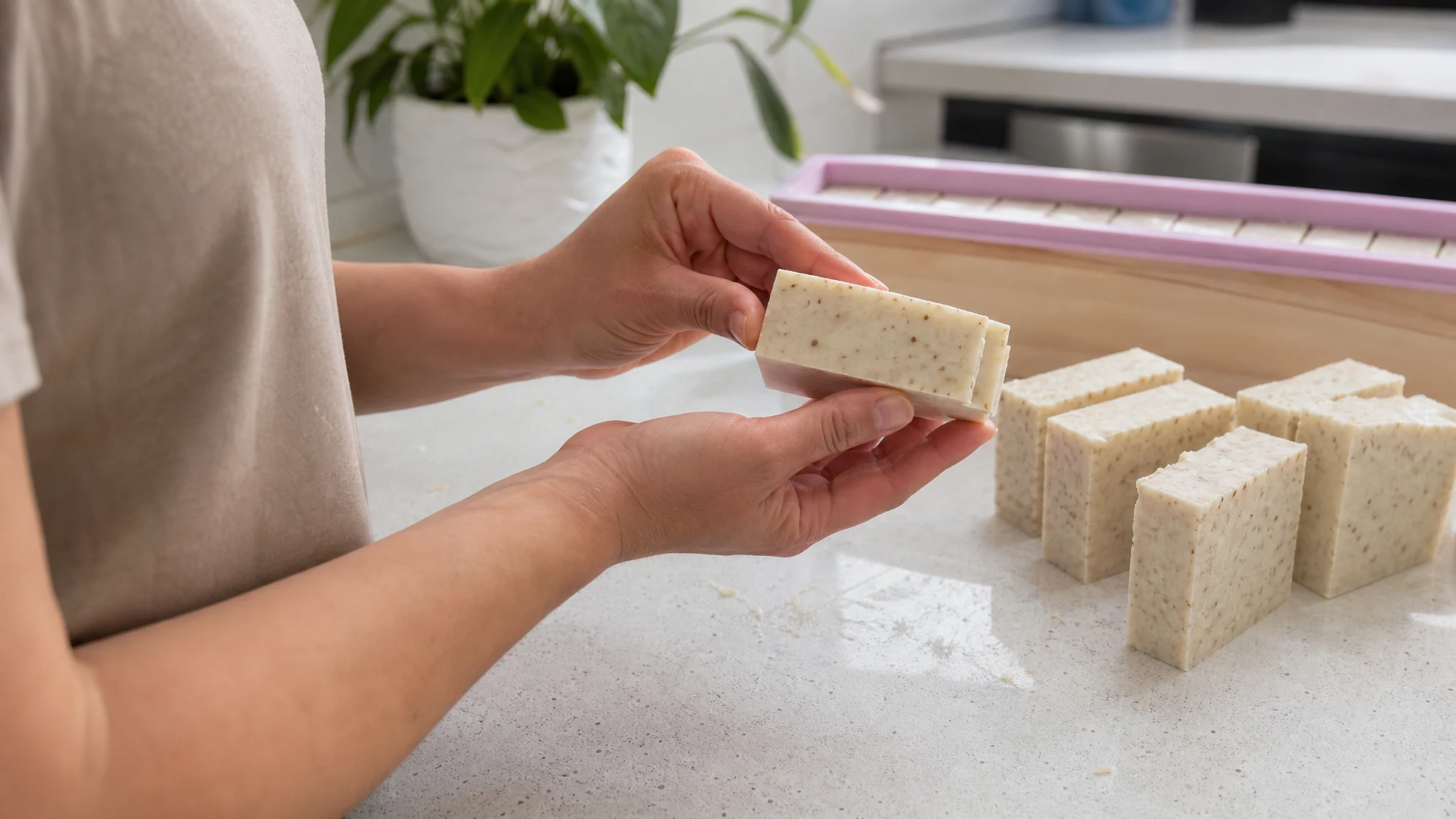
Nutmeg Oil in Cold Process Soap: The Safrole Cap on Usage Rate
The usual soap-scenting advice, a bit under an ounce of essential oil per pound of soap, would put about 25 g of nutmeg oil into a 500 g batch of oils. The published fragrance limits allow roughly 3 to 4 g for oil that resembles the analysed nutmeg oils, about a seventh as much. This guide works through that gap with arithmetic you can redo with your own numbers, and says plainly what it will not print: a lye-and-oil recipe.
Nutmeg Essential Oil
Our own Nutmeg Essential Oil, in sizes from 0.5 oz to bulk.
From $10.99
Shop Now →Where the two numbers come from
The general supplier figure is from Soap Queen, the Bramble Berry blog: "you can add .8 ounces of fragrance or essential oil per pound of cold process soap" for a strong scent, within regulatory limits, varying by scent (Soap Queen, 2015). It is a general rate for fragrance oils and essential oils together, not a nutmeg figure, and it does not say whether the pound is of oils or of batter. Read as a share of the oils, 0.8 oz is 22.7 g per 453.6 g, or 5.0%.
The regulatory ceiling comes from IFRA, the fragrance industry's standards body. Its 51st Amendment compilation has no standard named for nutmeg oil, but the safrole standard (Amendment 17, 1987) covers natural extracts in every product category: the total safrole, isosafrole and dihydrosafrole in the finished consumer product must not exceed 0.01%. Bar soap sits in category 9, products with body and hand exposure that are primarily rinsed off (IFRA, 51st Amendment, 2024; IFRA guidance, 2023). Nutmeg oil carries safrole: seven batches of Indonesian nutmeg oil analysed for an EFSA opinion measured 1.69% to 2.30% (mean 2.02%), and EFSA's panel noted the oil is classified carcinogenic category 1B because of safrole (EFSA FEEDAP Panel, 2023). Our oils have no published safrole figure; the certificate of analysis we publish for the batch it covers lists density, refractive index and optical rotation only. A maker who needs the figure should ask the seller for GC-MS data in writing before ordering and keep the answer in writing.
The worked batch
This is reasoning from those sources, not a tested rate. The cap for any extract is: maximum oil (g) = finished soap weight (g) x 0.0001 divided by the safrole fraction of the oil. Say the batch is 500 g of oils, and your lye calculator reports a finished weight of 700 g (an assumption: use the number your calculator gives, and remember bars lose water as they cure, so the weight to use is the cured weight, which is lower).
| Reading | Nutmeg oil on 700 g of soap | Drops (20 per ml, density 0.887) |
|---|---|---|
| 0.8 oz per pound read as 5% of the 500 g of oils | 25.0 g | about 564 |
| 0.8 oz per pound read as 5% of 700 g | 35.0 g | about 789 |
| IFRA safrole cap, oil at 2.02% safrole | 3.47 g | about 78 |
| Same cap, oil at 2.30% safrole | 3.04 g | about 69 |
| Same cap, oil at 1.69% safrole | 4.14 g | about 93 |
So the cap is about 0.7% of the weight of the oils (3.47 g in 500 g), against 5% from the general rate. Divided across six bars of about 117 g, 3.47 g is about 0.58 g per bar, roughly 13 drops. Drop counts vary with the dropper, which is why the arithmetic weighs the oil. The methyl eugenol standard does not bind here: category 9 allows 0.0017% methyl eugenol, so at the EFSA mean of 0.23% in the oil the cap is 700 x 0.000017 / 0.0023, about 5.2 g (3.6 g at the batch maximum of 0.33%). Both limits apply, and the lower one governs. Oil from another source with a lower safrole figure moves the cap up in direct proportion; an oil with a higher figure moves it down.
Two notes on what this is not. Tisserand's published nutmeg chart gives maximum dilutions for topical use (0.8% for adults, East Indian type), which are leave-on figures and have no rinse-off row, so they are not used for soap (Tisserand Institute, 2019). And our pages give 0.5% to 2% for skin dilution in a carrier oil, which is a different use; our pages give no soap rate, and we recommend working from the lower, IFRA-derived figure.
Why there is no lye recipe here
A soap recipe is a lye weight matched to specific oils, and a wrong lye weight is a hazard: sodium hydroxide is listed by the CDC's NIOSH Pocket Guide with skin and eye burns, and its advice is to prevent skin and eye contact and to flush with water immediately (CDC NIOSH, Pocket Guide). The decision for you is simple: run your own oils through a lye calculator, with your chosen superfat, and use its weights. Weigh everything, never measure by volume, and add lye to water, never water to lye, as the Certified Lye soap page puts it (Certified Lye). Lye, oils, molds and scales are not things we sell; a soap-making supplier is the place for them, and for the lye calculator's instructions.
Scent fade, and what is not known
Soap Queen attributes scent loss to pH, "the pH level of cold process soap can attack components of the oil," says gel phase can reach 180 F, and suggests anchoring a light scent with a deeper one (Soap Queen, 2015). The search found no published trial of nutmeg oil in cold process soap, no source describing it accelerating trace or discolouring a bar, and no fade data. Reasoning only: a review of nutmeg oil chemistry says it consists mainly of monoterpenes and phenylpropanoids, with sabinene and pinenes among the commonly identified monoterpenes (Warsito, 2021), and at about 0.7% of the oils the nutmeg will be an accent, not the main scent. Treat it as a top-level spice note over a base you have already used, not as the soap's whole fragrance, and expect to judge it after a full cure on a small batch, which we have not made.
If the blend includes partner oils, each has its own limit in the same category 9 table, and they add to what nutmeg oil already contributes. Eugenol (clove) is capped at 4.9% and cinnamal (cinnamon bark) at 0.49% in category 9 (IFRA, 51st Amendment, 2024). As a worst case, assume an oil is all cinnamal: the cap is then 0.49 g per 100 g, or 3.4 g in 700 g. Ask the supplier of each oil for its constituent analysis.
Who should not make it, and what to call it
Rinse-off still involves skin contact, hands and a bathroom shelf. Our copy says unsuitable for anyone pregnant or nursing, unsuitable for children, and no use at all with medication acting on the central nervous system; a bar given away carries none of that knowledge, so label it. Do a patch test on a small area before general use. If you sell the bar, FDA regards a product as soap only if it is labeled, sold and represented solely as soap, and a cleanser with other uses, or claims, is a cosmetic or a drug (FDA, 2024); a regulatory consultant is the person to ask about your label. The live body scrub post is a leave-on cousin and its quantities should be read against the limits above; the safety basics post and 18 uses are live, and the perfume and gift guides apply the same safrole arithmetic to other products.
For a nutmeg soap, the working figure is the cap from your own supplier's safrole number, a few grams for a 500 g batch of oils, and a lye calculator for everything else.
Nutmeg Essential Oil
Nutmeg Essential Oil from our own shop, in sizes from 0.5 oz to bulk.
From $10.99
Shop Now →Sources & Further Reading
- Soap Queen (Bramble Berry), 2015. How to Prevent Scent Fading in Soap. soapqueen.com
- IFRA, 2024. IFRA Standards, 51st Amendment (safrole, isosafrole and dihydrosafrole; methyl eugenol; eugenol; cinnamal). ifrafragrance.org
- IFRA, 2023. Guidance for the use of IFRA Standards (product categories). ifrafragrance.org
- EFSA FEEDAP Panel, 2023. Safety and efficacy of nutmeg oil as a feed additive. EFSA Journal 21(6):e08066. PMC10273060
- Tisserand Institute, 2019. Nutmeg essential oil safety guidelines. tisserandinstitute.org
- CDC NIOSH. Pocket Guide to Chemical Hazards: sodium hydroxide. cdc.gov/niosh/npg/npgd0565
- Certified Lye. Lye soap and lye calculator. certified-lye.com
- Warsito MF, 2021. A review on chemical composition, bioactivity, and toxicity of Myristica fragrans Houtt. essential oil. Indonesian J Pharm 32(3):304-313. journal.ugm.ac.id
- FDA, 2024. Is it a cosmetic, a drug, or both (or is it soap)? fda.gov