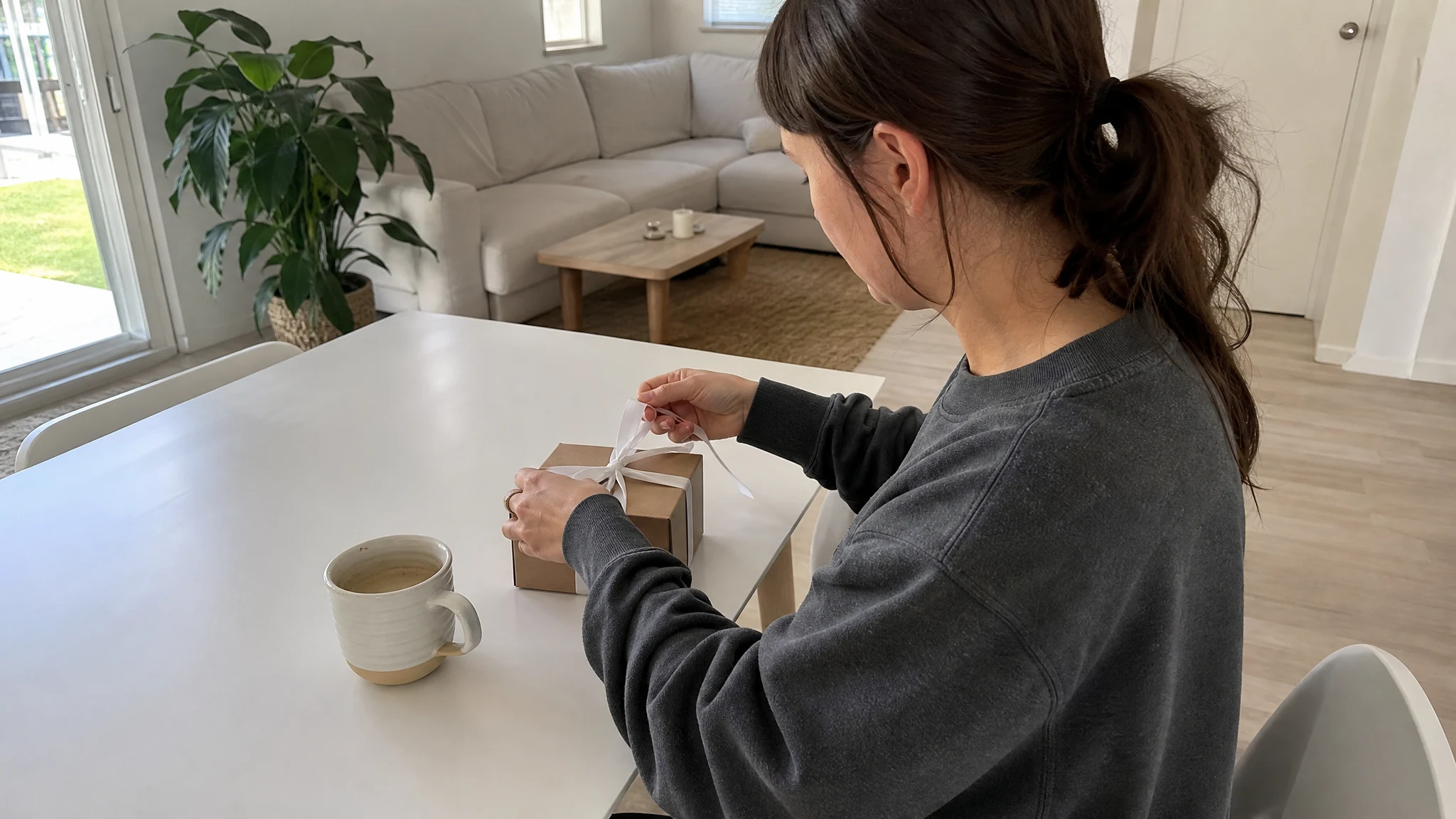
DIY Nutmeg Oil Gifts: What to Make, Skip and Put on the Label
The best nutmeg oil gift is one that never touches skin and never goes near a child, and the arithmetic below shows why a roller bottle is the one to drop from the list. A gift leaves the maker's hands, so the label has to carry the warnings, because nobody is standing there to give them out loud. This guide sorts the usual gift ideas in the order a maker has to decide: who the recipient can be, which gift survives the published limits, what the label says, and what the packaging has to do.
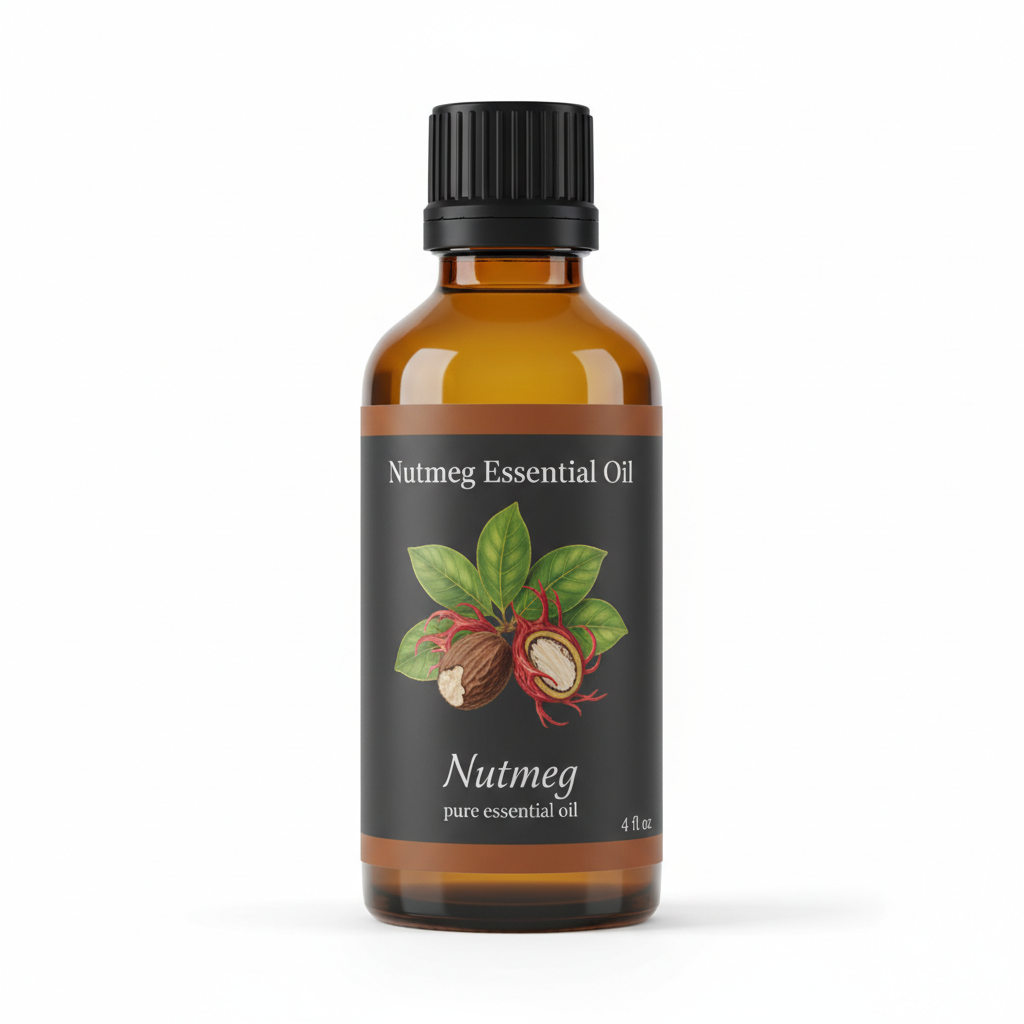
Nutmeg Essential Oil
Our own Nutmeg Essential Oil, in sizes from 0.5 oz to bulk.
From $10.99
Shop Now →Step 1: who cannot receive it
Our own safety copy for the oils says never swallow it, keep it from children and pets, and unsuitable in pregnancy and for children, with no use at all alongside medication that acts on the central nervous system. That list rules out more recipients than most gift lists admit: a new parent, a pregnant friend, a household with a dog or cat, a teenager, anyone on a prescription you do not know about. The Tisserand Institute's chart of recommended topical maximums (published November 2019, based on Essential Oil Safety, 2nd edition) agrees on direction: for East Indian nutmeg oil it shows an X (do not use) for ages 3 to 24 months and 2 to 6 years, 0.2% for ages 6 to 15, 0.2% in pregnancy and 0.8% above 15; the West Indian row reads X, 0.5%, 1%, 5% and 1% in the same columns (Tisserand Institute, 2019). Our oils' origin is not stated, so this guide reads the stricter East Indian row.
Ingestion is the other reason. In the Illinois Poison Center review of 2001 to 2011, 32 people swallowed nutmeg (the paper does not say whether spice or oil; the gram and tablespoon amounts it quotes suggest ground spice); 17 of the exposures were unintentional, 10 of them in children under 13, and 10 patients were treated in hospital, all aged 15 to 17, with no deaths among the 32 (Ehrenpreis et al., 2014). That is spice, not oil, so it does not give a dose for a bottle of oil. It does show who ends up swallowing nutmeg by accident. A gift sitting on a shelf at a child's height is that scenario. If the recipient is not an adult you know well, choose a different gift.
Step 2: the numbers that decide which gift survives
The skin limit people quote for nutmeg oil depends on which authority you ask. Tisserand's adult figure for the East Indian type is 0.8%. IFRA, the fragrance industry's standards body, has no standard named for nutmeg oil in its 51st Amendment compilation, but its safrole standard (Amendment 17, 1987) applies to natural extracts in every product category: the total safrole, isosafrole and dihydrosafrole in the finished product must not exceed 0.01% (IFRA, 51st Amendment, 2024). Nutmeg oil contains safrole. An EFSA opinion on nutmeg oil as an animal-feed additive analysed seven batches, all from Indonesia, and measured 1.69% to 2.30% safrole (mean 2.02%), and classified the oil as carcinogenic category 1B under EU classification rules because of that safrole (EFSA FEEDAP Panel, 2023). Those seven batches describe those batches, not our oils, which have no published safrole figure.
As reasoning from those two sources, not a published limit: 0.01% divided by 2.30% is 0.43%, and divided by 1.69% is 0.59%. For oil that resembles the EFSA batches, the safrole standard caps nutmeg oil at roughly 0.4% to 0.6% of any finished product. Our product pages say to dilute to 0.5% to 2%. The top of that range, 2%, is above both Tisserand's 0.8% and the safrole-derived figure, by a factor of about 3 to 5 against the second. For a gift, we recommend staying at or below 0.5% and treating even that as a ceiling, not a target. The methyl eugenol standard (Amendment 51, 2023) is less restrictive here: 0.0015% in body-lotion-type products (category 5A) and 0.066% in candles (category 12). At 0.23% methyl eugenol, the EFSA batch mean, those allow about 0.65% oil in a 5A product (a little above the safrole figure) and about 29% in a candle (far above it) (IFRA, 51st Amendment, 2024). A buyer who needs a safrole or methyl eugenol figure for a specific lot should ask for GC-MS data in writing before ordering and get the answer in writing; the certificate of analysis we publish lists density, refractive index and optical rotation only.
| Gift | Cap used | Arithmetic | Verdict |
|---|---|---|---|
| Roller bottle, 0.33 oz (about 10 ml) | 0.5% of the filled bottle | 0.5% of 10 ml is 0.05 ml, one drop at about 20 drops per ml | Skip: one drop is already at the ceiling, and drop size varies |
| Wax melt or wax sachet, 100 g of wax | about 0.5 g of oil per 100 g (safrole) | 0.5 g is 0.56 ml at density 0.887, about 11 drops | Possible: check your wax maker's data sheet load against this |
| Scent card or unglazed ceramic blank | no skin contact | no published limit; keep it light | Best option |
| Soap bar | 0.01% safrole in the finished bar | see the soap guide | Only after reading it |
Why the roller is the gift to drop
The roller is the gift people plan first, and the arithmetic is unkind to it. Droppers vary, so 20 drops per ml is a working figure, not a fixed one (weigh instead). At 15 to 25 drops per ml, one drop in a 0.33 oz bottle lands between roughly 0.4% and 0.67%, already straddling the safrole-derived ceiling. Two drops would be about 1%, above it. Going lower than one drop needs a scale that reads to 0.001 g: 0.05 g of oil in 10 g of carrier. Our position is that a gift is the wrong place for a formulation whose margin is one drop, for a recipient whose pregnancy status, medication and household you may not know. If you still want to make one for a named adult, the roller blend guide covers the method; this guide has not made or tested any roller, and a patch test on a small area is the minimum before anyone uses it.
Gifts that work
A scent card (a blotter or a piece of unglazed ceramic with the oil on it) avoids both the dilution problem and skin contact. It still holds a concentrated oil, so the warnings go on the card. Wax gifts are possible within the cap above: IFRA's category 12 covers candles and other products not intended for direct skin contact (IFRA guidance, 2023), and the safrole note box applies there too. The live post on holiday baking scents covers the diffuser side, and the live body scrub post is the skin-contact version; read the limits in this guide before following its quantities. The diffuser blend card should state the manufacturer's reservoir volume from the diffuser's own manual and the line from our copy: diffuse sparingly. No drop count is given here because there is no test behind one.
What the label says
The FDA's labeling summary is written for cosmetics "produced or distributed for retail sale to consumers"; it does not address gifts, so a gift label is a matter of judgment, not a legal template. FDA does say products that may be hazardous when misused need appropriate warnings and directions, and an ingredient list in descending order (FDA, current page). Once you sell at a craft fair, the retail rules apply and a regulatory consultant is the person to ask. Reasoned from our copy and the Tisserand chart, a gift label would carry:
- the contents by name (nutmeg essential oil, Myristica fragrans) and, for a skin product, the percentage and the carrier;
- never swallow it; keep from children and pets;
- not for use in pregnancy or nursing, by children, or alongside medication acting on the central nervous system;
- patch test first; stop if irritation occurs; keep away from eyes;
- the poison help line, 1-800-222-1222, listed on poison.org as "free, expert, and confidential" (Poison Help); for animals, a veterinarian or the ASPCA hotline, (888) 426-4435 (ASPCA).
Do not write claims on the label or the card: a product described as treating or preventing a condition is judged by its intended use, and FDA treats such claims as turning a cosmetic into a drug (FDA, 2024).
Packaging
Packaging is not something we sell, so buy bottles, closures and wax from a craft or packaging supplier and ask for a closure the recipient's children cannot easily open. The US Consumer Product Safety Commission requires special, child-resistant packaging for products with more than 5% methyl salicylate under 16 CFR 1700.15, and its December 2022 warning on wintergreen and birch oils said a 6 mL sample size may also not be child-resistant (CPSC, 2022). That notice concerns methyl salicylate oils and does not name nutmeg; whether a given nutmeg product needs special packaging is a question for a product-safety attorney or CPSC, not for this page. If the plan is to gift more than a handful, the pregnancy and soap guides show how limits change the quantity.
Nutmeg is a gift for adults you know, in forms that do not go on skin, with the warnings written on the object.
Nutmeg Essential Oil
Nutmeg Essential Oil from our own shop, in sizes from 0.5 oz to bulk.
From $10.99
Shop Now →Sources & Further Reading
- IFRA, 2023. Guidance for the use of IFRA Standards (product categories). ifrafragrance.org
- Tisserand Institute, 2019. Nutmeg essential oil safety guidelines (chart) and "Assessing the Safety of Essential Oils: the Nutmeg Case". tisserandinstitute.org/assessing-safety-nutmeg
- IFRA, 2024. IFRA Standards, 51st Amendment (safrole, isosafrole and dihydrosafrole; methyl eugenol). ifrafragrance.org
- EFSA FEEDAP Panel, 2023. Safety and efficacy of nutmeg oil as a feed additive. EFSA Journal 21(6):e08066. PMC10273060
- Ehrenpreis JE et al., 2014. Nutmeg poisonings: Illinois Poison Center, 2001 to 2011. J Med Toxicol 10(2):148-151. PMC4057546
- FDA. Summary of cosmetics labeling requirements. fda.gov
- FDA, 2024. Is it a cosmetic, a drug, or both (or is it soap)? fda.gov
- CPSC, 2022. Product Safety Warning 23-079, wintergreen and birch essential oils. cpsc.gov
- Poison Help, poison.org. poison.org
- ASPCA. Animal Poison Control. aspca.org