Nutmeg Oil in Natural Perfume: The Safrole Cap and Two Accords
In a perfume, nutmeg oil is capped by a safrole standard, not by how much of the smell you want. For oil that resembles the analysed nutmeg oils, the cap works out to about 2.5% to 3.3% of a 15% to 20%-strength fragrance concentrate, which is a spice accent of about five to seven drops per 10 g, not a heart note. This guide gives the arithmetic, two accord structures by weight that fit under it, and the points where a perfume you sell stops being a hobby.
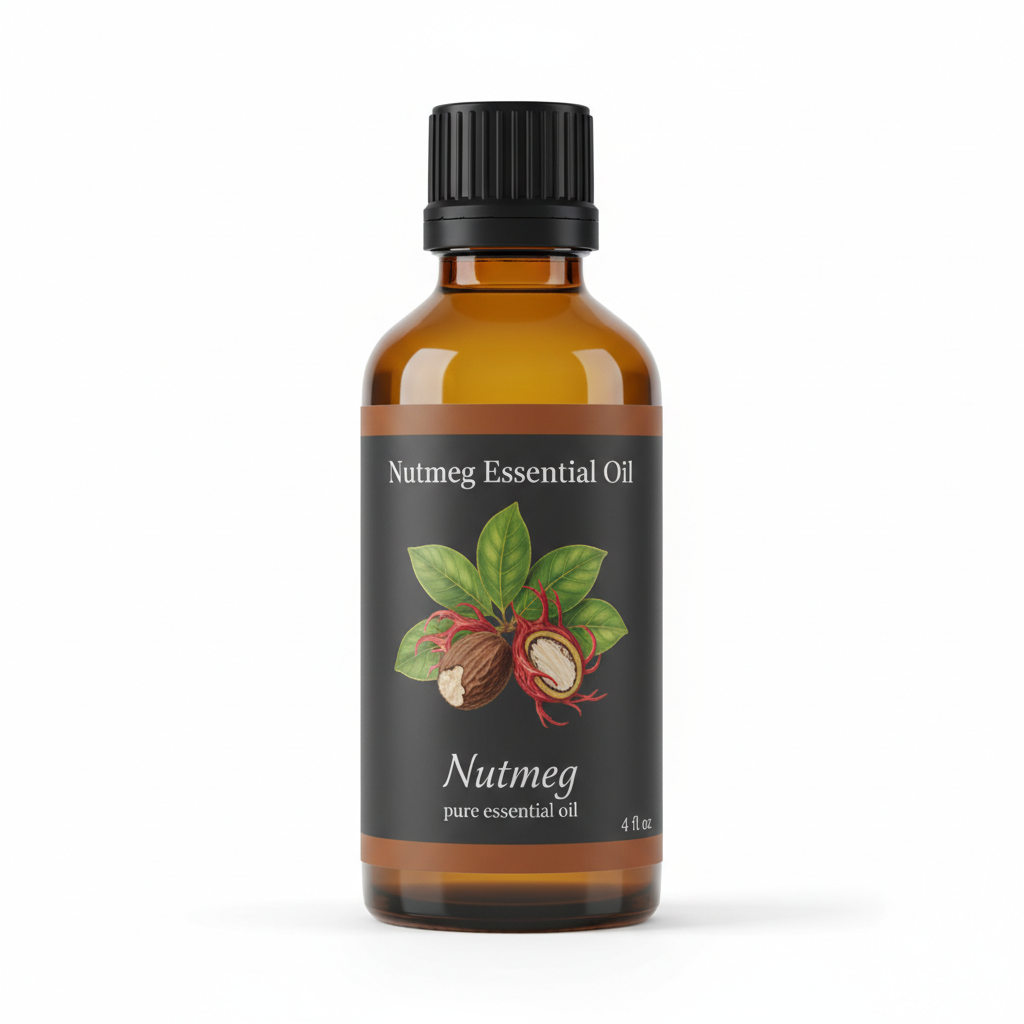
Nutmeg Essential Oil
Our own Nutmeg Essential Oil, in sizes from 0.5 oz to bulk.
From $10.99
Shop Now →Start with the safrole number, not the recipe
IFRA, the fragrance industry's standards body, has no standard named for nutmeg oil in its 51st Amendment compilation. Two of its standards bite on the oil's constituents. The safrole, isosafrole and dihydrosafrole standard (Amendment 17, 1987) allows natural extracts containing them "as long as the total concentration" in the finished product "does not exceed 0.01%", for every product category. The methyl eugenol standard (Amendment 51, 2023) sets category limits; for category 4, which IFRA's guidance describes as fine fragrance (eau de toilette, parfum and similar), it is 0.011% (IFRA, 51st Amendment, 2024; IFRA guidance, 2023). IFRA's own table of typical natural contributions, which would give a nutmeg figure, could not be retrieved, and its guidance says an analysed value from the supplier replaces any typical one.
The only published batch figures found are from an EFSA opinion on nutmeg oil as a feed additive: seven batches, all Indonesian, measured safrole 1.69% to 2.30% (mean 2.02%) and methyl eugenol 0.18% to 0.33% (mean 0.23%), and the panel classified the oil carcinogenic category 1B because of the safrole (EFSA FEEDAP Panel, 2023). Those are seven specific batches. Our oils are described only by their product pages and the certificate of analysis we publish for one batch, which gives density, refractive index and optical rotation and no constituent figure. A perfumer who needs safrole and methyl eugenol percentages for our oils should ask in writing before ordering and get the answer in writing; everything below scales in proportion to that number.
The cap, per 10 g of concentrate
This is derived arithmetic, not a published limit. Maximum oil in the finished perfume = 0.01% divided by the oil's safrole fraction. At 2.02% safrole that is 0.495% of the finished product (0.435% at 2.30%, 0.59% at 1.69%). Methyl eugenol does not bind in category 4: 0.011% divided by 0.23% allows 4.8% (3.3% at the 0.33% maximum), well above the safrole figure. Convert with the oil's density on the published certificate (0.887, so 1 ml is about 0.887 g) and about 20 drops per ml, though droppers vary and weighing is better.
| Concentrate as % of finished perfume | Nutmeg oil per 10 g of concentrate at 2.02% safrole | At 2.30% safrole |
|---|---|---|
| 10% | 0.495 g, about 11 drops | 0.435 g, about 10 drops |
| 15% | 0.33 g, about 7 drops | 0.29 g, about 6.5 drops |
| 20% | 0.25 g, about 5.6 drops | 0.22 g, about 5 drops |
The same formula applies to any nutmeg oil once its safrole figure is known, so the practical position we take is to spend it as an accent: roughly 2.5% to 5% of the concentrate, never more, and less if the safrole figure you receive is higher than 2%.
Two accord structures that fit under it
These are formulations worked out from the cap above and the limits below. We have not made or tested either, and none of the other materials is sold by us: buy sweet orange, clove bud, cinnamon bark, sandalwood and vanilla from a perfumery or aromatherapy supplier and ask each for its IFRA certificate and constituent analysis. They are written for a concentrate that will be 15% of the finished perfume by weight, in 10 g of concentrate.
| Material | Bright spice (g) | Dark spice (g) |
|---|---|---|
| Sweet orange oil | 6.05 | 0 |
| Sandalwood | 3.00 | 5.60 |
| Vanilla (absolute or CO2 extract) | 0.60 | 4.00 |
| Nutmeg oil | 0.25 | 0.25 |
| Clove bud oil | 0.10 | 0.10 |
| Cinnamon bark oil | 0 | 0.05 |
| Total | 10.00 | 10.00 |
Nutmeg at 0.25 g is 2.5% of the concentrate and 0.375% of the finished perfume, under the 0.435% to 0.495% cap. At a 20% concentrate the same 0.25 g would be 0.5% of the finished product, over the cap for 2.30% oil, so cut it to 0.20 g. Checks on the partners, worst case, so no analysis is needed to bound them: IFRA's eugenol standard (Amendment 51) caps category 4 at 2.5%. If clove oil were entirely eugenol, 0.10 g in 10 g at 15% is 0.15% of the finished product. The cinnamal standard (Amendment 49) caps category 4 at 0.25%; if cinnamon bark oil were entirely cinnamal, 0.05 g is 0.075%. Nutmeg's own eugenol content is not covered by these figures, so keep a margin and use the supplier's analysis, and the standards' own allergen and sensitization limits for any other oil. IFRA's citrus standard names cold-pressed bitter orange, lemon, lime, grapefruit and bergamot among its phototoxic oils and does not name sweet orange; ask the sweet orange supplier for its bergapten figure.
What the accord smells like is a matter for your own nose. A fragrance supplier's listing for a nutmeg fraction oil, a different product from a whole nutmeg oil, describes it as "spicy, fresh nutmeg, terpenic, with lime top notes" (The Good Scents Company, Robertet listing). Our pages say only that our oils make a warm spice accord, and give no note position. The pairing guide, scent profile and clove and cinnamon comparison cover the scent side.
On skin
A perfume goes on skin, so the skin figures matter as well. Tisserand's published chart of recommended topical maximums (2019; Essential Oil Safety, 2nd edition) gives East Indian nutmeg oil 0.8% above age 15, 0.2% for ages 6 to 15 and in pregnancy, and an X (do not use) under 6; West Indian oil 5% above 15 (Tisserand Institute, 2019). Our oils' origin is not stated, so the cautious row applies. A perfume with 0.375% nutmeg oil is under 0.8%, and over the 0.2% figures. Our own copy says unsuitable for anyone pregnant or nursing, unsuitable for children, no use alongside medication acting on the central nervous system, never swallow it, and patch test first. Those go on a perfume label too, and a patch test of the finished perfume on a small area comes before wearing it.
If you sell it
A hobby perfume and a product for sale differ in law. The FDA's MoCRA page says the law requires FDA to establish regulations for fragrance allergen labeling and gives no rule status; it also says serious adverse events must be reported within 15 business days, products must be listed, and certain small businesses are exempt from some requirements (FDA, MoCRA page). Alcohol for perfumery has its own purchasing and regulatory rules that this guide has not checked: ask the supplier and a regulatory consultant. The label is a regulatory consultant's question, and the nutmeg and safrole arithmetic above, repeated in the soap guide for a different category, belongs in your file with the supplier's analysis attached.
One nutmeg figure, the safrole percentage from your own supplier, decides how many drops a perfume can hold; ask for it before you buy.
Nutmeg Essential Oil
Nutmeg Essential Oil from our own shop, in sizes from 0.5 oz to bulk.
From $10.99
Shop Now →Sources & Further Reading
- IFRA, 2024. IFRA Standards, 51st Amendment (safrole, isosafrole and dihydrosafrole; methyl eugenol; eugenol; cinnamal; citrus oils). ifrafragrance.org
- IFRA, 2023. Guidance for the use of IFRA Standards (product categories). ifrafragrance.org
- EFSA FEEDAP Panel, 2023. Safety and efficacy of nutmeg oil as a feed additive. EFSA Journal 21(6):e08066. PMC10273060
- Tisserand Institute, 2019. Nutmeg essential oil safety guidelines. tisserandinstitute.org
- The Good Scents Company. Nutmeg fraction oil (Robertet listing). thegoodscentscompany.com
- FDA. Modernization of Cosmetics Regulation Act of 2022 (MoCRA). fda.gov