Nutmeg Oil on Skin: Allergy Record, Acne Paper, Dilution
Nutmeg oil on skin raises two separate questions: whether it irritates or sensitizes, and whether it does anything for a skin condition. The published record answers the first with warnings and the second with a single laboratory paper, not a trial. A scented ingredient is not an acne treatment, the dilution figures published for nutmeg oil are lower than the top of our own 0.5% to 2% shop copy, and for the face they are far lower.
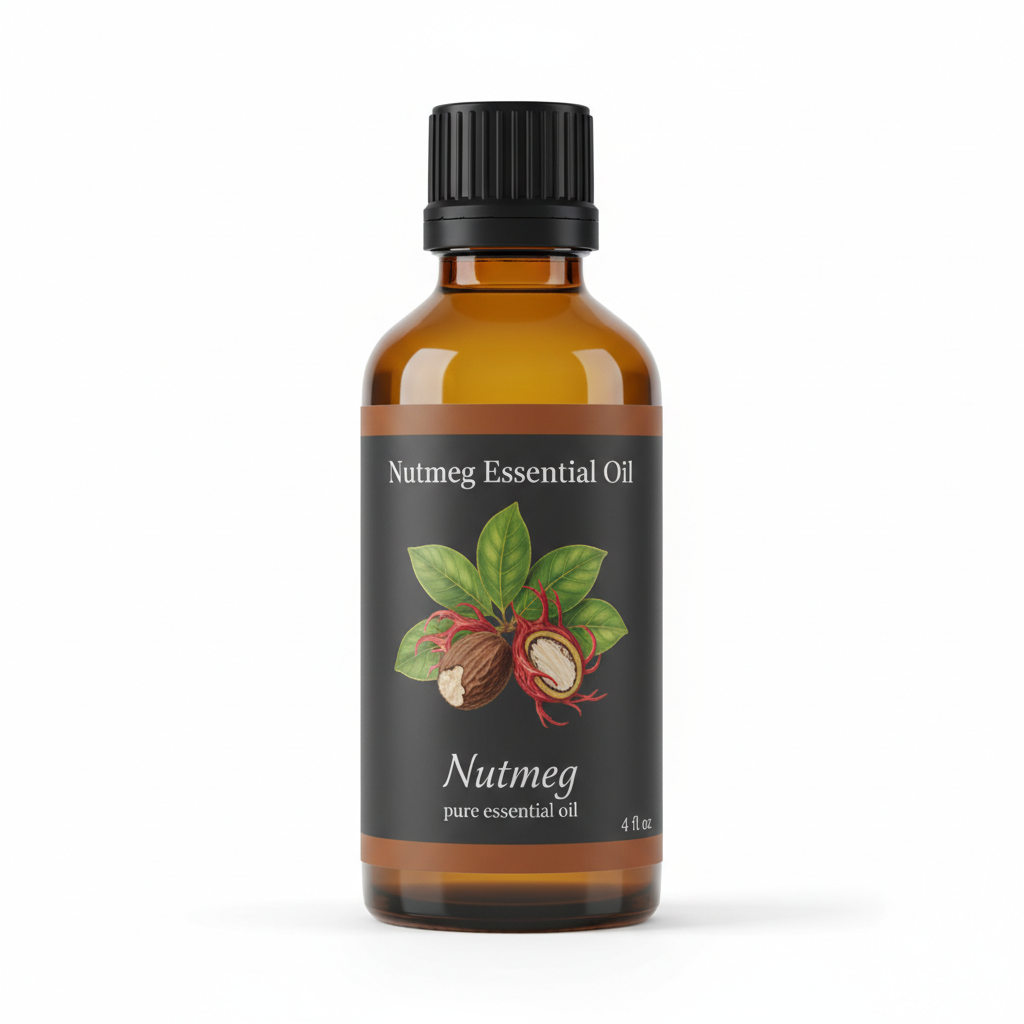
Nutmeg Essential Oil
Our own Nutmeg Essential Oil, in sizes from 0.5 oz to bulk.
From $10.99
Shop Now →Step one: what exists on nutmeg and skin
A PubMed search on 28 October 2026 (title and abstract fields) found 406 records for "Myristica fragrans". Nutmeg or Myristica fragrans together with skin, dermal or cutaneous gave 33 records; together with acne or acnes, one; together with contact dermatitis, patch test, sensitization, allergy or allergic, 18, most of them about food allergy, cell biology or other topics by title. Filtering nutmeg for clinical-trial publication types gave six records, and by title none is a trial of nutmeg oil for acne or any skin condition (they include an extract trial for diabetic neuropathy, a spice-exposure study on children's vegetable acceptance and a 2024 study of a branded topical product for musculoskeletal pain). The search covers indexed journals only, so it supports "no acne trial was found", not "none exists".
Step two: the one acne paper, read closely
The single acne-related record is Lee and colleagues (Lee et al., 2020, Molecules 25(19):4563), and it is a laboratory study. The authors hydrodistilled nutmeg to get an essential oil (MFO), extracted the residue with 50% methanol (MFE-M), and tested MFE-M against Cutibacterium acnes and Staphylococcus aureus. The reported minimum inhibitory concentration (MIC) of MFE-M was 0.64 mg/mL for both (the abstract prints "0.64 mg" without the volume; the results section gives mg/mL). An isolated neolignan from the extract, compound 2, had MICs of 6.25 micrograms/mL against C. acnes and 3.12 micrograms/mL against S. aureus, and reduced inflammatory markers (nitric oxide, PGE2, iNOS, COX-2) in RAW 264.7 cells stimulated with lipopolysaccharide or heat-killed C. acnes.
Three details limit what that means for a bottle of oil. First, the active material was a methanol-extract fraction chosen because it is low in safrole: the paper's HPLC measured safrole at 4.46% in the oil and 0.01% in the extract, and myristicin at 2.62% and 2.49%. The authors' own conclusion favors the low-safrole extract for cosmetics, not the oil. Second, the paper reports no MIC for the oil. Third, the skin-irritation test was a single 4-hour patch on shaved rat skin read at 24 and 48 hours; the abstract says the oil and MFE-M caused no irritation, while the methods describe testing the oil and a different extract (MFE-E), animal numbers are not given and the data are marked "data not shown". Bacterial broth and cell cultures are not human skin, and no one in this study had acne.
Step three: the contact-allergy record
The older dermatology literature is more useful to someone deciding whether to apply nutmeg, and it concerns ground spice, not oil, so the application to oil is inference.
- van den Akker and colleagues patch-tested 103 people suspected of contact allergy with a spice series that included nutmeg. In the 32 who had reacted to an indicator allergen (colophony, balsam of Peru, fragrance mix or wood tars), 47% reacted to at least one spice, against 15% of the 71 who had not, and nutmeg gave the most reactions at 28%, followed by paprika and cloves; the fragrance mix was an especially important indicator for nutmeg (van den Akker et al., 1990, Contact Dermatitis).
- Futrell and Rietschel tested 55 patients with suspected contact dermatitis to spices at 10% and 25% in petrolatum. Among patients who reacted at only one concentration, five reacted to nutmeg at 25%, more than any other spice listed, though the authors note such solo responses may be a true allergy threshold or marginal irritation, and only three patients had relevant spice reactions overall (Futrell and Rietschel, 1993, Cutis).
- Dooms-Goossens and colleagues describe contact and systemic contact-type dermatitis to spices including nutmeg and mace as possibly rare but easily overlooked, and found patch testing with the spice itself very useful (Dooms-Goossens et al., 1990, Dermatologic Clinics).
- For essential oils generally, de Groot and Schmidt counted nearly 80 oils that have caused contact allergy; 55 had been tested in consecutive patients and nine (laurel, turpentine, orange, tea tree, citronella, ylang-ylang, sandalwood, clove and costus root) gave more than 2% positive patch tests, and most reactions followed application of undiluted oils or high-concentration products (de Groot and Schmidt, 2016, Dermatitis). The abstract does not name nutmeg among the nine and does not say whether it was among the 55, so it neither clears nor condemns nutmeg oil.
- Regulators treated the oil itself as a hazard. The EFSA panel's 2023 opinion on a nutmeg oil feed additive says it should be considered an irritant to skin and eyes and a skin and respiratory sensitizer, and notes that earlier literature points to a mild skin irritant and likely dermal sensitizer (EFSA FEEDAP Panel, 2023).
One more mechanism is worth knowing. The IFRA Standard on limonene (Amendment 29, 1995) says oxidation products of limonene, especially hydroperoxides, are potent sensitizers and that oils containing substantial limonene should be used only with peroxides kept low (peroxide value under 20 millimoles per liter) (IFRA Standards, 51st Amendment compilation, 2024). One 2026 study reported D-limonene at 9.63% in a single commercial nutmeg oil batch (Gaurav et al., 2026, Pharmaceuticals). Applying the limonene standard to nutmeg oil is inference, and the certificate of analysis we publish has no peroxide value; what it does justify is the shop's own storage advice (tightly capped, cool, dark).
Step four: the dilution arithmetic, face versus body
Our shop copy says to dilute to 0.5% to 2% in a carrier oil and to patch test first. At about 20 drops per ml, 1 oz (29.57 ml) of carrier is about 591 drops, so 0.5% is about 3 drops and 2% about 12. Published figures for nutmeg oil:
| Basis | Oil share of the product | Drops per 1 oz carrier |
|---|---|---|
| Our shop copy | 0.5% to 2% | about 3 to 12 |
| Tisserand Institute chart: East Indian oil, over 15 years | 0.8% (pregnancy 0.2%, ages 6 to 15 0.2%, under 6 not recommended) | about 4.7 |
| Same chart: West Indian oil, over 15 years | 5% (pregnancy 1%) | about 30 |
| Derived, safrole at IFRA's 0.01% note-box figure, oil with 2.30% to 1.69% safrole | 0.43% to 0.59% | about 2.5 to 3.5 |
| Derived, methyl eugenol cap for body lotion and oil use (Category 5A, 0.0015%), oil with 0.33% to 0.18% | 0.45% to 0.83% | about 2.7 to 4.9 |
| Derived, methyl eugenol cap for face moisturizer (Category 5B, 0.00021%), same compositions | 0.064% to 0.12% | about 0.4 to 0.7 |
The derived rows are our arithmetic, not published limits for nutmeg oil. IFRA names no nutmeg standard in the 51st Amendment compilation; it restricts safrole in natural extracts to 0.01% of the finished product and methyl eugenol by product category, and its guidance defines 5A as body lotion products applied by hand, primarily leave-on, and 5B as face moisturizer (IFRA Guidance, June 2023). The compositions are the range EFSA reported for seven Indonesian batches of a feed-additive oil (safrole 1.69% to 2.30%, methyleugenol 0.18% to 0.33%). Dividing each cap by the constituent share gives the oil percentage that reaches it: for the face, 0.00021 / 0.33 = 0.064% and 0.00021 / 0.18 = 0.117%.
The plain reading: the top of our 0.5% to 2% copy is above the Tisserand figure for East Indian oil (0.8%) and above every derived ceiling in the table, and the face is the most restrictive case. Our recommendation is to stay at or below the lower published figures, not to treat 2% as a target, and not to put nutmeg oil on the face at all on the strength of this evidence. Which Tisserand row applies depends on botanical origin, which a certificate of analysis showing density, refractive index and optical rotation does not establish, so the lower row is the cautious reading. The real ceiling for our oils is unknown without a constituent analysis, and a buyer who needs one should ask in writing before ordering. A patch test on a small area, as our copy says, shows irritation but is not a substitute for any of these limits.
Step five: acne, and who to see
The FDA's page on cosmetics and drugs says intended use decides the category and gives cleansers that are also intended as acne medication as an example that may be regulated as a drug (FDA, content current as of 11 September 2024). Our nutmeg oils are aroma materials, and nothing on this page says they help skin. The American Academy of Dermatology says that if breakouts continue after following its skin-care tips the next step is a board-certified dermatologist, who can reduce the risk of scarring, and that acne extraction should be done only by a trained doctor (AAD, acne treatment; AAD, acne skin care). The same AAD tips page says hair oil can contribute to forehead acne.
Stop and ask a physician or pharmacist if a rash, swelling or blistering follows any exposure, and for anyone pregnant, nursing or on medication; our own copy says never to swallow the oil, keep it from children and pets, and that it is unsuitable in pregnancy and for children. The nearest relevant topics: the safety basics post, carrier oils, the body scrub post, nutmeg oil and hair and the honest benefits post.
Our nutmeg oils are sold for scent and craft, neat, with the dilution maths left to the buyer; the figures above are the reason to keep the numbers low.
Nutmeg Essential Oil
Nutmeg Essential Oil from our own shop, in sizes from 0.5 oz to bulk.
From $10.99
Shop Now →Sources & Further Reading
- Lee CJ et al., 2020. (+)-Erythro-Delta(8')-7S,8R-dihydroxy-3,3',5'-trimethoxy-8-O-4'-neolignan, an anti-acne component in degreasing Myristica fragrans Houtt. Molecules 25(19):4563. pubmed.ncbi.nlm.nih.gov/33036279
- van den Akker TW et al., 1990. Contact allergy to spices. Contact Dermatitis 22(5):267-272. pubmed.ncbi.nlm.nih.gov/2383985
- Futrell JM, Rietschel RL, 1993. Spice allergy evaluated by results of patch tests. Cutis 52(5):288-290. pubmed.ncbi.nlm.nih.gov/8299390
- Dooms-Goossens A et al., 1990. Contact and systemic contact-type dermatitis to spices. Dermatol Clin 8(1):89-93. pubmed.ncbi.nlm.nih.gov/2137403
- de Groot AC, Schmidt E, 2016. Essential oils, part IV: contact allergy. Dermatitis 27(4):170-175. pubmed.ncbi.nlm.nih.gov/27427818
- EFSA FEEDAP Panel, 2023. Nutmeg oil as a feed additive. EFSA Journal 21(6):e08066. pmc.ncbi.nlm.nih.gov/PMC10273060
- IFRA, 2024. Standards, 51st Amendment compilation (safrole, methyl eugenol, limonene); IFRA, 2023. Guidance for the use of IFRA Standards. ifrafragrance.org
- Tisserand Institute. Nutmeg essential oil safety guidelines chart. tisserandinstitute.org
- Gaurav A et al., 2026. Fungicidal potency of nutmeg essential oil against Candida auris. Pharmaceuticals 19(2):233. pmc.ncbi.nlm.nih.gov/PMC12943223
- FDA, 2024. Is It a Cosmetic, a Drug, or Both? fda.gov
- American Academy of Dermatology. Acne: treatment and skin care tips. aad.org/public/diseases/acne