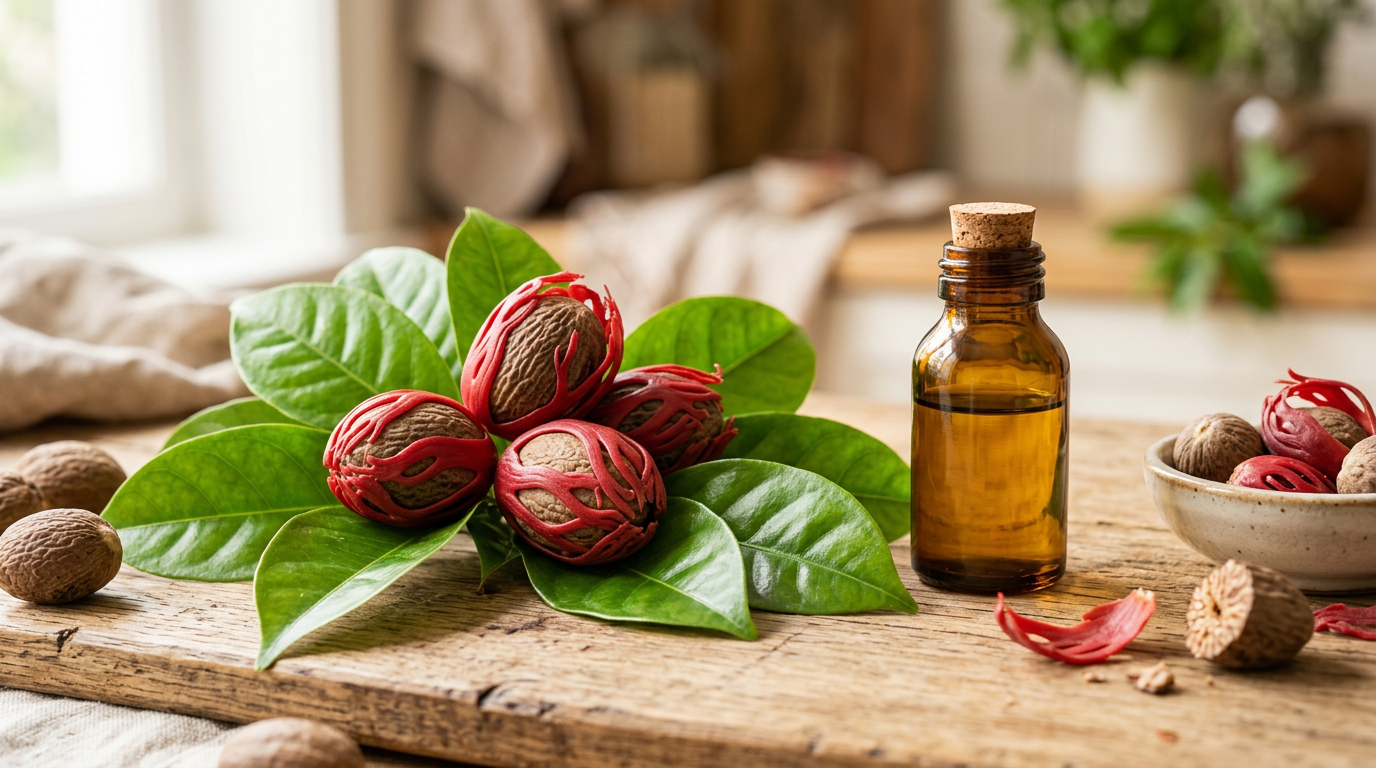
A Candle Studio's Nutmeg Oil Trial: Six Batches, Cold Throw Notes
A small candle studio in the Pacific Northwest spent three weeks running a nutmeg oil in candles case study, pouring six batches back to back to answer one question they kept getting from customers: does a straight essential oil, rather than a synthetic fragrance oil, actually hold its scent in a finished candle? What follows is their process, their notes, and the honest limits of what six batches can tell you. This is a candle making log, not a scientific study, and it should be read that way.
Nutmeg Essential Oil
Our own Nutmeg Essential Oil, in sizes from 0.5 oz to bulk.
From $9.99
Shop Now →The Problem: Fragrance Oils Are Easy, Essential Oils Are a Gamble
Most commercial candle fragrance comes from blended fragrance oils built specifically for wax. They're formulated with fixatives and carrier ratios that essential oils simply don't have. Nutmeg essential oil, distilled straight from the seed, is a different animal: it's volatile, it's not designed for a wax matrix, and its performance in a jar candle is not something most suppliers document in detail.
The studio's owner had fielded enough requests for an "all natural, essential oil only" nutmeg candle that she decided to test it properly instead of guessing. Her starting question was simple: at what percentage does nutmeg oil give a usable cold throw without scorching, without separating in the wax, and without costing more than the candle could reasonably sell for.
The Approach: Six Batches, One Variable at a Time
The studio used a coconut-soy wax blend across all six batches to keep the wax itself as a constant, changing only the nutmeg oil load, the pour temperature, or the wick size from batch to batch. Each candle was poured into the same 8-ounce amber glass jar with a cotton wick, cured for the same length of time, and evaluated by the same three people (the owner and two staff members) so that at least the panel stayed consistent even if their noses didn't always agree.
| Batch | Nutmeg Oil Load | Change from Prior Batch | Cold Throw Note |
|---|---|---|---|
| 1 | 6% | Baseline | Faint, barely detectable at jar's mouth |
| 2 | 8% | Increased load | Noticeable but thin, spicy top note only |
| 3 | 10% | Increased load | Stronger, but oil pooled slightly at surface after cure |
| 4 | 8% | Added a warm base note oil to the blend | Rounder scent, less sharp, better balance |
| 5 | 8% blend | Lowered pour temperature by 15°F | Less separation, cold throw held steadier over 2 weeks |
| 6 | 8% blend | Switched to a slightly larger wick | Cold throw unchanged; hot throw improved |
Worth noting up front: this was six candles from one studio, evaluated by three people over a few weeks. It's a useful nutmeg oil candle making notes record for anyone considering the same experiment, not a controlled study, and the team is careful to say so to customers who ask about the results.
Cold Throw Observations Across the Trial
Cold throw, the scent a candle gives off unlit, is where nutmeg oil struggled the most in the early batches. At 6%, the team could barely detect anything unless they put their nose directly to the wax. This tracks with what a lot of candle makers report anecdotally: nutmeg oil's aromatic compounds are lighter and more volatile than the heavier fixative molecules used in synthetic fragrance blends, so a straight essential oil tends to read as quieter in an unlit jar even at loads that would smell plenty strong from a diffuser bottle.
Pushing the load to 10% in batch three did improve cold throw, but it introduced a new problem: a thin film of oil separated and sat on the surface of the wax after a few days of curing. The team suspects this was a load-and-temperature interaction rather than the oil load alone, since dropping the pour temperature in batch five (while keeping the load at 8% in a blend) reduced the separation noticeably. That's an observation worth flagging for other candle makers rather than a settled rule.
The nutmeg essential oil candle scent trial's clearest finding was that nutmeg performs better blended than alone. Batch four, which paired the nutmeg oil with a warm, heavier base note oil, produced a cold throw the panel described as rounder and less sharp than the straight nutmeg batches, even at the same percentage load. Nutmeg oil's peppery, slightly sharp top note seems to benefit from something underneath it to slow its evaporation rate and give the scent more presence at rest.
Hot Throw: A Secondary but Telling Data Point
Hot throw (the scent released once the candle is burning) was not the primary focus of this trial, but the team tracked it anyway since it's the other half of how customers judge a candle. Here the results were more encouraging across the board. Even the thinner cold throw batches gave off a warm, spicy scent once lit, and batch six, where only the wick size changed, showed the clearest hot throw improvement of the whole series. That lines up with general candle-making knowledge: wick size controls the melt pool and burn temperature, which governs how much scent gets released into the air regardless of how strong the cold throw was to begin with.
The takeaway the studio drew from this: if a candle's cold throw is your main concern, focus on oil load and blending. If hot throw is the priority, wick sizing may matter as much as the oil formulation itself.
What the Studio Would Do Differently
A few adjustments came up repeatedly in the team's notes when they debriefed after batch six.
- Test fewer variables per round. Changing the blend and the pour temperature in the same stretch of batches made it harder to isolate which change caused which result. A slower, single-variable approach would have produced cleaner nutmeg oil candle making notes.
- Extend the cure time comparison. All batches were evaluated at the same cure length, but the team suspects a longer cure (three to four weeks instead of two) might change how the blended batches perform, since some fragrance compounds continue to bind with wax well past the standard curing window.
- Bring in more evaluators. Three noses is a small panel, and scent perception varies enough person to person that the studio would like to widen the group for any future round, ideally including people outside the shop who have no prior expectation of what nutmeg "should" smell like in a candle.
- Document flash point margins more carefully. Nutmeg oil's flash point sits within a range where pour temperature matters more than with some other essential oils, and the team wants a written safety margin for future batches rather than relying on memory.
A Note on Working Safely with Nutmeg Oil in a Workshop
Essential oils used in candle making still deserve the same care as essential oils used anywhere else in a workshop. Nutmeg oil is concentrated, and undiluted contact with skin during pouring or blending is worth avoiding, gloves are an easy habit to build into a pour session. Anyone testing a new blend on their own skin, say by dabbing a small amount to check scent character before adding it to wax, should patch test on a small area first and watch for any reaction before wider use. Good ventilation in the workshop matters too, both for the essential oil itself and for any wax fumes released during melting. If you have questions about how nutmeg oil interacts with any product you're already using on your skin or in your home, a qualified healthcare provider is the right person to ask, not a candle blog.
On the wax side, always check your fragrance oil's maximum usage recommendation and your wick manufacturer's guidance before scaling a small test batch into a full production run. Flash points, maximum safe loads, and burn behavior can vary by supplier and by wax type, so a load that worked well in this studio's coconut-soy blend is not automatically safe or effective in paraffin or a different wax ratio.
Key Learnings for Candle Makers Considering Nutmeg Oil
Pulling the six batches together, a few patterns held up well enough that the studio felt comfortable sharing them, with the caveat that this remains one small trial and not a broad study:
- Straight nutmeg oil at low loads (around 6%) tends to read as quiet in cold throw, even when hot throw is reasonably present.
- Blending nutmeg oil with a heavier base note oil appeared to improve cold throw balance more than simply raising the nutmeg percentage alone.
- Pour temperature seemed to affect how well the oil stayed integrated in the wax over the curing period, with lower temperatures showing less surface separation in this trial.
- Wick size influenced hot throw independently of the oil blend itself, a reminder that scent formulation and burn mechanics are two separate problems.
The studio's plan going forward is a second, more controlled round: single-variable batches, a longer cure window, and a wider tasting panel. They're treating this first trial as a starting map rather than a finished answer, and they're encouraging other candle makers who try nutmeg oil to keep their own batch notes, since wax type, climate, and jar size can all shift results from one workshop to the next.